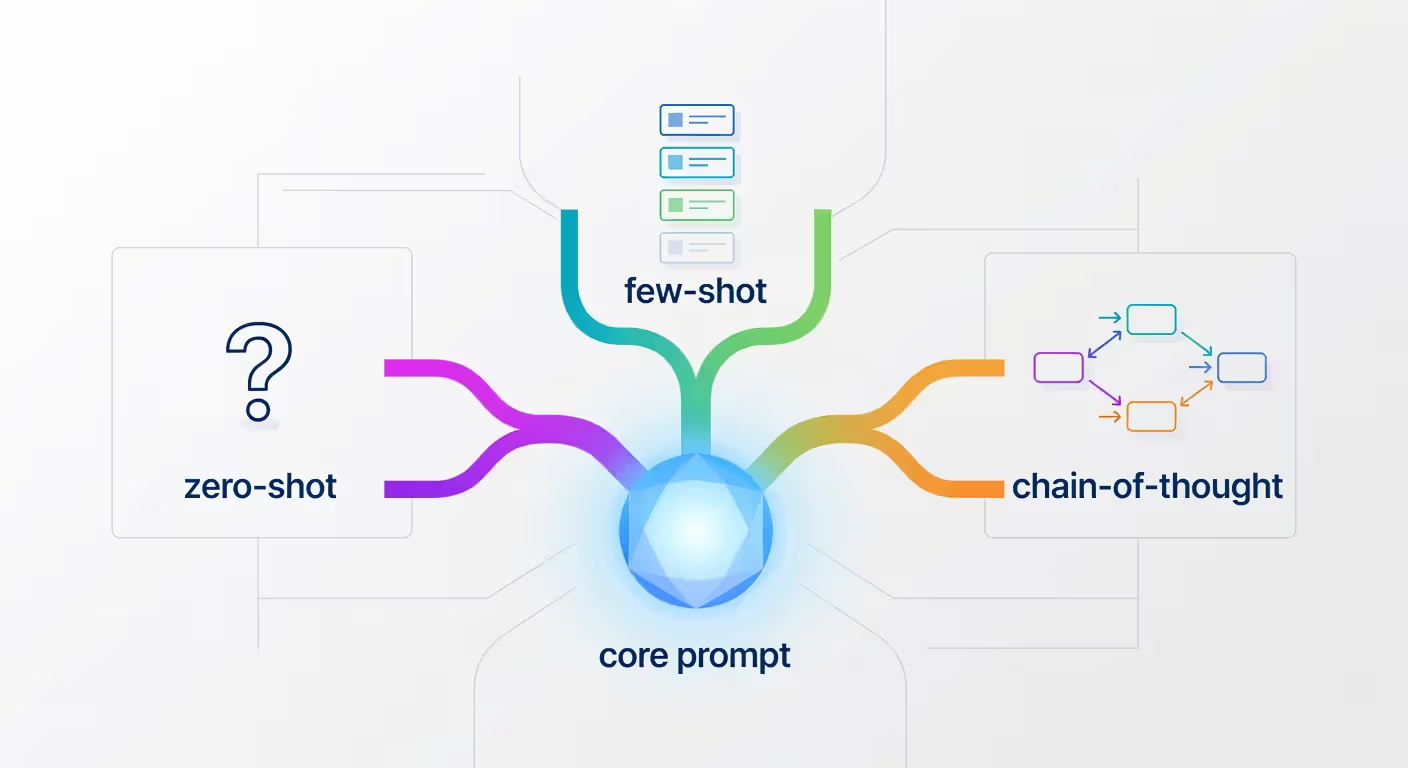
Prompt engineering isn't some mystical skill reserved for tech insiders. It's simply understanding how to communicate with AI tools so they deliver what you actually need. Picture the difference between telling someone "I need help with work stuff" versus "Can you proofread this 800-word proposal by Thursday and highlight any budget inconsistencies?" One leaves people guessing. The other gets things done.
What I notice constantly is users approaching AI like it's Google circa 2010—tossing in random keywords and crossing their fingers. That approach is outdated. Today's language models—ChatGPT, Claude, Gemini—can handle sophisticated instructions, but only when you structure your requests properly. That's the core of prompt engineering.
Understanding Prompt Engineering Basics
What is prompt engineering when you strip away the jargon? It's the discipline of crafting inputs that steer AI language models toward specific, valuable outputs. You're writing clear directions that influence how the model processes information and generates responses.
Here's the reality: Large language models work with enormous datasets during training, but they can't intuit your intentions. These systems generate text by recognizing patterns from what they've learned. Unclear requests yield unclear results. Precisely structured requests deliver exactly what you're after.
Prompt engineering explained without the complexity: you're speaking the model's dialect. These tools respond most effectively to organized frameworks, relevant background information, and defined boundaries. This isn't manipulation—it's effective communication with technology that interprets language through statistical patterns rather than human intuition.
The practical impact is significant. Imagine a content team spending three hours fixing mediocre AI-generated drafts that came from hastily written prompts. Compare that to investing ten minutes upfront crafting thoughtful prompts that produce immediately usable material. Identical tool, radically different outcomes.
This principle holds across all major platforms. Whether you're working with OpenAI's technology, Anthropic's Claude, Google's Gemini, or open-source alternatives, the fundamental concepts remain constant. Superior prompts generate superior results.
Author: Selena Briarwood;
Source: aleanetwork.net
Core Prompt Engineering Techniques That Get Results
Let me walk you through prompt engineering techniques that deliver measurable improvements. These methods are battle-tested, not academic theories.
Zero-Shot vs Few-Shot Prompting
Zero-shot prompting involves requesting a task without providing reference examples. You simply articulate your requirement:
"Draft a polite email turning down a lunch meeting."
That's the complete instruction. The model draws entirely on its training knowledge to interpret and execute. This approach succeeds with routine tasks the model encountered repeatedly during training.
Few-shot prompting supplies reference examples before making your request:
"Draft a polite email turning down a lunch meeting. Here are two reference examples: [Example 1] [Example 2] Now create one declining a Tuesday 3 PM meeting."
The quality gap can be substantial. Few-shot prompting excels for particular formats, distinctive tone requirements, or specialized domain tasks. You're demonstrating the pattern visually instead of just describing it verbally.
Many users stick with zero-shot because it saves time. But when outputs miss the mark, including 2-3 reference examples frequently resolves the issue instantly.
Chain of Thought Prompting
This approach revolutionized complex reasoning tasks. Rather than requesting only final answers, you ask the model to articulate its reasoning process.
Standard prompt: "Determine if 47 is prime."
Chain of thought prompting: "Determine if 47 is prime. Walk through your logic systematically."
That straightforward addition—"walk through your logic systematically"—prompts the model to document intermediate reasoning steps. You'll see improved accuracy with mathematical problems, logical puzzles, and analytical tasks requiring multiple steps.
The mechanism works because language models generate content sequentially. Requiring them to verbalize intermediate stages reduces premature conclusions. The reasoning pathway itself strengthens the final output.
You'll encounter variations like "Break this down methodically" or "Explain your reasoning before concluding." All achieve identical goals: transforming implicit processing into explicit, more reliable reasoning.
Role-Based and System Prompts
Role-based prompting assigns the model particular expertise or perspective:
"You're a lead cybersecurity engineer with enterprise experience. Audit this code for potential vulnerabilities."
This technique isn't merely cosmetic. It genuinely shifts response patterns toward knowledge and communication styles connected with that identity. You're accessing targeted segments of the model's training corpus.
System prompts (detailed in an upcoming section) extend this concept by establishing persistent directives that govern entire conversations. They're particularly valuable when AI needs consistent behavior across numerous exchanges.
Specificity drives effectiveness. "Behave as an expert" lacks power. "Behave as a licensed physical therapist explaining rehabilitation exercises to someone recovering from knee surgery" carries weight. Greater role specificity produces more focused outputs.
Author: Selena Briarwood;
Source: aleanetwork.net
How to Write Effective Prompts for AI Models
Here's your actionable prompt design guide. These fundamentals work across ChatGPT, Claude, and every comparable language model.
Prioritize precision. Articulate your exact requirement using straightforward language. "Create a blog post" lacks definition. "Create an 800-word blog post teaching restaurant owners about inventory management software, emphasizing cost savings over technical specifications" delivers precision.
Supply background information. The model lacks awareness of your circumstances unless you share them. When requesting marketing materials, mention target demographics, brand personality, and industry context. Background details dramatically boost relevance.
Define boundaries. Length requirements, structural format, voice characteristics, inclusion criteria, exclusion criteria—specify everything. "Maximum 250 words, conversational style, avoid industry jargon, incorporate two real-world examples" establishes clear parameters.
Organization counts. Decompose complicated requests into labeled components:
This format isn't universally necessary, but complex tasks benefit from preventing the model from overlooking critical elements.
Provide reference material strategically. Demonstrate quality standards directly. This proves especially helpful for specialized formats, unconventional styles, or when descriptions alone produce inadequate results.
Embrace refinement. Initial prompts rarely achieve perfection. That's expected. Adjust based on what you receive. Wrong tone? Add voice specifications. Excessive length? Insert word caps. Prompt engineering inherently involves iteration.
Effective prompt frameworks:
Direct instruction: "Execute X. Incorporate Y. Exclude Z."
Identity-based: "As {specific role}, complete {task} for {audience}."
Template-driven: "Match this pattern: {structure or sample}."
Boundary-focused: "Complete {task} meeting these criteria: {specifications}."
One frequent mistake: excessive elaboration. Politeness and verbosity don't enhance outputs. "Please create an extremely thorough and detailed article covering..." wastes processing capacity without improving quality. "Create a 1,200-word article about X addressing Y and Z" works better.
Another pitfall: cramming unrelated questions into single prompts. The model attempts addressing everything simultaneously, degrading overall quality. One focused objective per prompt typically outperforms multitasking attempts.
System Prompts Explained
System prompts operate differently from standard user prompts, and grasping this distinction benefits anyone developing AI applications.
A system prompt establishes foundational instructions governing AI behavior throughout entire conversations or sessions. Consider it the AI's operational manual. User prompts represent individual requests made within that established framework.
Here's the functional distinction:
System prompt (configured initially): "You function as technical support for cloud storage software. Maintain helpfulness and patience consistently. When uncertain, acknowledge limitations rather than speculating. Limit responses to 150 words unless users request elaboration."
User prompts (ongoing messages): "How do I recover deleted files?" "Why is syncing failing?"
The system prompt influences every subsequent response. User prompts contain actual questions and requests.
Not every AI interface exposes system prompts to users. ChatGPT's custom instructions essentially function as system prompts. API access to models like GPT-4 or Claude allows explicit system prompt configuration. Some consumer applications completely hide this layer.
Appropriate system prompt applications:
Developing chatbots or assistants requiring behavioral consistency
Configuring AI tools for particular workflows (programming, writing, research)
Establishing tone, style, or expertise levels across multiple interactions
Creating boundaries (acceptable and unacceptable AI actions)
Sample system prompt for content editing assistance:
"You function as a professional manuscript editor. Deliver constructive feedback emphasizing clarity, organization, and reader engagement. Always justify your recommendations. Adopt an encouraging tone. Identify grammatical issues but prioritize structural improvements. When writing demonstrates strength, acknowledge it—avoid manufacturing problems."
These directives persist across every submitted document. Individual user prompts would contain specific drafts requiring review.
System prompts deliver consistency. You avoid repeating requirements with every interaction. Configure the framework once, then concentrate on actual tasks.
Author: Selena Briarwood;
Source: aleanetwork.net
Common Prompt Design Mistakes to Avoid
Even seasoned users commit these errors. Recognizing them helps diagnose problematic outputs.
Ambiguous directions. "Create marketing content" provides virtually no guidance. The model generates something generic and likely worthless. Precision isn't optional—it's foundational for effective prompting.
Absent context. You understand your project, audience, and objectives. The model doesn't. Expecting it to infer context from minimal prompts guarantees irrelevant outputs. Two sentences establishing background frequently transforms results entirely.
Excessive complexity. Some prompts resemble legal contracts. Multiple nested clauses, redundant qualifiers, conflicting requirements. Simplicity nearly always wins. When your prompt requires multiple readings to comprehend, the model struggles equally.
Format neglect. When you need particular output structures—JSON, tables, bullet lists, specific organization—state it explicitly. "Provide the five best options" beats "What options exist?" when you want clean formatting.
Abandoning iteration. Frustration after one attempt followed by quitting happens frequently. But prompt engineering fundamentally involves iteration. Your first prompt represents a hypothesis. The output indicates necessary adjustments. Refine and retry.
Requesting impossibilities. Language models can't access real-time internet data (unless specifically enabled), retrieve information beyond training cutoffs, or perform precise calculations reliably. Understanding capabilities and limitations prevents wasted effort.
Ignoring token constraints. Your prompt and generated response both consume tokens against limits. Extremely lengthy prompts restrict response space. When hitting cutoffs, your prompt might be the culprit.
A counterintuitive insight: sometimes fewer instructions yield superior results. Overly formal outputs might stem from overly formal prompts. Models mirror your communication style. Relaxing your language often relaxes output accordingly.
Output quality from large language models directly correlates with prompt quality. Our research demonstrates that structured prompting methodologies can boost task performance by 30-40% versus unstructured approaches, especially for complex reasoning challenges. The model's potential exists—prompt engineering unlocks it systematically.
— Bowman Samuel
Practical Prompt Engineering Examples by Use Case
Theory provides foundation, but examples demonstrate real-world application. Here are before-and-after prompts across different scenarios.
Content Writing
Before: "Create a blog post about email campaigns."
After: "Create a 700-word blog post for entrepreneurs explaining three email marketing errors that decrease engagement rates. Adopt a conversational voice, include concrete examples, and conclude with one immediately applicable recommendation."
Key improvements: defined length, identified audience, focused scope, voice specification, and structural guidance.
Coding
Before: "Create Python code for analyzing data."
After: "Create a Python function accepting a CSV file path as input, loading it into a pandas DataFrame, eliminating rows containing null values, and returning descriptive statistics (mean, median, standard deviation) for numeric columns. Add inline comments documenting each operation."
Key improvements: precise input/output specification, defined operations sequence, documentation requirement.
Data Analysis
Before: "Review this dataset."
After: "I'm providing Q2 2026 revenue data across four product lines. Determine the highest-performing line, compute monthly growth percentages, and identify any irregular trends warranting investigation. Format findings as a concise executive briefing."
Key improvements: dataset context, specific analytical tasks, designated output format.
Customer Service
Before: "Handle this customer complaint."
After: "Compose a customer service reply addressing this late shipment complaint. Acknowledge the problem directly, apologize genuinely, note that severe storms disrupted regional deliveries, provide a 20% discount code for their next purchase, and maintain professionalism with warmth throughout."
Key improvements: explicit action steps, specific details for inclusion, tone requirements.
Creative Work
Before: "Write a detective story."
After: "Write a 400-word mystery story introduction featuring a forensic accountant who discovers an encrypted USB drive. Set the scene in a corporate office tower during winter. Employ contemporary thriller pacing while maintaining mainstream accessibility. Conclude with a cliffhanger prompting continuation."
Key improvements: specified length, character details, setting description, tone guidance, structural endpoint.
Notice the recurring pattern? Superior prompts emphasize specificity, provide context, establish constraints, and describe desired outcomes clearly. You're not merely stating what—you're explaining how, why, and for whom.
Prompt Engineering Techniques Compared
Technique Name
Best Use Case
Complexity Level
Example Scenario
Zero-Shot Prompting
Routine tasks with straightforward directions
Low
"Condense this document into three key points"
Few-Shot Prompting
Specialized formats or distinctive styles
Medium
Providing 2-3 sample emails before requesting a comparable one
Chain of Thought
Advanced reasoning or sequential problems
Medium
"Determine this campaign's return on investment, documenting each calculation step"
Role-Based Prompting
Domain expertise requirements
Low-Medium
"As a certified nutritionist, explain meal planning to a diabetic patient"
System Prompts
Maintaining consistency across extended conversations
Medium-High
Configuring customer service chatbot with enduring behavioral guidelines
Prompt Chaining
Decomposing elaborate tasks into sequential stages
High
Feeding one prompt's output as another prompt's input within workflows
FAQ: Prompt Engineering Questions Answered
Do I need coding skills to do prompt engineering?
No coding knowledge is required. Prompt engineering centers on writing clear directions using everyday language. You're communicating with AI through standard English, not programming syntax. That said, understanding language model mechanics helps you craft stronger prompts, and building AI-powered applications requires some technical implementation skills. But for typical usage—improving outputs from ChatGPT, Claude, or similar platforms—you simply need effective communication strategies.
What's the difference between a prompt and a system prompt?
A prompt represents a single instruction or question directed at the AI. A system prompt contains persistent directives shaping AI behavior across numerous interactions. Consider system prompts as the AI's job description and regular prompts as specific assignments within that role. System prompts prove particularly useful when developing AI applications or using customized configurations, though many consumer interfaces don't provide this level of control.
How long should a good AI prompt be?
Length depends entirely on task complexity. Simple requests might need only one sentence. Complicated tasks might require multiple paragraphs containing context, examples, and specifications. No universal rule exists. Appropriate length means communicating clearly without unnecessary padding. Consistently hitting token limits suggests overly long prompts. Receiving irrelevant outputs indicates insufficient detail or clarity. Test and modify based on actual results.
Can prompt engineering work with any AI model?
Core principles apply broadly, but specific methods perform differently across models. Contemporary large language models like GPT-4, Claude, and Gemini all respond effectively to structured prompting, examples, and explicit instructions. Earlier or smaller models might handle complex prompts less effectively. Specialized models (image generation, code completion, etc.) follow their own prompting conventions. Fundamentals transfer, but you'll adapt approaches based on specific tools.
Is prompt engineering the same as AI training?
Completely different processes. AI training involves feeding enormous datasets to models and adjusting their internal parameters—a technical undertaking requiring substantial computing resources and machine learning expertise. Prompt engineering occurs after training concludes. You're working with a completed model, learning effective communication methods. You're not modifying the model itself, just discovering how to extract better outputs from it.
What are tokens and why do they matter in prompting?
Tokens represent the processing units language models use for text. Approximately, one token equals three-quarters of a word, though this varies. "Prompt engineering" contains two tokens. "Don't" represents one token. Models impose token limits on both input (your prompt) and output (the response). Exceeding limits causes response truncation. This matters because extremely long prompts reduce available response space, and API usage typically charges per token. Efficient prompting means achieving quality results without squandering tokens on unnecessary verbiage.
Prompt engineering isn't a one-time learning experience. Models evolve, applications change, and you'll uncover new approaches through continued AI interaction. The fundamentals discussed here—precision, context, structure, iteration—remain valuable regardless of which specific models or applications you encounter. Begin with straightforward, clear prompts. Introduce complexity only when necessary. And remember: the objective isn't impressing AI with sophisticated prompts. It's obtaining useful outputs efficiently. Everything else distracts from that goal.
Computer vision enables machines to interpret visual data like humans do—only faster and more accurately. This comprehensive guide explains the technology behind facial recognition, autonomous vehicles, medical imaging, and more, breaking down how it works and where it's applied.
Retrieval Augmented Generation combines information retrieval with language models to create AI systems that provide accurate, source-backed answers. This guide explains how RAG works, its architecture, and practical implementation steps for building production systems.
Discover what makes transformer models the foundation of modern AI. This guide explains attention mechanisms, architecture components, and why transformers outperform RNNs for language tasks, with real-world examples from ChatGPT to BERT.
Generative AI creates new content rather than analyzing existing data. Learn how neural networks and transformers power tools like ChatGPT and DALL-E, explore different model types, and understand real-world applications across industries from healthcare to marketing.
The content on this website is provided for general informational and educational purposes only. It is intended to explain concepts related to AI tools, agents, developer infrastructure, coding assistants, APIs, and productivity workflows.
All information on this website, including articles, guides, and examples, is presented for general educational purposes. Outcomes and tool performance may vary depending on implementation, skill level, and use case.
This website does not provide professional AI consulting, development services, or guarantees of results, and the information presented should not be used as a substitute for consultation with qualified AI or software development professionals.
The website and its authors are not responsible for any errors or omissions, or for any outcomes resulting from decisions made based on the information provided on this website.