Artificial intelligence has quietly shifted from analyzing data to creating it. You've probably used a tool powered by generative AI this week—maybe to draft an email, generate an image, or get a quick answer to a complex question. Unlike traditional AI that recognizes patterns or makes predictions, generative AI produces entirely new content: text, images, code, music, even video. It's trained on massive datasets and learns to mimic the patterns it observes, then creates original outputs that didn't exist before. The technology has moved from research labs to everyday tools faster than almost any computing innovation in history. Understanding how it works and where it's headed isn't optional anymore—it's practical knowledge for anyone navigating the modern digital landscape.
Understanding Generative AI Technology
Generative AI refers to algorithms that create new content rather than simply analyzing or categorizing existing information. Think of it this way: traditional AI might look at a thousand photos of cats and tell you which ones contain a tabby. Generative AI looks at those same photos and creates a brand-new image of a cat that never existed.
The distinction matters because it represents a fundamental shift in what machines can do.
Traditional AI systems excel at classification, prediction, and decision-making based on historical data. A spam filter reads your emails and sorts them. A recommendation engine suggests products based on past purchases. These systems operate within defined boundaries—they don't create anything new.
Generative AI breaks those boundaries. It learns the underlying structure and patterns in training data, then uses that knowledge to generate novel outputs. When you ask ChatGPT to write a poem about your hometown, it's not retrieving a stored poem—it's constructing one word by word based on patterns it learned from billions of text examples.
The core concept revolves around probability and pattern recognition at an enormous scale. These models learn what typically comes next in a sequence—whether that's the next word in a sentence, the next pixel in an image, or the next note in a melody. They don't "understand" content the way humans do. Instead, they've mapped incredibly complex statistical relationships between elements in their training data.
Here's what surprises most people: generative AI doesn't store examples to copy later. A model trained on a million paintings doesn't keep those paintings in memory. It extracts patterns—how light typically falls on objects, which color combinations appear together, how composition creates balance—then applies those patterns to generate something new.
Author: Adrian Westmere;
Source: aleanetwork.net
The pattern I see most often is people assuming these systems "think" or "know" things. They don't. They're extraordinarily sophisticated prediction engines that have learned to produce outputs humans find useful, creative, or accurate.
How Generative AI Works Behind the Scenes
The magic happens through a training process that would be impossible without modern computing power. Let's break down how generative AI actually works, starting with the foundation.
Training Models on Large Datasets
Generative AI models learn by exposure to massive amounts of data. We're talking about billions of images, trillions of words, or millions of hours of audio. The model processes this data repeatedly, adjusting internal parameters each time to improve its ability to predict what comes next.
Training happens in stages. First, the model sees examples and makes guesses. Then it compares those guesses to the actual data and calculates how wrong it was. Finally, it adjusts its internal settings to reduce that error. Repeat this process billions of times, and you get a model that's learned the statistical patterns underlying the training data.
The scale matters more than most people realize. A model trained on 100 books will produce mediocre text. Train that same architecture on 100 billion words from diverse sources, and suddenly it can write coherent essays, answer questions, and even generate working code.
But there's a catch: the model can only generate what it's seen patterns for. Train it exclusively on medical textbooks, and it won't know how to write a detective novel. The breadth and quality of training data directly determine the model's capabilities and limitations.
Data preparation is equally crucial. Raw internet text includes errors, biases, duplicate content, and low-quality material. Teams spend enormous effort cleaning, filtering, and balancing datasets before training begins. This preprocessing shapes what the model learns and what biases it might inherit.
The Role of Neural Networks and Transformers
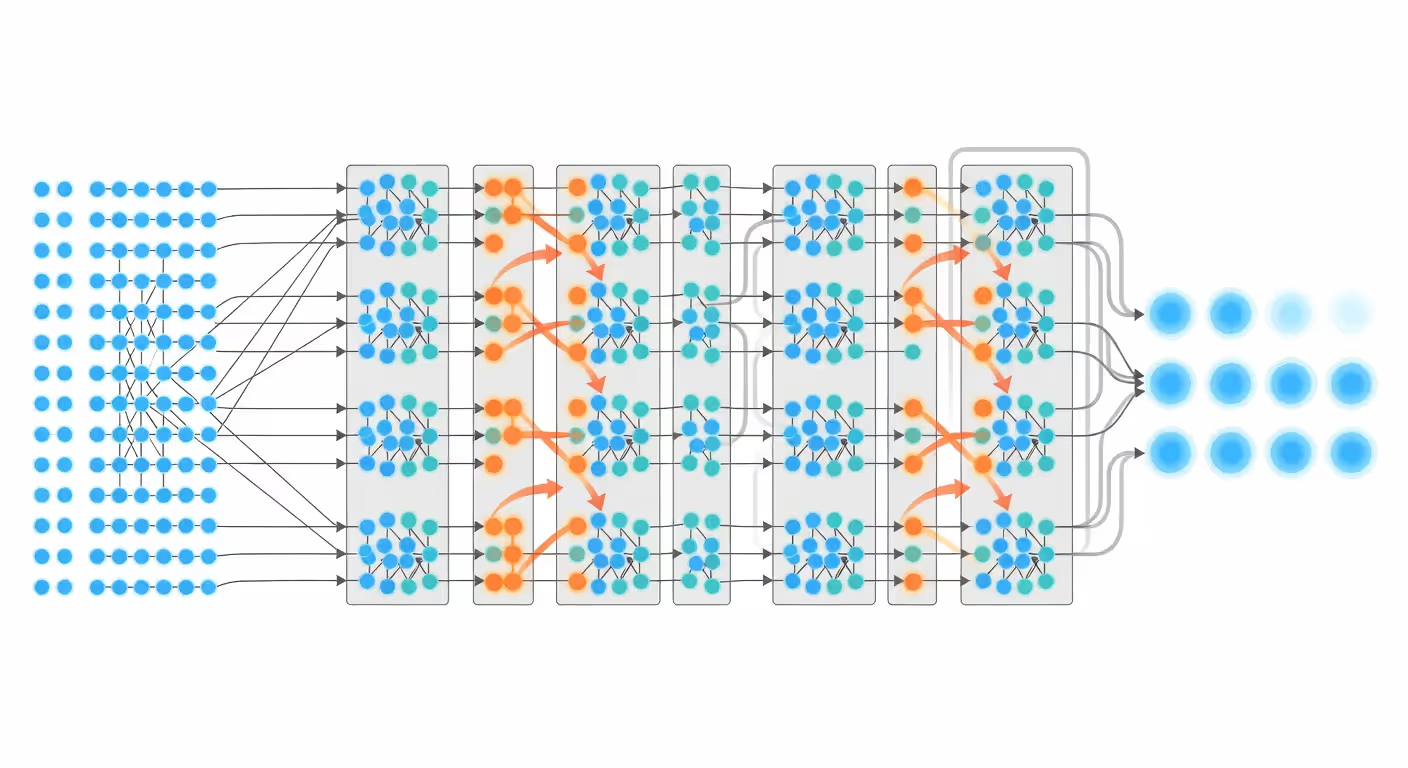
Neural networks form the architecture that makes learning possible. These are mathematical structures loosely inspired by how neurons connect in biological brains. Each artificial neuron receives inputs, applies a calculation, and passes the result forward. Chain millions of these together in layers, and you create a system capable of learning incredibly complex patterns.
Early neural networks struggled with sequential data like text or music because they processed each element independently. They couldn't "remember" what came before or anticipate what might come next.
Transformers solved this problem. Introduced in 2017, the transformer architecture revolutionized generative AI by introducing attention mechanisms—a way for the model to weigh which previous elements matter most when predicting the next one.
Author: Adrian Westmere;
Source: aleanetwork.net
Here's a concrete example: when generating the sentence "The cat sat on the ___", a transformer pays more attention to "cat" than to "the" when predicting the next word, because it's learned that subjects and verbs have stronger relationships than articles and verbs. It does this calculation for every word simultaneously, considering context from hundreds or thousands of previous tokens.
Transformers scale remarkably well. The same basic architecture powers small models that run on your phone and massive models with hundreds of billions of parameters running across thousands of specialized processors. The difference is capacity—larger models can learn more nuanced patterns and handle more complex tasks.
This architecture enables what's called "emergent abilities"—capabilities that appear only when models reach certain sizes. Smaller models might complete sentences. Scale them up, and they suddenly start reasoning through multi-step problems, translating languages they weren't explicitly trained on, or generating coherent long-form content.
Main Types of Generative AI Models
Different architectures excel at different creative tasks. Understanding the main types helps you grasp why certain tools work the way they do.
Generative Adversarial Networks (GANs) operate through competition. Two neural networks face off: a generator creates fake content, while a discriminator tries to distinguish fake from real. The generator improves by fooling the discriminator, and the discriminator sharpens by catching fakes. This adversarial process produces remarkably realistic images, videos, and audio.
GANs dominated image generation before 2022. They create photorealistic faces, transform sketches into photos, and age or de-age portraits. The downside? They're notoriously difficult to train and can be unstable, sometimes producing bizarre artifacts or failing to converge on good results.
Variational Autoencoders (VAEs) take a different approach. They compress input data into a compact representation (the latent space), then learn to reconstruct the original from that compressed form. Once trained, you can sample random points in the latent space to generate new, similar content.
VAEs produce smoother, more controlled outputs than GANs but often lack the sharp detail. They're popular in drug discovery, where researchers explore the latent space to find novel molecular structures, and in generating variations of existing designs.
Transformer models have become the dominant architecture for text generation and increasingly for other media. GPT (Generative Pre-trained Transformer) models, BERT, and similar systems all use transformer architecture. They excel at understanding context over long sequences and generating coherent, contextually appropriate content.
These models power most conversational AI, code generation tools, and text-based applications you encounter daily. Their ability to handle multiple languages, follow complex instructions, and maintain context across thousands of words makes them remarkably versatile.
Diffusion models represent the newest breakthrough, especially for images. They work by learning to reverse a gradual noising process. During training, they add random noise to images step by step until nothing recognizable remains. Then they learn to reverse this process—removing noise iteratively to recover the original image.
At generation time, you start with pure noise and let the model denoise it, guided by a text description or other input. This produces the image step by step, refining details through dozens of iterations.
Diffusion models power DALL-E 2, Midjourney, and Stable Diffusion. They've largely replaced GANs for image generation because they're more stable to train, produce higher-quality results, and allow finer control over the generation process.
Here's a comparison of these major types:
Model Type
Primary Use Cases
Training Complexity
Output Quality
Popular Examples
GANs
Image generation, video synthesis, face manipulation
High (unstable training)
Very high detail but inconsistent
StyleGAN, CycleGAN
Transformers
Text generation, code, translation, conversation
Moderate to high (requires massive data)
Excellent coherence and context
GPT-4, Claude, Gemini
Diffusion Models
Image generation, video, 3D models
Moderate
Consistently high quality
DALL-E 3, Midjourney, Stable Diffusion
VAEs
Drug discovery, design variations, compression
Moderate
Good but sometimes blurry
Molecular generation tools, design software
The simpler option usually wins here: for most business applications, you'll interact with transformer-based text models or diffusion-based image generators. The other architectures matter mainly to researchers and specialized applications.
Real-World Generative AI Applications Across Industries
Generative AI has moved far beyond tech demos. It's reshaping how work gets done across major sectors.
Content Creation and Marketing
Marketing teams use generative AI to produce first drafts of blog posts, social media content, email campaigns, and product descriptions. The workflow typically involves generating multiple variations, selecting the best, then editing for brand voice and accuracy.
Image generation has transformed visual content production. Marketers create custom illustrations, product mockups, and advertising visuals in minutes rather than days. A furniture company can show their couch in dozens of room settings without a photo shoot. An apparel brand can generate model photos wearing products that don't physically exist yet.
Video generation is emerging as the next frontier. Tools now create short marketing videos from text prompts, animate still images, or generate synthetic spokespersons. Quality varies widely, but the technology improves monthly.
The common mistake here is using AI-generated content without human review. These tools produce plausible-sounding text that can contain factual errors, inappropriate tone, or subtle nonsense. Smart teams use generative AI to accelerate production, not replace editorial judgment.
Healthcare and Drug Discovery
Pharmaceutical companies use generative AI to design new drug candidates by exploring chemical space more efficiently than traditional methods. The AI generates molecular structures predicted to bind to disease targets, which researchers then synthesize and test. This approach has already produced several drug candidates now in clinical trials.
Medical imaging benefits from generative models that can synthesize training data for rare conditions, helping researchers develop diagnostic tools without compromising patient privacy. AI can generate synthetic CT scans or MRIs that look real but contain no actual patient information.
Personalized treatment planning uses generative AI to simulate how different interventions might affect individual patients based on their specific biology and medical history. This varies significantly between patients, and AI helps clinicians explore options more thoroughly.
Author: Adrian Westmere;
Source: aleanetwork.net
Diagnostic support tools generate differential diagnoses by analyzing symptoms, test results, and medical histories. They don't replace doctors but help ensure rare conditions aren't overlooked.
Software Development and Code Generation
Developers now use AI coding assistants that autocomplete entire functions, explain code, convert between programming languages, and debug errors. Tools like GitHub Copilot, Amazon CodeWhisperer, and others have been adopted by millions of programmers.
The productivity gains are measurable. Studies show developers complete tasks 30-50% faster with AI assistance for routine coding work. The tools excel at boilerplate code, common patterns, and standard implementations.
But there's a counterintuitive finding: junior developers often benefit less than experienced ones. Experts use AI to accelerate tasks they already know how to do, while beginners sometimes accept AI suggestions they don't fully understand, leading to buggy or insecure code.
Code generation extends beyond programming. AI now generates SQL queries from natural language, creates regular expressions from examples, and writes configuration files based on requirements. This democratizes some technical tasks—non-programmers can accomplish things that previously required developer time.
Testing and documentation benefit too. AI generates test cases, writes technical documentation from code, and creates API examples. These tedious tasks get done more consistently when AI handles the first draft.
Common Generative AI Use Cases You Encounter Daily
You interact with generative AI more often than you probably realize. These applications have become embedded in everyday digital experiences.
Conversational assistants like ChatGPT, Claude, and Google Gemini answer questions, help with research, draft emails, explain concepts, and assist with countless daily tasks. They've replaced search engines for many queries because they synthesize information rather than just linking to sources.
Image generators let anyone create custom visuals. Need an illustration of a purple elephant wearing a top hat in a Victorian library? Type that description, and you'll have a dozen variations in seconds. Designers use these tools for concept exploration, marketers for social media content, and individuals for personal projects.
Writing assistants help with everything from fixing grammar to rewriting text in different tones. Tools like Grammarly, Jasper, and built-in AI features in word processors suggest improvements, expand bullet points into paragraphs, or condense long text into summaries.
Voice synthesis has become eerily realistic. AI can clone voices from short samples, generate narration in dozens of languages and accents, and even adjust emotional tone. Audiobook production, podcast editing, and accessibility tools all benefit.
Author: Adrian Westmere;
Source: aleanetwork.net
Personalized content recommendations use generative models to create customized playlists, news feeds, and product suggestions. Spotify doesn't just recommend existing playlists—it generates custom mixes based on your listening patterns. Netflix creates personalized artwork for shows, emphasizing actors or themes you tend to prefer.
Email and message composition tools generate replies, schedule meeting invitations, and draft responses to common inquiries. Smart reply features predict what you want to say and offer one-click options.
Design tools generate color palettes, suggest layouts, create logo variations, and produce design assets. Canva, Figma, and Adobe products now include generative features that accelerate creative work.
Educational applications generate practice problems, explain concepts in multiple ways, create study guides, and provide personalized tutoring. Students use AI to understand difficult material, though this raises questions about academic integrity when misused.
The pattern across all these examples: generative AI handles the initial creation or suggestion, but humans make final decisions. It's a collaboration that works best when you understand both the capabilities and limitations of the technology.
The most powerful models today are still just the beginning—we're seeing early glimpses of systems that can reason, create, and assist in ways that fundamentally change how people work and learn.
— Altman Sam
Limitations and Risks of Generative AI
For all its capabilities, generative AI comes with significant limitations you need to understand before relying on it.
Hallucinations are the most notorious problem. These models confidently generate false information that sounds plausible. Ask for citations, and it might invent nonexistent papers with realistic-sounding titles and authors. Request historical facts, and it might blend real events with fiction. The model doesn't "know" it's wrong—it's simply predicting what text would plausibly come next.
This happens because the model learned patterns, not facts. It can't distinguish between accurate information in its training data and fiction, speculation, or errors. It has no mechanism to verify truth or access current information unless explicitly connected to external tools.
Bias permeates these systems because it permeates their training data. If you train a model on internet text, it absorbs the biases present in that text—gender stereotypes, cultural assumptions, political leanings, and more. Image generators trained on photos from the internet tend to overrepresent certain demographics and underrepresent others.
Researchers work to mitigate bias through careful data curation, fine-tuning on balanced datasets, and adding safety filters. But it's an ongoing challenge with no perfect solution. The models reflect patterns in human-created content, which means they reflect human biases.
Intellectual property concerns remain legally murky. If a model trained on copyrighted images generates a new image, who owns it? If it produces code similar to open-source libraries in its training data, what license applies? Courts are still working through these questions, and different jurisdictions may reach different conclusions.
Misinformation and deepfakes pose societal risks. Generative AI makes it trivial to create fake but convincing photos, videos, audio recordings, and written content. Distinguishing real from synthetic becomes increasingly difficult. This enables fraud, political manipulation, and harassment at scale.
Environmental costs matter too. Training large generative models consumes enormous energy—estimates suggest training GPT-3 produced as much carbon as driving a car for 700,000 miles. Inference (actually using the model) also requires significant computing resources, though much less than training.
Quality inconsistency frustrates users. The same prompt might produce brilliant results one time and nonsense the next. Models perform unpredictably, especially on edge cases or unusual requests. You can't fully trust them for critical applications without human oversight.
Security vulnerabilities include prompt injection attacks (tricking models into ignoring safety guidelines), data extraction (getting models to reveal training data), and using AI to generate malicious code or phishing content.
The counterintuitive point: larger, more capable models often exhibit more of these problems, not fewer. They hallucinate more confidently, inherit biases from larger datasets, and create more convincing misinformation. Capability and safety don't automatically improve together.
Frequently Asked Questions About Generative AI
What is the difference between generative AI and traditional AI?
Traditional AI analyzes and categorizes existing data to make predictions or decisions. It might classify emails as spam, recommend products, or predict equipment failures. Generative AI creates entirely new content—text, images, code, music—that didn't exist before. Traditional AI recognizes patterns in data; generative AI uses those patterns to produce novel outputs. Think of it this way: traditional AI reads and understands, while generative AI writes and creates.
Can generative AI replace human creativity?
Not entirely, though it's reshaping creative work. Generative AI excels at producing variations on existing patterns and handling routine creative tasks. It can draft initial concepts, generate multiple options quickly, and handle technical execution. But it lacks genuine understanding, emotional depth, cultural context, and the ability to create truly groundbreaking work that breaks from established patterns. The most effective approach combines AI's speed and scale with human judgment, taste, and originality. Creative professionals who learn to direct AI tools gain leverage; those who ignore them risk falling behind.
What are the most popular generative AI tools available today?
For text generation, ChatGPT, Claude, and Google Gemini lead the conversational AI space. For images, Midjourney, DALL-E 3, and Stable Diffusion dominate. Developers rely on GitHub Copilot and Amazon CodeWhisperer for code generation. Video tools like Runway and Pika are gaining traction. Adobe has integrated Firefly across its creative suite. Microsoft Copilot brings AI into Office applications. The landscape shifts rapidly—new tools launch monthly, and existing ones add capabilities constantly. Most offer free tiers so you can experiment before committing.
Is generative AI safe to use for business purposes?
It depends on how you use it. Generative AI works well for drafting content, brainstorming, data analysis, and accelerating routine tasks—with human review. It's risky for anything requiring accuracy without verification, handling sensitive data, or making final decisions without oversight. Major concerns include data privacy (don't input confidential information into public AI tools), accuracy (always verify factual claims), and bias (review outputs for fairness). Many businesses use enterprise versions with better security, data handling, and compliance features. Start with low-risk applications, establish clear usage policies, and train employees on appropriate use.
How much does it cost to implement generative AI?
Costs vary dramatically based on approach. Using existing tools through APIs or subscriptions runs $20-$200 per user monthly for most business applications. Custom implementation using pre-trained models costs $50,000-$500,000 depending on complexity, integration requirements, and scale. Training your own model from scratch requires millions of dollars in computing resources and expertise—only feasible for large enterprises or specialized applications. Most businesses start with off-the-shelf tools, then consider custom solutions only if generic models don't meet specific needs. Cloud providers offer pay-per-use pricing that lets you scale gradually without large upfront investment.
What skills do I need to work with generative AI?
For basic use, you need strong prompting skills—learning to write clear, specific instructions that get good results. This requires experimentation and understanding each tool's strengths and limitations. For integration work, familiarity with APIs and basic programming helps. For advanced applications, you'll need machine learning knowledge, Python programming, understanding of model architectures, and experience with frameworks like PyTorch or TensorFlow. But here's the good news: you don't need technical skills to benefit from generative AI. Many tools have intuitive interfaces designed for non-technical users. The most valuable skill is critical thinking—knowing when to trust AI outputs and when to question them.
Generative AI represents a fundamental shift in how we interact with computers—from tools that execute our instructions to collaborators that augment our capabilities. The technology will continue improving rapidly, with more accurate outputs, broader capabilities, and better integration into workflows. But the core principle remains constant: these are powerful tools that amplify human effort, not replacements for human judgment. Learning to work effectively with generative AI means understanding both what it can do and where it falls short. Experiment with different tools, develop your prompting skills, and always maintain healthy skepticism about outputs. The organizations and individuals who figure out this balance will gain significant advantages in productivity, creativity, and problem-solving capability. The technology isn't going away—it's becoming foundational infrastructure for knowledge work.
Computer vision enables machines to interpret visual data like humans do—only faster and more accurately. This comprehensive guide explains the technology behind facial recognition, autonomous vehicles, medical imaging, and more, breaking down how it works and where it's applied.
Retrieval Augmented Generation combines information retrieval with language models to create AI systems that provide accurate, source-backed answers. This guide explains how RAG works, its architecture, and practical implementation steps for building production systems.
Discover what makes transformer models the foundation of modern AI. This guide explains attention mechanisms, architecture components, and why transformers outperform RNNs for language tasks, with real-world examples from ChatGPT to BERT.
Explore the complete landscape of LLM tools, from API platforms to fine-tuning frameworks. Learn how to choose, implement, and optimize large language model tools for your development projects with practical comparisons and expert insights.
The content on this website is provided for general informational and educational purposes only. It is intended to explain concepts related to AI tools, agents, developer infrastructure, coding assistants, APIs, and productivity workflows.
All information on this website, including articles, guides, and examples, is presented for general educational purposes. Outcomes and tool performance may vary depending on implementation, skill level, and use case.
This website does not provide professional AI consulting, development services, or guarantees of results, and the information presented should not be used as a substitute for consultation with qualified AI or software development professionals.
The website and its authors are not responsible for any errors or omissions, or for any outcomes resulting from decisions made based on the information provided on this website.