Large language models have a frustrating limitation: they only know what they learned during training. Ask GPT-4 about something that happened after its training cutoff, and you'll get an apologetic "I don't have information about that." Ask it about your company's internal processes, and it'll make educated guesses—often wrong ones.
RAG (Retrieval Augmented Generation) fixes this by giving AI systems a research assistant's capabilities. Instead of relying purely on memorized training data, these systems search through external documents in real-time, pull relevant information, and use those sources to construct accurate answers. Think of it like the difference between taking a closed-book exam versus an open-book one where you can reference materials.
The practical implications are huge. Companies use RAG to build customer service bots that reference up-to-date documentation, internal search tools that scan thousands of policy documents, and specialized assistants that help professionals navigate technical materials. You get accurate, source-backed responses without the expense and complexity of retraining models.
What Is RAG AI and Why It Matters
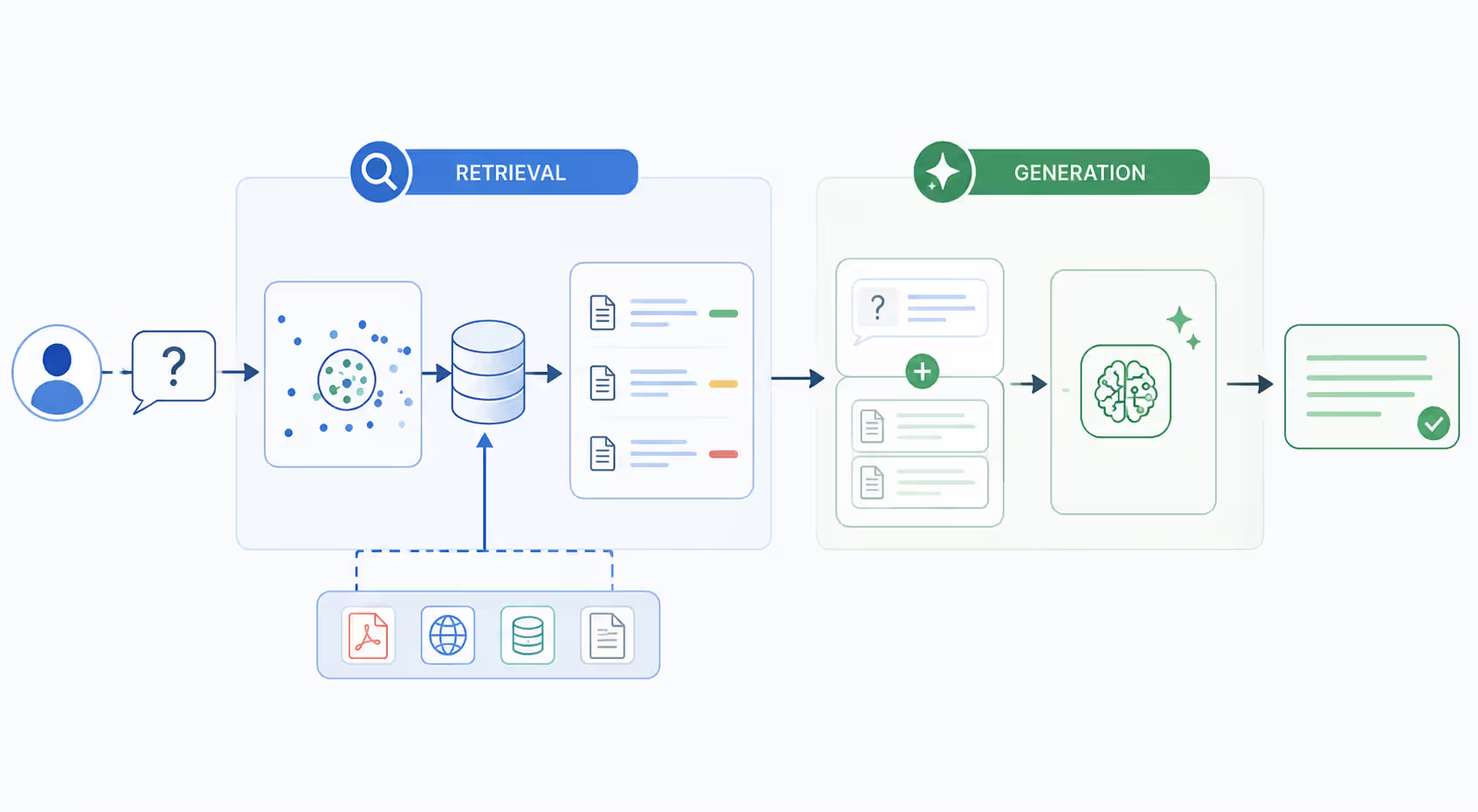
Here's how RAG AI actually works: it combines a search system with a text generator. When someone asks a question, the system first hunts through your document library to find relevant passages. Then it hands those passages to a language model, which crafts a natural-sounding answer based on what it found.
Why does this matter? Standard LLMs have a knowledge cutoff problem. GPT-4 trained on data through April 2023 can't tell you about events in December 2025. More importantly, it knows nothing about your business—your product specs, your customer data, your internal wikis. RAG bridges that gap instantly.
The core goal is simple: ground AI responses in real, verifiable information. When you ask a question, the system doesn't guess or improvise. It searches your documents, finds relevant sections, and bases its answer on those specific sources. You can even show users exactly which documents the AI consulted.
RAG represents a fundamental shift in how we build production AI systems. Rather than encoding all knowledge into model weights, we're teaching models to consult external memory—much like humans do when we look something up before answering.
— Lewis Patrick
This approach dramatically reduces hallucinations (those confident-sounding but completely fabricated answers LLMs sometimes produce). Instead of inventing details, the model works from concrete source material. That's critical for business applications where accuracy matters.
For development teams, RAG unlocks use cases that were previously impractical. You can build systems that answer questions about product documentation, analyze legal contracts, or help employees navigate company policies. The knowledge stays current because you're just updating documents, not retraining models—which would cost thousands of dollars and take weeks.
The economics make sense too. RAG costs less than fine-tuning custom models. It's easier to maintain, faster to deploy, and more transparent about how it generates answers. Teams can start with existing documentation and have working systems in days.
How RAG Works Under the Hood
Every time someone asks a question, RAG executes a specific sequence. Understanding each step helps you build better systems and troubleshoot when things go wrong.
The Retrieval Process
When a user submits a question, the system immediately converts it into an embedding—a list of numbers (typically 768 to 1536 of them) that captures the semantic meaning. Your entire document collection was converted into these same numerical representations when you first set up the system.
Here's where it gets interesting. The system compares the question's embedding against every document embedding in your vector database, looking for semantic similarity. It's not just matching keywords. A question about "getting my money back" might surface documents about "refund procedures" or "return guarantees" even if they never use the exact phrase "money back."
The database returns the most semantically similar chunks, usually ranked by a similarity score. Most implementations fetch 3-10 chunks, though this depends on your needs and how much context your language model can handle.
Common mistake: retrieving too much. More context doesn't automatically mean better answers. Flooding the model with 15 marginally relevant passages can confuse it or bury the most important information. Quality beats quantity.
The Generation Process
Once you've retrieved relevant chunks, the system constructs a prompt for the language model. This prompt contains three key pieces: the user's original question, the retrieved context passages, and instructions for how to use them.
A typical prompt structure looks like: "Answer the user's question using only the information in these reference documents. If the documents don't contain enough information, say so. Don't make up information. Reference documents: (retrieved chunks). User question: (original question)."
The LLM processes this combined input and generates a response. Because it has specific, relevant information in its context window, it can give accurate answers based on your actual documentation rather than its potentially outdated training data.
The model can also indicate when it doesn't have enough information to answer. That's a huge advantage over standard LLMs, which might confidently state incorrect information when they're out of their depth.
How These Components Work Together
The magic happens when retrieval and generation work in harmony. When both phases perform well, users get responses that sound natural and conversational while being backed by specific source documents.
Author: Damien Crowhurst;
Source: aleanetwork.net
Let's walk through a real example. User asks: "What's your return policy for electronics?" The system converts this to an embedding, queries the vector database, and finds three relevant chunks from your returns documentation. It feeds these to the LLM along with the question. The LLM responds: "Electronics can be returned within 30 days of purchase with original receipt and packaging. Items must be unused. Refunds take 5-7 business days to process."
The accuracy comes from direct document reference. The system can also cite which specific documents and sections it used, giving users confidence in the information.
One pattern I see repeatedly: teams underestimate how much document quality affects results. RAG can't fix poorly written, outdated, or contradictory documentation. Classic case of garbage in, garbage out—though the solution isn't better AI, it's better source material.
RAG Architecture Overview
A RAG system has four main components working together. Each serves a distinct purpose, and your choices for each component affect performance, cost, and accuracy.
Vector databases store your documents as embeddings and enable fast similarity searches. They're specifically engineered for finding the most similar vectors to a query vector—exactly what RAG needs. Options include Pinecone, Weaviate, Qdrant, and Chroma. Some teams use PostgreSQL with the pgvector extension for simpler deployments.
Embedding models convert text into numerical vectors that represent semantic meaning. These models are typically much smaller than full language models. Popular choices include OpenAI's text-embedding-3 series, Cohere's embed models, and open-source options like sentence-transformers. Consistency matters—you need to use the same embedding model for both documents and queries.
Large language models handle the generation step. They take retrieved context and produce natural language responses. You can use commercial APIs like GPT-4, Claude, or Gemini, or host open-source models like Llama or Mistral. The model needs enough context window to fit your retrieved passages plus the query.
Retrieval mechanisms determine how the system finds relevant information. The simplest approach uses pure vector similarity search. Advanced systems use hybrid search (combining vector and keyword approaches), reranking (using a second model to re-order results), or query expansion (generating multiple variations of the question).
Here's how these components stack up:
Component
What It Does
Your Options
What to Consider
Vector Database
Stores and searches document embeddings
Pinecone, Weaviate, Qdrant, Chroma, pgvector
Scalability, query speed, cost per million vectors, metadata filtering capabilities
Embedding Model
Converts text to semantic vectors
OpenAI embeddings, Cohere, sentence-transformers
Vector size, language support, domain specialization, API pricing
LLM
Generates natural language responses
GPT-4, Claude, Gemini, Llama, Mistral
Context window size, reasoning quality, cost per token, latency
Retrieval Method
Finds relevant documents
Similarity search, hybrid search, reranking
Accuracy vs. speed tradeoffs, complexity, computational cost
The architecture is modular—you can swap components as needs change. Start simple with a managed vector database, commercial embedding API, and hosted LLM. Optimize later based on actual usage patterns and performance metrics.
One technical consideration that catches teams off-guard: dimensionality. Your embedding model produces vectors of a fixed size (commonly 768, 1536, or 3072 dimensions). Your vector database needs to support that size, and higher dimensions mean more storage and slower searches. There's always a tradeoff.
RAG vs Fine Tuning: Which Approach to Choose
RAG and fine-tuning solve different problems. Understanding when to use each saves you time and money.
Fine-tuning means taking a pre-trained language model and continuing its training on your specific data. This modifies the model's internal weights, teaching it new patterns, terminology, or behaviors. It's great for changing how a model writes or reasons, but it's expensive and time-consuming.
RAG doesn't touch the base model at all. Instead, it gives the model access to external information at inference time. This makes it ideal for knowledge-heavy applications where accuracy and freshness matter most.
Here's how they compare side-by-side:
Factor
RAG
Fine-Tuning
Data Needs
Works with small datasets; even a few dozen documents help
Needs hundreds to thousands of examples for real improvement
Cost
Cheaper—no model training required
Expensive—requires GPU time, experiments, specialized infrastructure
Updates
Instant—just add or modify documents
Slow—requires full model retraining
Factual Accuracy
Better—answers grounded in source docs
Worse—models still hallucinate despite training
Style Control
Limited—model keeps its original voice
Better—can learn specific writing styles
Maintenance
Easy—update documents as info changes
Hard—requires retraining for every update
Best For
Q&A, knowledge bases, document search, support bots
Custom writing styles, domain-specific reasoning, instruction following
Generally speaking, simpler wins. If your AI needs to access specific information, RAG is almost always the right choice. Fine-tuning makes sense when you need to change behavior, not add knowledge.
Many successful implementations combine both. You might fine-tune a model to follow a specific response format or adopt your company's tone, then add RAG to give it access to current information. This combination gives you RAG's knowledge accuracy plus fine-tuning's behavioral control.
Counterintuitive insight: fine-tuning is surprisingly bad at teaching models new facts. Research shows fine-tuned models still hallucinate information, especially for factual questions. They're better at learning patterns and styles than memorizing specific data. When factual accuracy matters, RAG is the proven approach.
Building RAG Applications: Key Steps and Considerations
Building a RAG system involves several technical decisions. Making smart choices upfront prevents major rework later.
Choosing Your Data Sources
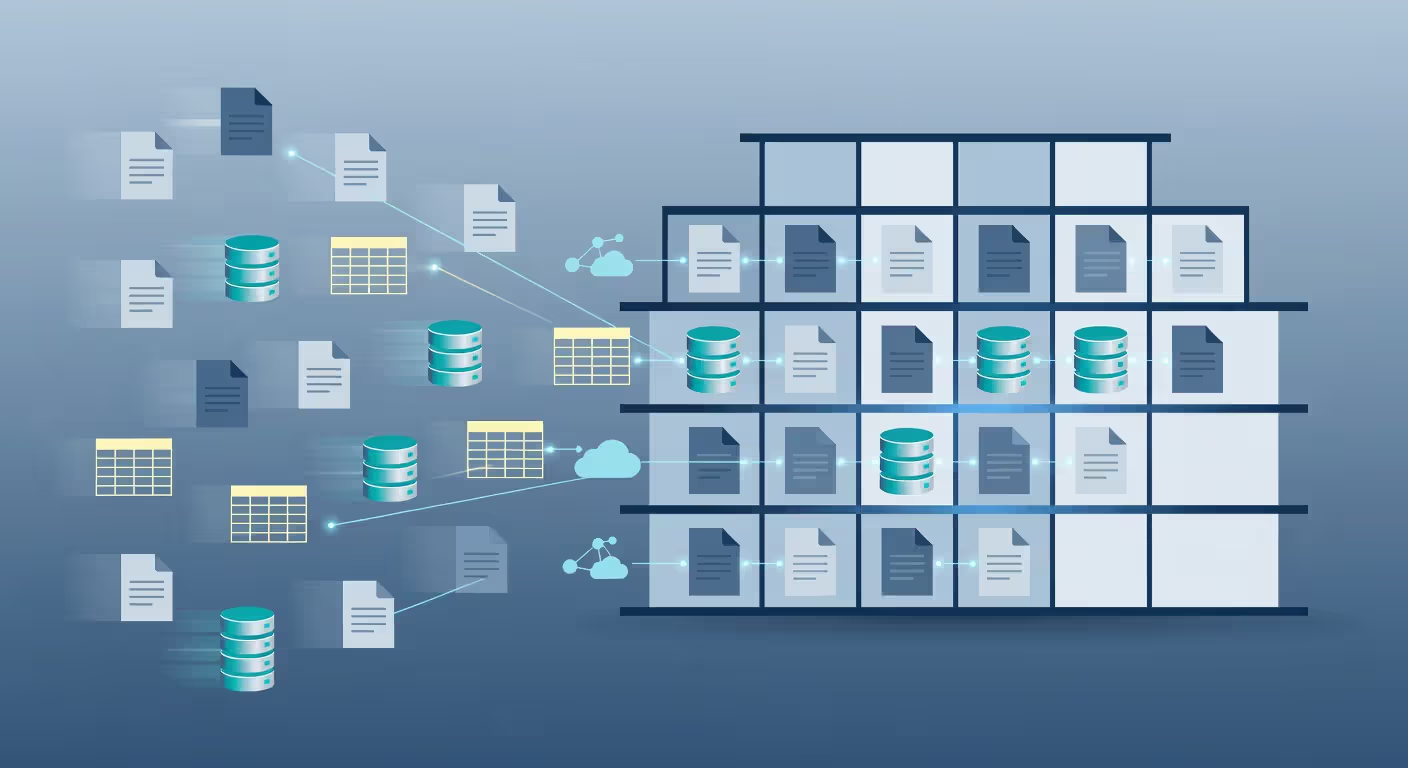
Start by identifying what information your system needs to access. This might include product documentation, support articles, internal wikis, customer databases, or technical specifications. The quality and structure of these sources directly determines your output quality.
Clean, well-organized documents work best. If your documentation is scattered across formats, full of duplicates, or hasn't been updated in years, fix that first. RAG amplifies whatever you feed it.
Author: Damien Crowhurst;
Source: aleanetwork.net
Chunking strategy requires thought. You can't feed entire 100-page manuals to an LLM—you need to break documents into digestible pieces. Common approaches include splitting by paragraphs, by character count (with overlap between chunks), or by semantic sections. Each method has tradeoffs between preserving context and achieving retrieval precision.
Don't ignore metadata. Tagging documents with categories, dates, or other attributes enables filtering search results. A user asking about "current pricing" should only see recent pricing documents, not outdated versions from three years ago.
Selecting Embedding Models and Vector Databases
Your embedding model choice affects both accuracy and operational costs. Larger models (higher dimensions) generally capture semantics better but increase compute costs and storage needs. For most applications, models producing 1024 or 1536 dimensions strike a good balance.
Test several models on your actual documents. Run sample queries and see which model retrieves the most relevant results. The best model for general text might underperform on technical documentation or legal language.
For vector databases, start with a managed service unless you have specific constraints. Pinecone, Weaviate Cloud, or Qdrant Cloud handle scaling, backups, and performance tuning for you. Self-hosting makes sense at large scale or with strict data residency requirements.
Performance matters more as you scale. A database that works fine with 10,000 documents might struggle at 10 million. Look at query latency benchmarks and understand the accuracy vs. speed tradeoffs. Some databases use approximate nearest neighbor search, trading slight accuracy loss for much faster queries.
Common Implementation Mistakes
The biggest mistake is not testing retrieval quality before adding the LLM. Set up your vector database, run queries, and manually check whether the retrieved chunks actually answer the questions. If retrieval fails, generation can't save you.
Another common issue: ignoring context window limits. If you retrieve 10 chunks of 500 words each, that's 5,000 words before you even add the user's question and system instructions. Make sure everything fits in your model's context window with room to spare.
Many teams also underestimate prompt engineering importance. The instructions you give the LLM about how to use the context dramatically affect results. Experiment with different prompt templates and measure which produces the most accurate, concise responses.
Don't skip evaluation. Build a test set of questions with known correct answers. Run your system against it regularly and track metrics like answer accuracy, retrieval precision, and response latency. This catches regressions when you make changes.
One more consideration: plan for failure cases. What happens when retrieval finds nothing relevant? What if the LLM refuses to answer? Build fallback behaviors so users get helpful responses even when things don't work perfectly.
Real-World RAG Use Cases and Applications
RAG has proven valuable across many industries. These applications show the strongest adoption in 2026.
Customer support is the most common implementation. Companies build RAG systems that answer customer questions using help docs, past support tickets, and product manuals. The AI handles routine questions instantly while escalating complex issues to human agents. Response times drop from hours to seconds, and support teams focus on problems that genuinely need human judgment.
Internal knowledge bases help employees find information in large organizations. Instead of searching through SharePoint sites, Confluence pages, and Google Docs, employees ask natural language questions. The system searches across all repositories and returns answers with source citations. This is especially valuable for onboarding new hires who don't know where information lives.
Author: Damien Crowhurst;
Source: aleanetwork.net
Legal and medical document analysis leverages RAG's ability to search and synthesize information from massive document collections. Lawyers use it to find relevant case law and contract clauses. Medical researchers use it to search published studies and clinical guidelines. The key advantage is the system's ability to cite specific sources, which is non-negotiable in these fields.
Code assistance tools help developers by searching through documentation, internal codebases, and past solutions. A developer can ask "How do we handle authentication in our API?" and get answers based on the actual codebase and internal docs, not generic programming advice.
Financial services firms deploy RAG for research and compliance. Analysts can query earnings reports, SEC filings, and market research. Compliance teams can search regulations and internal policies to answer specific questions about requirements.
The common thread across these implementations: a large body of information that changes over time, and people who need accurate answers quickly. That's exactly where RAG shines.
FAQ: RAG Technology Questions Answered
Is RAG better than fine-tuning?
It depends on your goal. RAG wins for knowledge-intensive applications that need accurate, current information. Fine-tuning wins for changing how a model behaves, writes, or reasons. For most business applications that need document-based question answering, RAG is the more practical choice. It costs less, is easier to maintain, and produces more reliable factual responses.
What are the limitations of RAG?
RAG struggles when answers require synthesizing information across many disparate documents or performing complex reasoning across sources. The retrieval step might miss relevant information if queries are ambiguous or documents are poorly structured. Latency is another cost—RAG systems respond slower than using an LLM alone because they need to query the vector database first. Also, RAG quality can't exceed your source document quality. If the information isn't in your knowledge base, the system can't answer.
Do I need a vector database for RAG?
Technically, alternatives exist—you could use other search methods. Practically speaking, yes. Vector databases are specifically engineered for the semantic similarity search that RAG requires. They vastly outperform alternatives when searching through thousands or millions of documents. For small prototypes with few documents, simpler approaches might work, but any production deployment benefits enormously from a purpose-built vector database.
How much does it cost to build a RAG system?
Costs vary widely based on scale. A small system might cost $50–200/month for managed vector database, embedding API calls, and LLM usage. Medium-scale systems handling thousands of queries daily might run $500–2,000/month. Large enterprise implementations can cost much more, but typically still less than fine-tuning and maintaining custom models. Main cost drivers are LLM API calls (charged per token) and vector database storage plus queries.
Can RAG work with any LLM?
Yes, RAG is model-agnostic. You can use it with commercial APIs like GPT-4, Claude, or Gemini, or with self-hosted open-source models like Llama or Mistral. The main requirement is the model having enough context window to fit your retrieved passages plus the query. Models with 4,000+ token context windows work for most applications, though 8,000+ gives more comfortable margins. Newer models with 128,000+ token windows let you include many more retrieved documents when helpful.
What's the difference between RAG and semantic search?
Semantic search is actually one component of RAG—specifically the retrieval step. Semantic search finds relevant documents based on meaning rather than just keyword matching. RAG takes this further by feeding those retrieved documents to a language model that synthesizes a natural language answer. Think of semantic search as returning a list of relevant passages, while RAG turns those passages into a conversational response. You can use semantic search alone, but combining it with generation (making it RAG) produces much better user experiences.
RAG has matured from experimental technique to production-ready approach for building AI applications that need accurate, current information. The technology is accessible—you don't need a research team or massive infrastructure to build effective RAG systems. Start with your existing documentation, pick a vector database and embedding model, and iterate based on real user queries. The results will speak for themselves.
Computer vision enables machines to interpret visual data like humans do—only faster and more accurately. This comprehensive guide explains the technology behind facial recognition, autonomous vehicles, medical imaging, and more, breaking down how it works and where it's applied.
Discover what makes transformer models the foundation of modern AI. This guide explains attention mechanisms, architecture components, and why transformers outperform RNNs for language tasks, with real-world examples from ChatGPT to BERT.
Generative AI creates new content rather than analyzing existing data. Learn how neural networks and transformers power tools like ChatGPT and DALL-E, explore different model types, and understand real-world applications across industries from healthcare to marketing.
Explore the complete landscape of LLM tools, from API platforms to fine-tuning frameworks. Learn how to choose, implement, and optimize large language model tools for your development projects with practical comparisons and expert insights.
The content on this website is provided for general informational and educational purposes only. It is intended to explain concepts related to AI tools, agents, developer infrastructure, coding assistants, APIs, and productivity workflows.
All information on this website, including articles, guides, and examples, is presented for general educational purposes. Outcomes and tool performance may vary depending on implementation, skill level, and use case.
This website does not provide professional AI consulting, development services, or guarantees of results, and the information presented should not be used as a substitute for consultation with qualified AI or software development professionals.
The website and its authors are not responsible for any errors or omissions, or for any outcomes resulting from decisions made based on the information provided on this website.