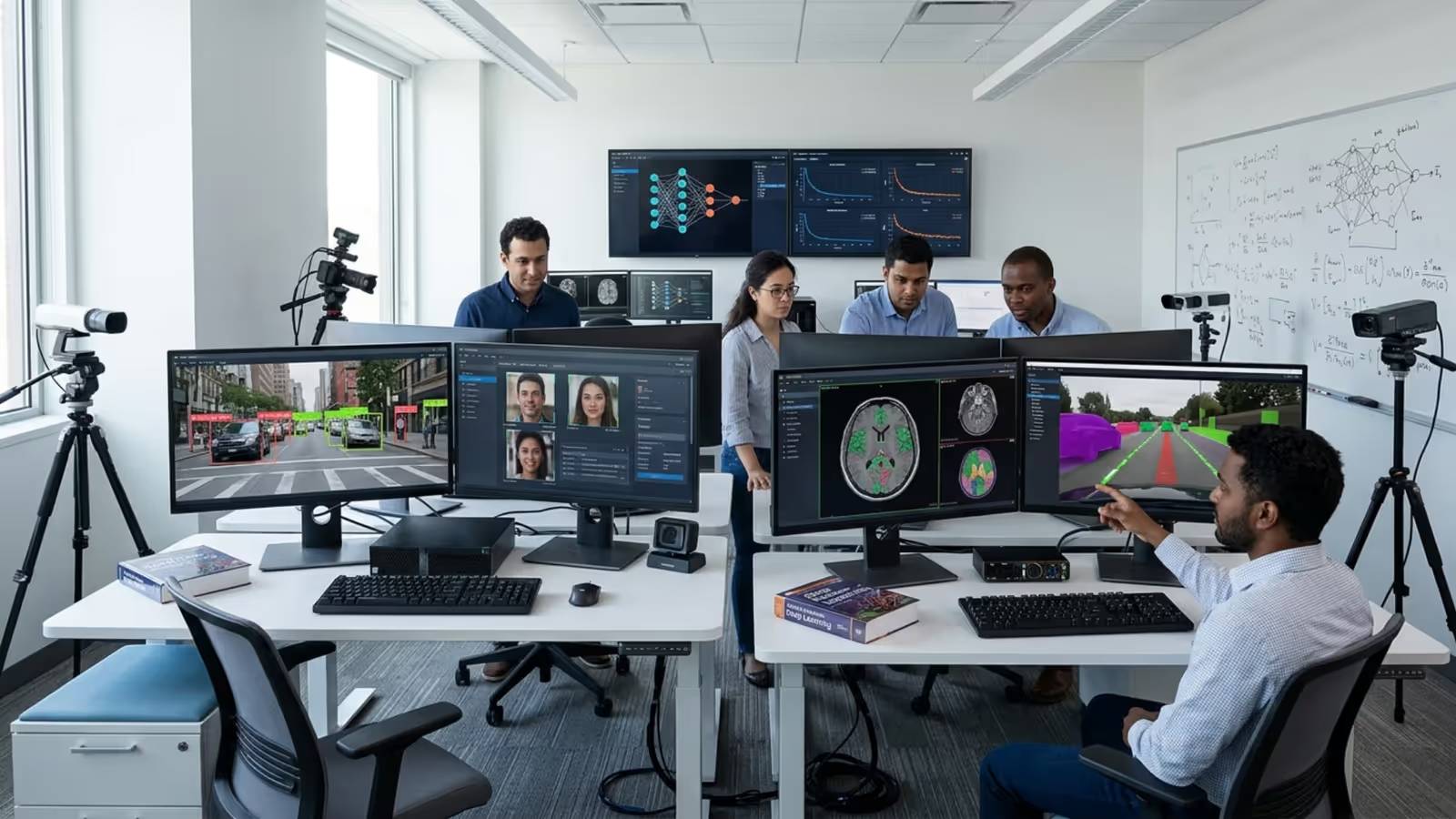
Computer vision allows machines to interpret and understand visual information from images and video in ways that replicate—and frequently surpass—human visual capabilities. This technology drives the facial authentication system on your smartphone, enables self-driving cars to navigate complex traffic environments, and helps medical professionals detect cancerous cells with remarkable precision. At its core, these systems process visual data using methods analogous to biological vision, but with computational benefits in processing speed and analytical consistency.
The evolution witnessed over the last ten years has been extraordinary. Operations that previously required specialized supercomputing infrastructure now run on standard consumer devices. Daily life involves regular interaction with visual AI systems, though these encounters often go unnoticed. Photo management apps automatically sort images by their content, vehicle safety systems warn drivers about lane drift, and checkout-free retail stores monitor purchases through ceiling-mounted cameras—all demonstrations of vision AI at work in everyday situations.
Understanding how this technology operates, where it fits within the broader artificial intelligence landscape, and how it's being deployed across different sectors presents real complexity. This comprehensive guide examines computer vision from its technical underpinnings through the industry transformations it's currently enabling.
What Is Computer Vision?
Computer vision constitutes an artificial intelligence field focused on enabling machines to extract meaningful information from visual inputs. These systems examine photographs and video sequences to recognize patterns, pull out relevant data, and enable automated decision-making based on what they observe.
Think of it as providing machines with sight—but with abilities that transcend biological constraints. Human brains handle visual information effortlessly through mechanisms refined by evolution, whereas computational systems need explicit training to differentiate a cat from its surroundings or identify microscopic defects in manufactured parts.
Simply recognizing objects represents just the starting point. Genuine visual intelligence requires understanding context. Sophisticated systems don't just register that an object exists within an image—they identify what it is, where it's located, how it's oriented, and what it's doing. This separation distinguishes basic pixel processing from authentic machine perception.
We're not just teaching computers to see. We're teaching them to understand context, make decisions, and interact with the physical world in ways that seemed impossible a generation ago.
— Fei-Fei Li
The discipline brings together multiple fields: digital image manipulation, statistical pattern analysis, algorithmic learning, and neural computation. Each contributes specific abilities toward enabling machines to derive meaning from arrays of pixels. Modern implementations have advanced sufficiently to outperform humans in specific visual tasks—spotting manufacturing defects or examining diagnostic images for disease markers.
Today's computer vision differs fundamentally from earlier approaches through two key factors: massive training datasets and adaptive learning systems. Current platforms process millions of example images, discovering patterns that would take decades for humans to catalog manually. Performance strengthens through exposure, with accuracy improving as training data expands.
How Computer Vision Works
Visual AI systems follow a structured workflow that transforms raw pixel information into actionable insights. The process begins when imaging hardware—cameras, scanners, or sensors—captures visual data. This digital file, fundamentally a grid of numerical color values, enters a computational pipeline.
Image acquisition marks the initial stage. Various capture devices—smartphone cameras, medical imaging equipment, satellite sensors, or industrial inspection systems—record visual information. Input quality and format substantially affect downstream analysis performance. Difficult conditions like poor lighting, low resolution, or motion blur complicate interpretation.
Preprocessing comes after acquisition. Raw captures rarely arrive in ideal condition for analysis. This stage normalizes the data—adjusting exposure and contrast, removing random noise, standardizing image dimensions, and converting between color representation formats when needed. Preprocessing improves reliability and decreases computational demands in later stages.
Feature extraction represents the next essential phase. Algorithms locate distinctive visual elements: boundary edges, corner points, surface textures, geometric shapes, and color gradients. These features become fundamental building blocks for understanding image content. Earlier systems depended on manually designed feature detectors. Contemporary approaches use neural networks that automatically discover relevant features.
Pattern recognition follows. Systems compare extracted features against learned templates from training datasets. Does this arrangement of visual elements match characteristics of human faces? Do these edge patterns correspond to traffic signage? Algorithms calculate probability scores for competing interpretations.
The pipeline concludes with interpretation and action. Systems produce outputs—object labels, bounding boxes highlighting detected items, categorical classifications, or triggers for automated responses. Results might be straightforward like "cat detected" or complex like "pedestrian entering roadway from driver's left, initiate emergency braking."
Image Processing and Pattern Recognition
Image processing encompasses mathematical operations that enhance or extract information from visual data. Common operations include edge detection, which emphasizes boundaries between distinct objects, and segmentation, which divides images into semantically meaningful regions.
Pattern recognition involves matching observed visual elements against known templates or learned representations. Classical approaches used handcrafted rules: "Faces contain two eyes positioned above a nose positioned above a mouth." This worked for simple scenarios but failed when confronting variations in lighting, viewing angle, or partial obstruction.
Author: Adrian Westmere;
Source: aleanetwork.net
Modern pattern recognition leverages statistical models and machine learning algorithms. Systems learn from examples rather than executing rigid programmed instructions. After examining 10,000 cat photographs, the system discovers statistical signatures that characterize "cat-ness"—without explicit programming of whiskers or pointed ears.
Successful real-world implementations typically combine classical image processing with modern machine learning. Edge detection and color filtering maintain value for preprocessing stages, while neural networks handle complex pattern matching tasks.
Role of Neural Networks and Deep Learning
Deep learning revolutionized computer vision around 2012, when convolutional neural networks (CNNs) began dramatically exceeding previous accuracy benchmarks in image classification competitions.
CNNs architecturally mirror information processing in biological visual cortex. They use stacked layers of artificial neurons, each specialized for detecting particular features. Initial layers identify elementary patterns like edges and curves. Intermediate layers combine these into increasingly complex shapes. Final layers recognize abstract concepts like faces, vehicles, or text characters.
The "deep" descriptor refers to these numerous processing layers—sometimes numbering in the hundreds. Each layer transforms data, extracting progressively more abstract representations. A CNN analyzing automobile images might initially detect edges, then combine these into wheels and windows, ultimately recognizing vehicle categories like "sedan" or "truck."
Neural networks derive their strength from automatic feature learning. You don't specify what distinguishes dogs from cats. Instead, you provide thousands of labeled examples, and the network independently discovers distinguishing characteristics through training.
Training these networks requires enormous datasets and substantial computing resources. Typical computer vision models train on millions of images across days or weeks, adjusting billions of internal parameters to minimize classification errors. Once training completes, however, the network analyzes new images in milliseconds.
Transfer learning democratized advanced computer vision for smaller organizations. Rather than training from scratch, you can start with networks pre-trained on millions of images, then fine-tune for specific tasks using just hundreds or thousands of domain-specific examples. This approach makes sophisticated visual AI accessible without requiring massive infrastructure investments.
Computer Vision vs Machine Learning
The relationship between these disciplines creates confusion for many observers. Here's the fundamental distinction: machine learning represents the broader field, while computer vision constitutes one specialized application area.
Machine learning enables computers to improve performance on tasks through experience rather than explicit programming. The discipline addresses diverse problems: real estate price prediction, email spam filtering, entertainment recommendations, and visual data interpretation.
Computer vision specifically applies machine learning methods to visual information. It addresses unique challenges inherent in understanding images and videos. Not all machine learning involves visual data, but contemporary computer vision depends heavily on machine learning techniques.
Earlier computer vision implementations used rule-based logic. Programmers manually coded algorithms targeting specific visual features. This worked for constrained problems but couldn't handle the complexity and variability characterizing real-world visual scenarios.
Machine learning fundamentally transformed the approach. Rather than encoding explicit rules, you supply training examples. Systems discover patterns within data and generalize to novel situations. This methodology handles variation, noise, and ambiguity far more effectively than manually programmed rules.
Here's the practical comparison:
Aspect
Computer Vision
Machine Learning
Definition
Specialized AI field enabling machines to derive meaning from visual information
Broader discipline teaching systems to improve through data exposure and experience
Primary Function
Analyze images and video to extract actionable intelligence
Identify patterns in data to enable predictions or automated decisions
Data Input Type
Photographs, video frames, visual sensor data
Any data format including text, numerical records, audio signals, or images
Example Applications
Facial authentication, object localization, medical imaging analysis, autonomous navigation
Product recommendations, fraud detection, natural language processing, visual analysis
Relationship to AI
AI subdomain with substantial machine learning integration
Core AI methodology enabling diverse intelligent systems
This relationship operates bidirectionally. Computer vision benefits from machine learning advances—improved algorithms yield better image understanding. Conversely, computer vision challenges drive machine learning innovation by presenting unique problems that inspire novel neural network architectures.
These terms frequently appear together because they're deeply interconnected in practice. Self-driving vehicles employ computer vision to perceive road environments, while machine learning algorithms determine appropriate responses to observed conditions.
Real-World Computer Vision Applications
Computer vision has moved from academic research into mainstream products and services. The technology influences virtually every industry sector, often through implementations that remain invisible until explicitly highlighted.
Applications broadly categorize into: recognition (identifying image content), detection (locating specific objects or patterns), segmentation (partitioning images into meaningful regions), and tracking (following objects across video sequences). Each capability enables distinct use cases.
Healthcare and Medical Imaging
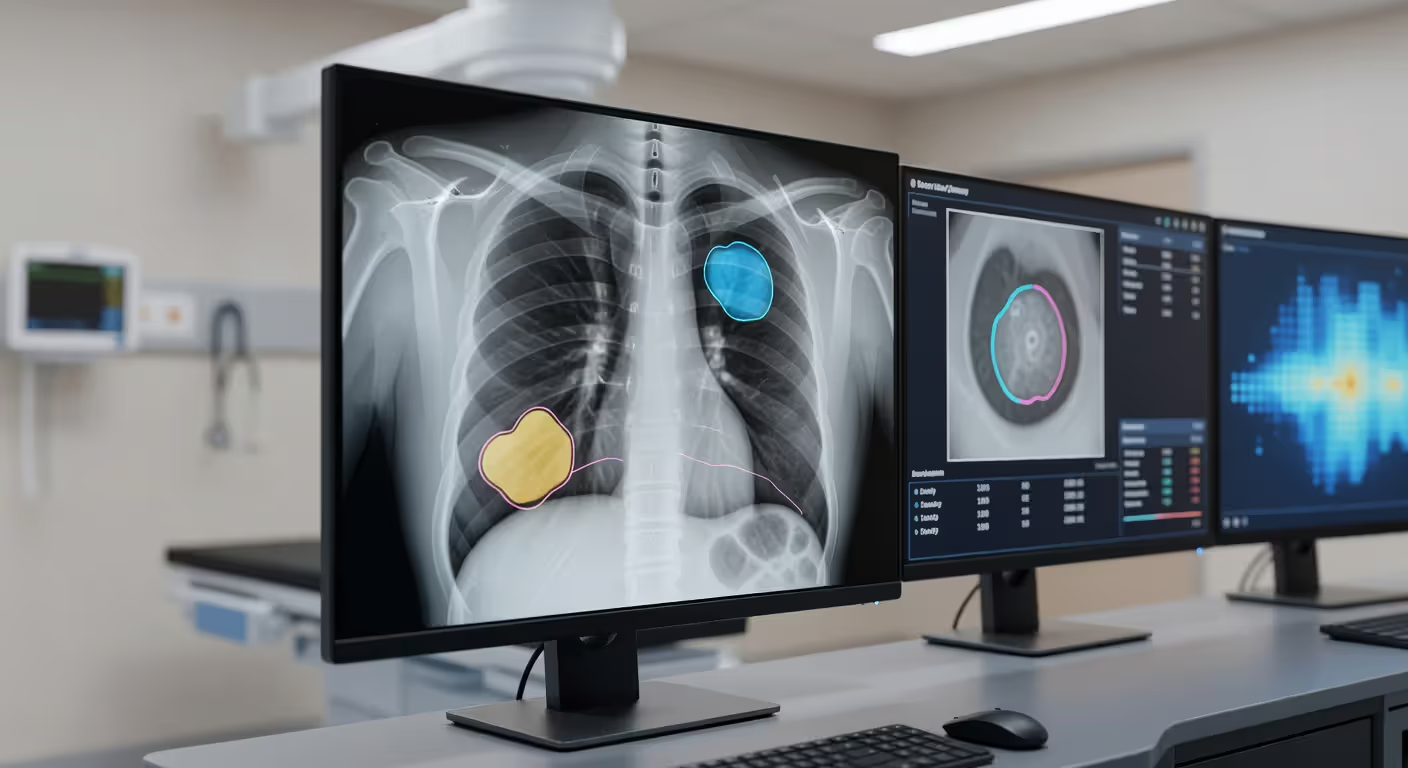
Medical imaging potentially represents computer vision's most transformative application domain. Radiologists employ AI-augmented systems for analyzing X-rays, MRI scans, and CT images. These systems identify anomalies that might escape human attention—early-stage tumors, subtle fractures, or degenerative disease indicators.
Pathology laboratories deploy computer vision for analyzing tissue samples and blood specimens. The technology counts cellular structures, identifies abnormalities, and flags samples requiring detailed human review. Results arrive faster and more consistently than manual analysis.
Author: Adrian Westmere;
Source: aleanetwork.net
Diabetic retinopathy screening exemplifies a breakthrough success. Computer vision systems analyze retinal photographs to detect diabetes-related eye damage. They've enabled screening programs in regions lacking sufficient ophthalmologists, identifying cases early enough for sight-preserving treatment.
Surgical assistance platforms use real-time computer vision to support surgeons during procedures. They can highlight vascular structures, track instrument positions, and alert surgeons to developing complications. This augments rather than replaces surgical expertise.
Accuracy questions arise frequently in medical contexts. For numerous diagnostic tasks, computer vision systems now equal or surpass typical human performance. However, optimal results emerge from human-AI collaboration, where systems flag potential concerns and trained professionals render final judgments.
Autonomous Vehicles and Transportation
Self-driving vehicles essentially function as robots navigating physical environments using computer vision as their primary sensory modality. Cameras mounted throughout vehicles capture surrounding environments continuously. Computer vision systems process these feeds to identify roadways, lane markings, traffic signs, signals, pedestrians, cyclists, and other vehicles.
The challenge extends beyond mere detection—prediction becomes critical. Systems must anticipate other road users' future actions. Will that pedestrian enter the roadway? Is that adjacent vehicle preparing to merge? Computer vision tracks movement patterns and forecasts trajectories to enable safe navigation decisions.
Advanced driver assistance systems like lane departure warnings, adaptive cruise functionality, and collision avoidance braking all rely on computer vision capabilities. These features already appear as standard equipment in many new vehicles. They don't require full autonomy but demonstrate how computer vision enhances driving safety.
Logistics companies deploy computer vision for warehouse automation. Camera-equipped robots navigate facilities, identify products, and manage inventory. They scan barcodes and labels, verify package contents, and sort items for shipping—entirely without human intervention.
Parking systems employ computer vision to direct drivers toward available spaces and enable automated parking. Cameras read license plates for access control and payment processing. Toll roads implement similar technology for automatic toll collection.
Retail and E-Commerce
Amazon Go stores demonstrate computer vision in retail environments. Overhead cameras throughout stores track which products customers select and return. Upon exit, the system automatically charges for items removed. No checkout queues, no manual scanning.
Visual search enables shoppers to find products by uploading photographs. After seeing an attractive lamp at a friend's residence, you photograph it and the retailer's application locates similar available items. This works for apparel, furniture, home décor, and numerous other categories.
Virtual try-on employs computer vision to preview how products appear on customers. Eyewear retailers let you visualize frames on your face through smartphone cameras. Furniture stores display how a sofa would appear in your living room. Cosmetics brands enable testing different shades without opening physical products.
Camera systems track product availability on store shelves, automatically detecting when items run low and alerting staff for restocking. They also verify correct product placement and ensure pricing labels match displayed items.
Loss prevention systems track suspicious behavioral patterns. They can identify when someone conceals merchandise or when checkout transactions don't align with camera observations. This reduces theft while minimizing false accusations.
Common Computer Vision Use Cases
Beyond industry-specific implementations, certain computer vision tasks appear across multiple domains. Understanding these fundamental use cases helps identify where the technology might address challenges in your specific context.
Facial recognition identifies or verifies individuals based on facial characteristics. Smartphones use it for device unlocking. Airports deploy it for passenger verification. Photo sharing platforms use it to suggest tagging. Security agencies employ it for suspect identification. The technology raises privacy concerns despite becoming ubiquitous in security and authentication.
Object detection locates and categorizes multiple items within images. A single photograph might contain vehicles, people, vegetation, and structures—object detection finds and labels each element. This powers applications from photo organization tools to industrial quality control. Algorithms draw bounding boxes around detected items and assign confidence scores.
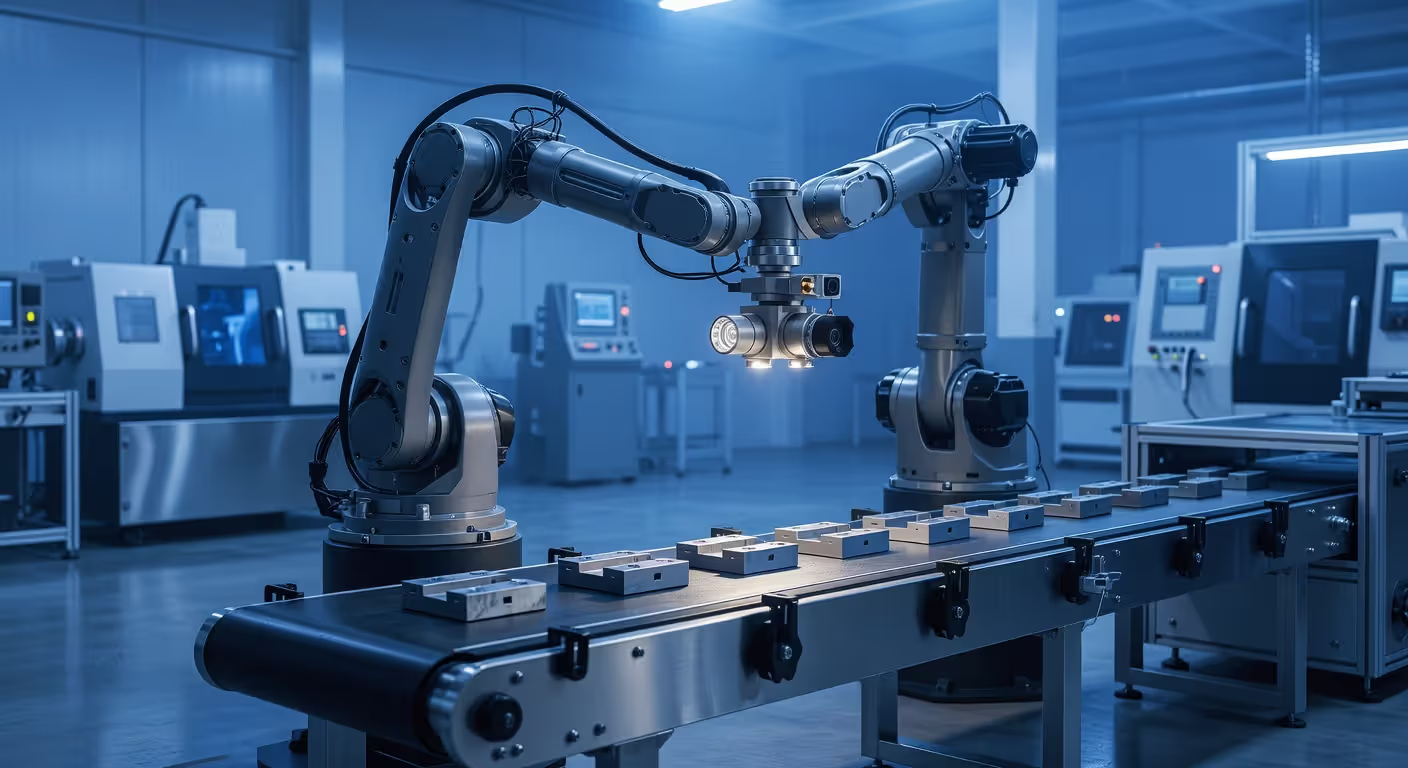
Quality inspection in manufacturing catches defects human inspectors might overlook. Computer vision systems examine products at production speeds, identifying scratches, cracks, misalignments, or incorrect assembly. They deliver more consistent results than human inspectors and don't experience fatigue. Common pitfall: assuming computer vision catches every defect category without extensive training data for each specific flaw type.
Author: Adrian Westmere;
Source: aleanetwork.net
Optical character recognition (OCR) transforms images of text into machine-readable characters. You encounter this when depositing checks through banking apps or digitizing historical documents. Modern OCR handles handwriting, multiple languages, and text in complex layouts. It bridges physical and digital worlds for text-based information.
Gesture recognition interprets human body movements and hand signals. Gaming systems use it for controller-free interaction. Smart televisions respond to hand gestures. Sign language translation systems use gesture recognition to convert signs into text or speech. The technology requires tracking movement across video frames and understanding motion pattern meanings.
Image classification assigns categorical labels to complete images. Does this photograph depict a canine or feline? Does this chest radiograph indicate pneumonia? Does this product review express positive sentiment based on attached photos? Classification often precedes more complex analysis. It's simpler than object detection because it labels entire images rather than locating specific objects within them.
Semantic segmentation classifies every pixel in images. Instead of drawing boxes around objects, it creates precise outlines. This matters for applications like medical imaging, where exact tumor boundaries are required, or autonomous driving, where precise road surface boundaries must be known.
Pose estimation identifies position and orientation of objects or people. It tracks body joints to understand human poses and movements. Fitness applications use it to evaluate exercise form. Animation studios use it to capture actor movements for CGI characters. Retail analytics employ it to understand customer behavior patterns in stores.
Computer Vision Technology Overview
Building computer vision systems requires integrating multiple technology components. The landscape encompasses software frameworks, hardware accelerators, pre-trained models, and development tools.
Popular frameworks and libraries provide foundational building blocks for computer vision applications. OpenCV stands as the veteran—an open-source library containing thousands of optimized algorithms for image processing and classical computer vision. Since its 2000 release, it remains extensively deployed.
TensorFlow and PyTorch dominate deep learning implementations. Both offer high-level APIs for constructing and training neural networks, with specialized tools for computer vision tasks. TensorFlow's Keras API makes experimentation accessible for newcomers. PyTorch has become favored in research communities for its flexibility.
Specialized libraries like YOLO (You Only Look Once) and Detectron2 deliver state-of-the-art object detection. MediaPipe from Google offers ready-made solutions for common tasks including face detection, hand tracking, and pose estimation. These pre-built tools enable implementing computer vision features without training models from scratch.
Hardware requirements vary dramatically depending on application scope. Training complex models demands substantial computing power—typically GPUs (graphics processing units) or specialized AI accelerators like Google's TPUs. Individual training runs might require days on high-end GPU clusters.
Executing trained models for inference proves less demanding. Many computer vision applications run on edge devices—smartphones, security cameras, drones, or embedded systems. Model optimization techniques like quantization and pruning reduce size and computational requirements without significantly sacrificing accuracy.
Author: Adrian Westmere;
Source: aleanetwork.net
Cloud platforms offer alternatives to managing hardware directly. AWS, Google Cloud, and Azure provide pre-configured environments for training and deploying computer vision models. They handle scaling, offer pre-trained models, and provide APIs for common tasks.
Current limitations matter equally with capabilities. Computer vision struggles with scenarios absent from training data. A system trained on clear-weather driving images might fail in dense fog. Models can be deceived by adversarial examples—carefully crafted inputs appearing normal to humans but triggering incorrect classifications.
Bias in training data produces biased systems. When your facial recognition model trains predominantly on one demographic, it performs worse on others. This transcends technical problems—it creates real social consequences when these systems make decisions affecting people's lives.
Computational costs remain substantial. Training state-of-the-art models requires resources exceeding most organizations' budgets. Even inference can prove expensive at scale. Energy consumption for AI represents a genuine environmental concern.
Explainability presents another challenge. Deep neural networks function as "black boxes"—they work, but understanding why they made specific decisions proves difficult. This matters for medical diagnosis, legal applications, or any context requiring decision justification.
The pragmatic approach typically succeeds: start with pre-trained models and transfer learning rather than training from scratch. Use cloud services for experimentation before investing in hardware. Focus on narrow, well-defined problems rather than attempting to solve general visual understanding.
Frequently Asked Questions About Computer Vision
What is computer vision in simple terms?
Computer vision teaches machines to understand and interpret visual information from images and videos. Think of it as giving computers the ability to see and make sense of what they're looking at, similar to how human vision works but using algorithms and mathematical models instead of biological processes.
Is computer vision part of artificial intelligence?
Yes, computer vision represents a major branch within artificial intelligence. It combines AI techniques with image processing, pattern recognition, and deep learning to enable machines to extract meaningful information from visual data. Most modern computer vision systems rely heavily on machine learning, another core AI discipline.
What industries use computer vision the most?
Healthcare leads adoption for diagnostic imaging and pathology analysis. Automotive manufacturers integrate it extensively for autonomous vehicles and driver assistance. Retail employs it for inventory management and cashier-free stores. Manufacturing uses it for quality control and defect detection. Monitoring and protection systems also represent significant application areas. Agriculture increasingly deploys computer vision for crop monitoring and automated harvesting.
How accurate is computer vision technology?
Accuracy depends heavily on the specific task, training data quality, and implementation. For well-defined problems with abundant training data, modern systems can exceed 95% accuracy and sometimes surpass human performance. However, accuracy drops significantly when systems encounter scenarios different from their training data. Medical imaging systems often achieve radiologist-level performance on specific tasks, while general object recognition in unconstrained environments remains more challenging.
Can I learn computer vision without a programming background?
Learning computer vision without programming proves extremely difficult since implementation requires coding skills. However, you can start by understanding concepts before diving into programming. Python has become the standard language for computer vision work. Many online courses teach both programming fundamentals and computer vision simultaneously. Expect several months of dedicated study to build functional skills. No-code platforms exist for simple applications, but they severely limit what you can accomplish.
What are the privacy concerns with computer vision?
Privacy concerns are substantial and growing. Facial recognition enables tracking individuals without consent. Surveillance systems can monitor behavior patterns in public and private spaces. Biometric data collected by computer vision systems could be breached or misused. Many systems lack transparency about what data they collect and how it's used. Regulations like GDPR in Europe and various state laws in the US attempt to address these concerns, but technology often outpaces regulation. Organizations deploying computer vision should implement privacy-by-design principles and clear data governance policies.
Retrieval Augmented Generation combines information retrieval with language models to create AI systems that provide accurate, source-backed answers. This guide explains how RAG works, its architecture, and practical implementation steps for building production systems.
Discover what makes transformer models the foundation of modern AI. This guide explains attention mechanisms, architecture components, and why transformers outperform RNNs for language tasks, with real-world examples from ChatGPT to BERT.
Generative AI creates new content rather than analyzing existing data. Learn how neural networks and transformers power tools like ChatGPT and DALL-E, explore different model types, and understand real-world applications across industries from healthcare to marketing.
Explore the complete landscape of LLM tools, from API platforms to fine-tuning frameworks. Learn how to choose, implement, and optimize large language model tools for your development projects with practical comparisons and expert insights.
The content on this website is provided for general informational and educational purposes only. It is intended to explain concepts related to AI tools, agents, developer infrastructure, coding assistants, APIs, and productivity workflows.
All information on this website, including articles, guides, and examples, is presented for general educational purposes. Outcomes and tool performance may vary depending on implementation, skill level, and use case.
This website does not provide professional AI consulting, development services, or guarantees of results, and the information presented should not be used as a substitute for consultation with qualified AI or software development professionals.
The website and its authors are not responsible for any errors or omissions, or for any outcomes resulting from decisions made based on the information provided on this website.