Artificial intelligence has changed dramatically in the past few years, and one innovation stands out above the rest: the transformer model. If you've used ChatGPT, Google Translate, or any modern AI assistant, you've already experienced transformers in action. They're the engine behind nearly every breakthrough in natural language processing since 2017, when a team at Google introduced them in the now-famous paper "Attention Is All You Need." This architecture fundamentally changed how machines process language, and understanding why requires looking at both the technical innovations and practical advantages that made transformers the dominant approach in modern AI.
Understanding Transformer Architecture Basics
When examining a transformer model overview, you'll encounter an architecture built on two primary stacks: encoders and decoders. The encoder stack takes input data and transforms it into meaningful representations that capture context and relationships. The decoder stack receives these representations and produces output—whether that's translating text, generating responses, or completing sentences.
Within each stack, you'll discover multiple identical layers—typically six, twelve, or even more in larger models. These layers function like progressive refinement stages, each applying the same operations but with unique learned parameters. The data flows through these layers sequentially, becoming more refined and contextually rich at each step.
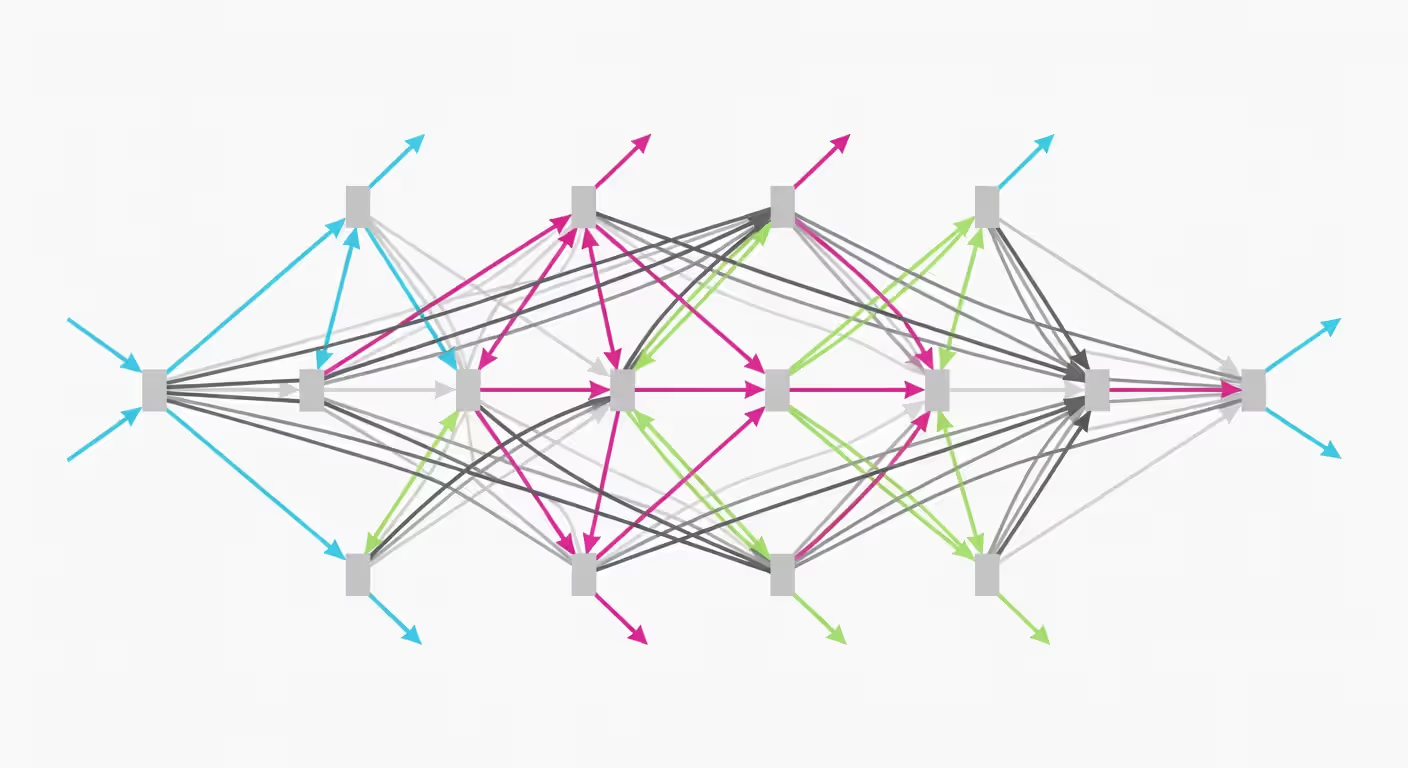
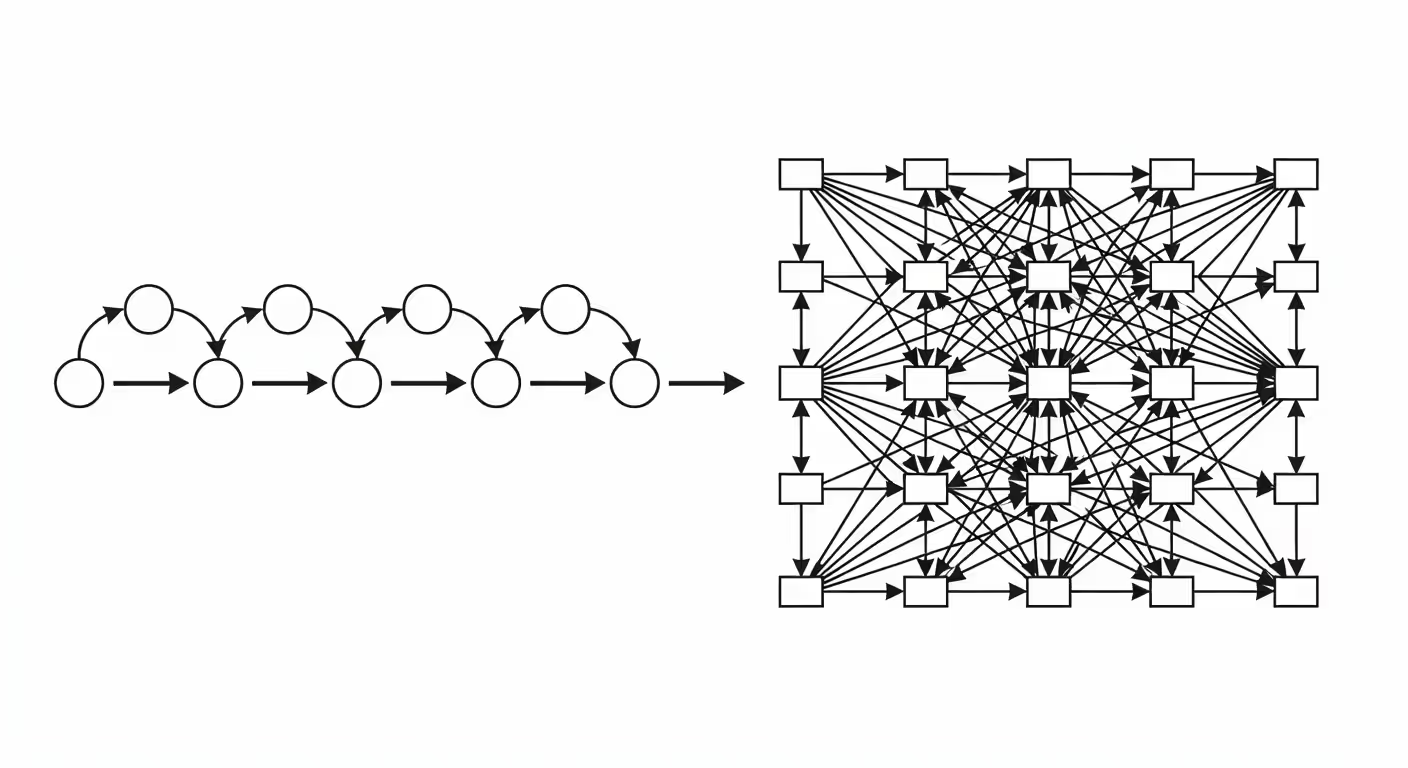
The revolutionary aspect of transformer architecture explained comes from how these models process information. Previous approaches handled words sequentially, moving from beginning to end like reading a book. Transformers analyze entire sequences simultaneously, examining all words at once. This parallel processing capability transformed both training efficiency and model performance.
Inside each layer, the transformer architecture explained reveals a sophisticated arrangement. Multi-head attention mechanisms work alongside position-wise feed-forward networks. Normalization layers and residual connections maintain data stability throughout the processing pipeline, preventing information loss as representations flow through the network.
Here's something that surprises many people learning about transformers: these models don't naturally understand word order. Without explicit guidance, "dog bites man" looks identical to "man bites dog." Positional encoding addresses this limitation by injecting sequence information directly into the input representations, which we'll explore in detail later. First, understanding attention mechanisms—the core innovation—is essential.
Author: Selena Briarwood;
Source: aleanetwork.net
How the Attention Mechanism Powers Transformers
The attention mechanism explained in straightforward terms: it's a mathematical system that determines which input elements matter most when processing each position. Your brain performs similar operations constantly—when reading "she" in a sentence, you automatically connect it to the relevant female noun mentioned earlier. Attention mechanisms replicate this contextual awareness through computation.
Earlier neural network architectures struggled with these connections. Processing "she" without clear links to nouns appearing twenty words earlier created ambiguity and errors. Transformers address this by calculating relevance scores between every position and every other position in the input sequence.
What Self-Attention Does
Self-attention forms the foundation of how transformers work. Each position examines all other positions in the input to determine their relevance. This process relies on three learned vector representations for every position: queries, keys, and values.
Imagine searching a library catalog. Your search term is the query. Book titles and descriptions are keys—they tell you what each book contains. The actual book contents are values—the information you want to retrieve. The system compares your query against all keys, calculates relevance scores, and returns a weighted combination of the corresponding values.
Take the sentence "The dog didn't cross the road because the weather was terrible." When processing "the weather," the model computes attention scores with every other word. High scores emerge between "the weather" and "terrible"—the model learns these words relate closely. Lower scores appear for unrelated words like "dog" or "cross." This happens simultaneously for every position in the sentence.
This simultaneous processing distinguishes transformers from recurrent networks. RNNs process "The," update their state, process "dog," update again, and continue sequentially through the entire sequence while trying to maintain relevant context. Transformers compute all relationships in parallel, eliminating the sequential bottleneck.
We designed the Transformer to rely entirely on attention mechanisms, dispensing with recurrence and convolutions entirely. This simple change allowed us to train models faster and capture dependencies that were previously out of reach.
— Vaswani Ashish
Multi-Head Attention Explained
Single attention mechanisms work well, but running multiple attention mechanisms in parallel works better. That's multi-head attention—typically eight or sixteen separate attention mechanisms operating simultaneously.
Each attention head discovers different patterns and relationships. Some heads might capture grammatical structures like subject-verb-object relationships. Others might identify semantic connections between synonyms or related concepts. Still others might track dependencies across long distances in the text.
What's fascinating is that these specializations emerge through training without explicit programming. The model discovers these distinct patterns automatically. After each head computes its attention, the transformer concatenates all outputs and applies a learned transformation to combine them into a unified representation.
This approach succeeds through diverse perspectives. Multiple attention mechanisms examining the same data from different angles capture subtleties that single mechanisms miss. It's similar to having several experts analyze the same document—each person notices distinct aspects and patterns.
Author: Selena Briarwood;
Source: aleanetwork.net
Key Components of Transformer Architecture
Several additional components beyond attention enable transformers to function effectively. Each element serves a specific purpose in the information processing pipeline.
Positional encoding addresses the sequence order challenge. Since transformers process all positions simultaneously, they need explicit information about word order to distinguish "cat chases mouse" from "mouse chases cat." The solution involves adding position-specific patterns to the input embeddings. The original transformer paper employed sine and cosine functions at varying frequencies, creating unique signatures for each sequence position.
These encodings get added directly to word embeddings rather than concatenated. The first position receives one mathematical pattern, the second position gets a different pattern, and this continues throughout the sequence. The model learns to interpret these patterns as positional information during training.
Feed-forward networks appear after attention in each transformer layer. These networks consist of two learned linear transformations with a nonlinear activation function between them. While conceptually straightforward, they're critical for processing the information gathered by attention mechanisms.
Attention mechanisms collect relevant information from across the sequence. Feed-forward networks then transform this collected information into more useful representations for subsequent layers. One component gathers context, the other refines it.
Layer normalization maintains numerical stability throughout the network. Deep neural networks can experience problems when values become extremely large or vanishingly small as data moves through many layers. Normalization rescales representations after each sub-component, preventing these numerical issues.
Residual connections (skip connections) allow information to bypass layers entirely. The input to each sub-component gets added directly to that sub-component's output. This architectural choice helps gradients flow effectively during training and prevents the vanishing gradient problem that plagued earlier deep architectures.
These components form an integrated system. Attention gathers contextual information. Feed-forward networks process and refine it. Normalization maintains stability. Residual connections preserve information flow. Together, they create models that train efficiently and achieve remarkable performance.
Transformer vs RNN: Why Transformers Won
Recurrent Neural Networks dominated sequence modeling before transformers emerged. RNNs processed sequences one step at a time, maintaining hidden states that theoretically captured all previous context. Enhanced variants like LSTMs and GRUs added sophisticated memory mechanisms to address RNN limitations.
Despite these improvements, fundamental problems remained.
Feature
Transformer
RNN
Training Speed
Rapid training through complete parallel processing of sequences
Training proceeds slowly due to mandatory sequential processing
Parallelization
Complete parallelization possible across the entire sequence
Architecture requires sequential processing with minimal parallelization opportunities
Long-Range Dependencies
Exceptional performance with direct attention connections between any positions
Context degrades over distance even with LSTM/GRU memory mechanisms
Memory Requirements
Substantial memory needed for storing all pairwise attention computations (quadratic complexity)
Moderate memory usage with fixed hidden state size independent of sequence length
Best Use Cases
Text generation, machine translation, language understanding, applications needing extensive context
Sophisticated architecture with numerous interacting components
Conceptually simpler design with fewer architectural elements
Training efficiency differences are dramatic. RNNs must complete processing at position t-1 before beginning position t. Transformers compute all positions simultaneously using modern parallel hardware. This reduces training duration from weeks to days for large-scale models.
Long-range context matters enormously for language understanding. In RNNs, information from the first word must propagate through every subsequent hidden state to reach word one hundred. The signal weakens along this path. Transformers establish direct attention connections—the first word can attend to the hundredth word with zero intermediate steps.
However, transformers aren't universally superior. Memory requirements scale quadratically with sequence length. Processing a 1,000-word document requires computing one million attention scores (1,000 × 1,000). A 10,000-word document demands 100 million scores. RNNs maintain constant-size hidden states regardless of input length.
For most contemporary applications, this tradeoff favors transformers. Memory costs continue declining while computational efficiency gains prove decisive. Yet for streaming data applications or resource-constrained edge devices, RNNs remain viable options.
Author: Selena Briarwood;
Source: aleanetwork.net
Real-World Applications of Transformer Models
Transformers power practical systems you interact with regularly, not just research projects.
ChatGPT and GPT-4 implement decoder-only transformer architectures trained on enormous text corpora. These models predict subsequent words in sequences, and this seemingly simple task—executed billions of times—produces systems capable of writing code, composing essays, and maintaining coherent conversations. The underlying architecture closely resembles the original transformer decoder, scaled to unprecedented sizes.
BERT implements an encoder-only design optimized for language understanding rather than generation. Google deployed BERT to enhance search quality, helping algorithms comprehend user intent and contextual meaning. Searching for "jaguar speed" now correctly returns information about the animal's velocity rather than car specifications, thanks to BERT's contextual understanding.
Translation systems represented transformers' initial breakthrough application. Google Translate migrated to transformer-based models in 2020, immediately improving translation quality across language pairs. Encoders process source language text, decoders generate target language output, and attention mechanisms align corresponding phrases across languages.
Vision transformers adapt this architecture for image processing. Images get divided into patches, each patch receives treatment analogous to a word, and standard transformer layers process the resulting sequence. Vision transformers now rival or surpass convolutional networks on numerous image recognition benchmarks. The same fundamental architecture succeeds for both text and images—a remarkable achievement.
Protein folding predictions in AlphaFold2 leverage transformers to determine three-dimensional protein structures from amino acid sequences. Attention mechanisms learn relationships between amino acids, enabling accurate folding predictions. This breakthrough has profound implications for drug development and biological research.
Speech recognition increasingly relies on transformer architectures. Whisper, developed by OpenAI, converts audio to text with impressive accuracy across dozens of languages. It handles diverse accents, background noise, and specialized terminology more effectively than previous approaches.
The unifying theme? Any task involving sequential or structured data benefits from transformers. Natural language, images, audio, genetic sequences, time series—wherever patterns and context exist, transformers excel.
Common Questions About Transformers
What makes transformers better than RNNs for language tasks?
Transformers analyze entire sequences simultaneously rather than processing words sequentially, dramatically accelerating training. Their attention mechanisms establish direct connections between any two words regardless of separation distance, whereas RNNs must propagate information sequentially through every intermediate position, causing signal degradation. For contemporary language applications—text generation, machine translation, question answering—transformers consistently deliver superior results while training substantially faster than recurrent architectures.
Do all transformer models use the same architecture?
Core principles remain consistent while specific implementations vary considerably. GPT architectures employ decoder-only designs optimized for generating text. BERT implements encoder-only structures for comprehension tasks including classification and information extraction. Models like T5 and BART utilize complete encoder-decoder architectures for translation and summarization. Vision transformers modify the design for image processing. Attention mechanisms and layer structures stay fundamentally similar, but researchers customize components for particular applications. Consider these variations on a common architectural theme rather than entirely distinct approaches.
How much data do transformers need to train effectively?
Data requirements vary significantly by application, though transformers generally demand substantial training data. Large language models train on hundreds of billions of tokens. Smaller task-specific transformers might require millions of training examples. Attention mechanisms contain numerous parameters requiring diverse examples for effective generalization. Transfer learning provides a practical solution—starting with pre-trained models and fine-tuning on smaller task-specific datasets has become standard practice since training from scratch demands resources beyond most organizations' capabilities.
Can transformers be used for tasks other than text?
Definitely. Vision transformers process images by dividing them into patches treated analogously to words. Audio transformers power speech recognition and music generation systems. Molecular transformers predict protein structures and chemical properties. Time series transformers forecast financial markets and weather patterns. The architecture proves surprisingly versatile—any data exhibiting sequential or spatial structure can potentially benefit. The fundamental insight is that attention mechanisms function effectively on any element collection where relationships matter, extending far beyond text sequences.
What are the main limitations of transformer models?
Memory demands increase quadratically with sequence length, making extremely long documents computationally expensive. Transformers lack inherent temporal or causal understanding—positional encoding must explicitly provide sequence information. Training requires specialized hardware and massive datasets, creating barriers for smaller organizations. Models can exhibit overconfidence in predictions and struggle with tasks demanding precise arithmetic or formal logical reasoning. Contemporary research addresses these constraints through sparse attention patterns, architectural efficiency improvements, and hybrid approaches combining transformers with complementary techniques.
Why are transformers so computationally expensive?
Attention mechanisms compute relationships between every token pair in the input. For sequences of length n, this requires n² calculations. Processing a 1,000-token document demands one million attention computations per layer, and transformers typically contain 12 to 96 layers. Multiplying by batch sizes and training iterations yields trillions of operations. While parallelization makes training faster than RNNs, absolute computational costs remain enormous. This explains why training large transformers requires clusters of high-performance GPUs operating for weeks or months.
Transformers constitute a fundamental shift in AI system design. They're imperfect—computational costs are substantial, and researchers continue developing more efficient variants. Yet the combination of parallel processing capabilities, attention mechanisms, and scalability has proven sufficiently powerful to drive most significant AI advances recently. Whether developing conversational agents, analyzing images, or predicting molecular structures, transformers provide a flexible and effective foundation. Understanding their operation transcends academic interest—it's becoming essential knowledge for anyone working with contemporary AI systems.
Computer vision enables machines to interpret visual data like humans do—only faster and more accurately. This comprehensive guide explains the technology behind facial recognition, autonomous vehicles, medical imaging, and more, breaking down how it works and where it's applied.
Retrieval Augmented Generation combines information retrieval with language models to create AI systems that provide accurate, source-backed answers. This guide explains how RAG works, its architecture, and practical implementation steps for building production systems.
Generative AI creates new content rather than analyzing existing data. Learn how neural networks and transformers power tools like ChatGPT and DALL-E, explore different model types, and understand real-world applications across industries from healthcare to marketing.
Explore the complete landscape of LLM tools, from API platforms to fine-tuning frameworks. Learn how to choose, implement, and optimize large language model tools for your development projects with practical comparisons and expert insights.
The content on this website is provided for general informational and educational purposes only. It is intended to explain concepts related to AI tools, agents, developer infrastructure, coding assistants, APIs, and productivity workflows.
All information on this website, including articles, guides, and examples, is presented for general educational purposes. Outcomes and tool performance may vary depending on implementation, skill level, and use case.
This website does not provide professional AI consulting, development services, or guarantees of results, and the information presented should not be used as a substitute for consultation with qualified AI or software development professionals.
The website and its authors are not responsible for any errors or omissions, or for any outcomes resulting from decisions made based on the information provided on this website.