Think back to 2019. The automation running your business then barely scratches the surface of what's possible today. We've moved beyond software that sits idle until you tell it what to do. Modern systems watch data streams, make judgment calls based on what they observe, and take action—all without someone clicking "approve" every five minutes.
These systems are AI agents. They're not just rebranded chatbots or slightly smarter automation scripts. The distinction matters more than most companies realize, because picking the wrong tool means you'll either overpay for capabilities you don't need or end up micromanaging a system that promised to run itself.
Let me show you what separates actual AI agents from everything else wearing that label.
Understanding AI Agents
An intelligent agent is a software system that monitors its environment, interprets incoming information, decides on appropriate responses, and carries out those actions autonomously. The defining characteristic? You set the parameters once, then step back.
Standard software applications operate on direct commands. Click a button, get a predetermined result. Feed in data, receive the same calculation every time. Intelligent agents work under different principles—they evaluate situations and make decisions within the framework you've established.
Consider your home thermostat. It reads the current temperature, compares that number to your target setting, and turns your heating or cooling system on or off accordingly. Nobody tells it when to make these adjustments. The device runs through this decision cycle on its own.
Modern AI agents follow this same perception-decision-action loop, just with exponentially more variables to consider. They sift through terabytes of data, balance competing objectives, and execute decisions that used to require experienced professionals.
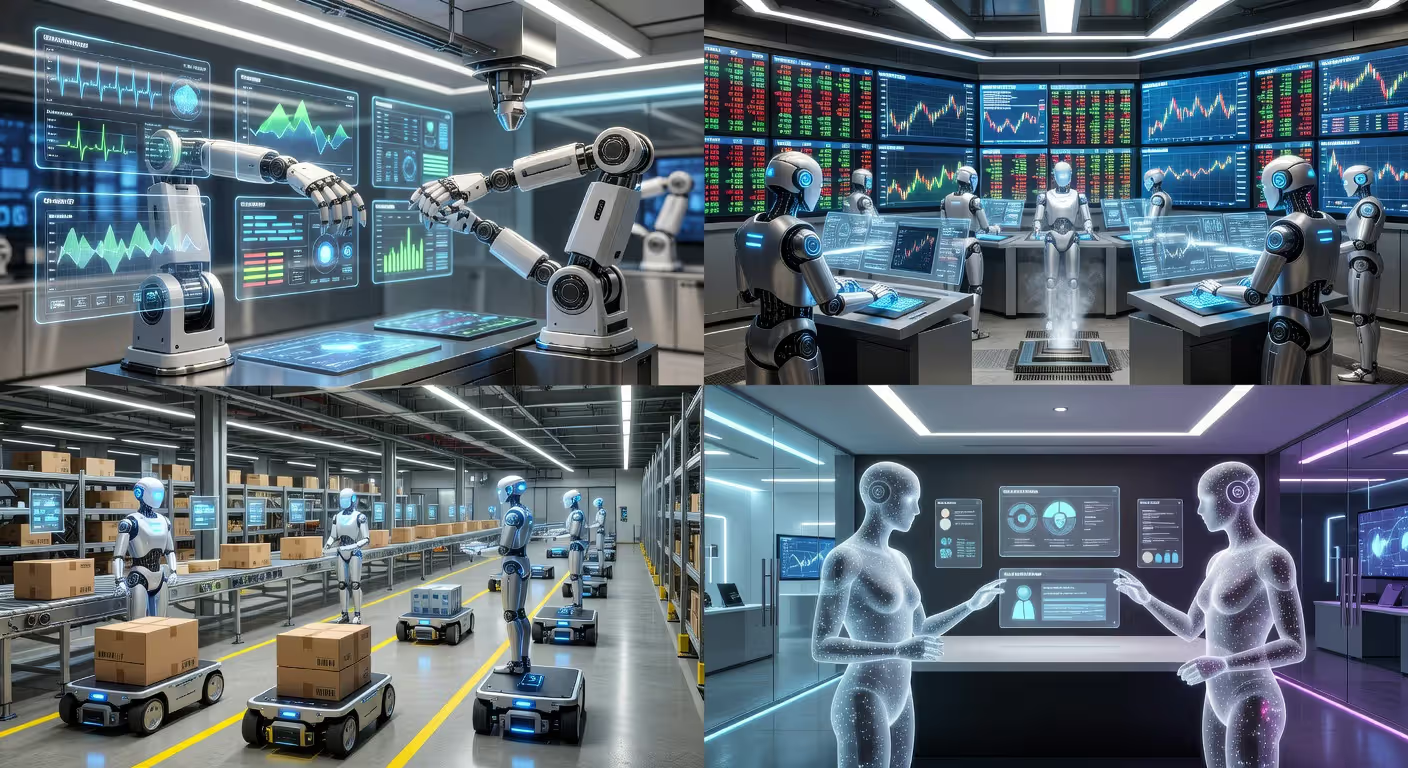
What are AI agents handling in production environments right now? Security systems that identify network intrusions and block them in milliseconds. Inventory management platforms that predict demand six months out and automatically reorder stock. Medical imaging software that flags potential tumors for radiologists to examine. The common thread: they all pursue defined objectives without someone watching over their shoulder.
The ai agent definition rests on four core characteristics:
Autonomy – The system operates independently once you've set the rules. You define acceptable boundaries, then it makes decisions within those constraints.
Reactivity – It perceives environmental changes and adjusts behavior accordingly. Customer service agents that detect frustration in support messages and immediately escalate to senior staff demonstrate this trait.
Proactivity – Rather than simply reacting, the agent takes initiative toward its goals. Financial trading agents spot market inefficiencies and execute positions based on real-time analysis.
Social ability – Many agents interact with other agents or humans using natural communication patterns. They negotiate resources, coordinate activities, and share information.
The biggest misconception I run into: assuming any automated workflow qualifies as an AI agent. It doesn't. Real agents show purposeful, adaptive behavior—not just scripted responses to predefined triggers.
Author: Selena Briarwood;
Source: aleanetwork.net
How AI Agents Work
AI agents operate on a continuous four-phase cycle: perceive, analyze, act, learn. This loop runs constantly, allowing the agent to respond to changing conditions and refine its approach through experience.
Perception kicks off each cycle. Agents gather information through sensors, API connections, database queries, or user inputs. An e-commerce recommendation agent tracks which products you browse, how much time you spend on each page, your purchase history, and current cart contents.
Analysis comes next. The agent processes all perceived information using its reasoning system or algorithms. This is where the actual "intelligence" lives. Depending on architecture, it might apply conditional logic, run machine learning models, or perform optimization calculations.
Look at delivery route planning. The agent ingests real-time traffic speeds, delivery time windows, truck capacity limits, and fuel consumption rates. Then it calculates which sequence of stops minimizes total cost and time. That's analysis converting raw data into executable strategy.
Action implements the decision. The agent sends commands, updates interfaces, or triggers other systems. Your route planning agent pushes updated directions to driver mobile devices. Trading agents submit orders to financial exchanges. Diagnostic agents mark patient files for urgent physician review.
Learning distinguishes contemporary agents from older automation systems. Advanced agents incorporate feedback mechanisms that improve future performance. When a product recommendation converts to a sale, that's positive reinforcement—the agent strengthens that decision pattern. When customers ignore suggestions, it recalibrates its model.
This learning occurs through several approaches: supervised training where humans label correct answers, reinforcement learning where the agent learns through trial and error, or unsupervised methods that discover patterns without guidance. Not every agent learns, but the most powerful ones do.
How ai agents work differs substantially based on design. Some agents treat each interaction as independent, maintaining no memory of past events. Others build detailed histories, accumulating context across thousands of interactions. More sophisticated memory and reasoning capabilities enable tackling increasingly complex challenges.
A common mistake: assuming all AI agents need neural networks or deep learning. Plenty of highly effective agents run on simpler foundations—decision trees, probabilistic models, or well-designed rule systems. Choose technology that fits your specific problem, not whatever's trending on tech blogs.
Types of AI Agents
Researchers classify agents into five main categories based on their internal architecture and decision-making approach. Each category represents increasing sophistication.
Simple Reflex Agents
These are the most straightforward intelligent agents. They operate on condition-action rules: if X happens, do Y. They don't maintain memory of previous events or consider future consequences.
A robotic vacuum using simple reflex logic might follow rules like: "Dirt sensor triggered? Start cleaning mode. Obstacle detected? Turn 90 degrees. Battery drops below 15%? Return to charging station."
These agents excel in fully observable environments where current sensor data provides all relevant information. They're extremely fast and completely predictable. They fail in complicated or partially observable situations because they can't incorporate context or history.
Model-Based Agents
These agents construct and maintain an internal representation of their world. They track how conditions change and how their actions affect outcomes.
Consider self-driving cars. They don't merely react to immediate camera input. They build a mental model of surrounding vehicles, their speeds, likely trajectories, road conditions, and traffic laws. This model updates continuously as new sensor data arrives.
This internal representation enables handling partial observability. When another vehicle disappears behind a truck, the model-based agent still knows it exists and factors that into navigation choices.
Models range from simple (a few variables tracking current state) to sophisticated (detailed physics simulations and behavior predictions). Richer models enable better handling of uncertainty and superior planning.
Goal-Based and Utility-Based Agents
Goal-based agents pursue specific objectives. They don't just react or maintain models—they plan sequences of actions to reach desired outcomes.
A package delivery agent might have the objective "complete all deliveries before 6 PM." It searches through possible action sequences (different route combinations) to find one that achieves the goal. This requires looking ahead and reasoning about consequences.
Utility-based agents go further. Instead of just achieving a goal, they maximize a utility function—a measure of how desirable different outcomes are.
Why does this matter? Real-world scenarios rarely have simple binary goals. Trade-offs exist everywhere. A delivery agent balances speed against fuel costs, vehicle wear, and customer satisfaction ratings. The utility function captures these competing priorities, and the agent selects actions maximizing total value.
Author: Selena Briarwood;
Source: aleanetwork.net
Learning Agents
Learning agents improve their performance through experience. They're not locked into their initial programming—they evolve.
A learning agent contains four conceptual components: a learning element (drives improvement), a performance element (selects actions), a critic (evaluates outcomes), and an exploration element (suggests experimental actions to discover better strategies).
Take email spam filters. They start with baseline rules or a pre-trained model. As you mark messages as spam or legitimate, the learning element updates the model. The performance element applies the current model to classify incoming mail. The critic uses your feedback to measure accuracy. The exploration element occasionally lets borderline emails through to test and refine classification boundaries.
Learning agents shine because they handle environments that shift or that weren't fully understood during initial design. They're essential for applications where optimal behavior can't be predetermined.
Which of the types of ai agents you need depends entirely on your situation. Simple reflex agents work great for straightforward, fast-response scenarios. Learning agents become necessary when environments are dynamic and complex. Most production systems use hybrid architectures, combining elements from multiple categories.
Author: Selena Briarwood;
Source: aleanetwork.net
AI Agent vs Chatbot: Key Differences
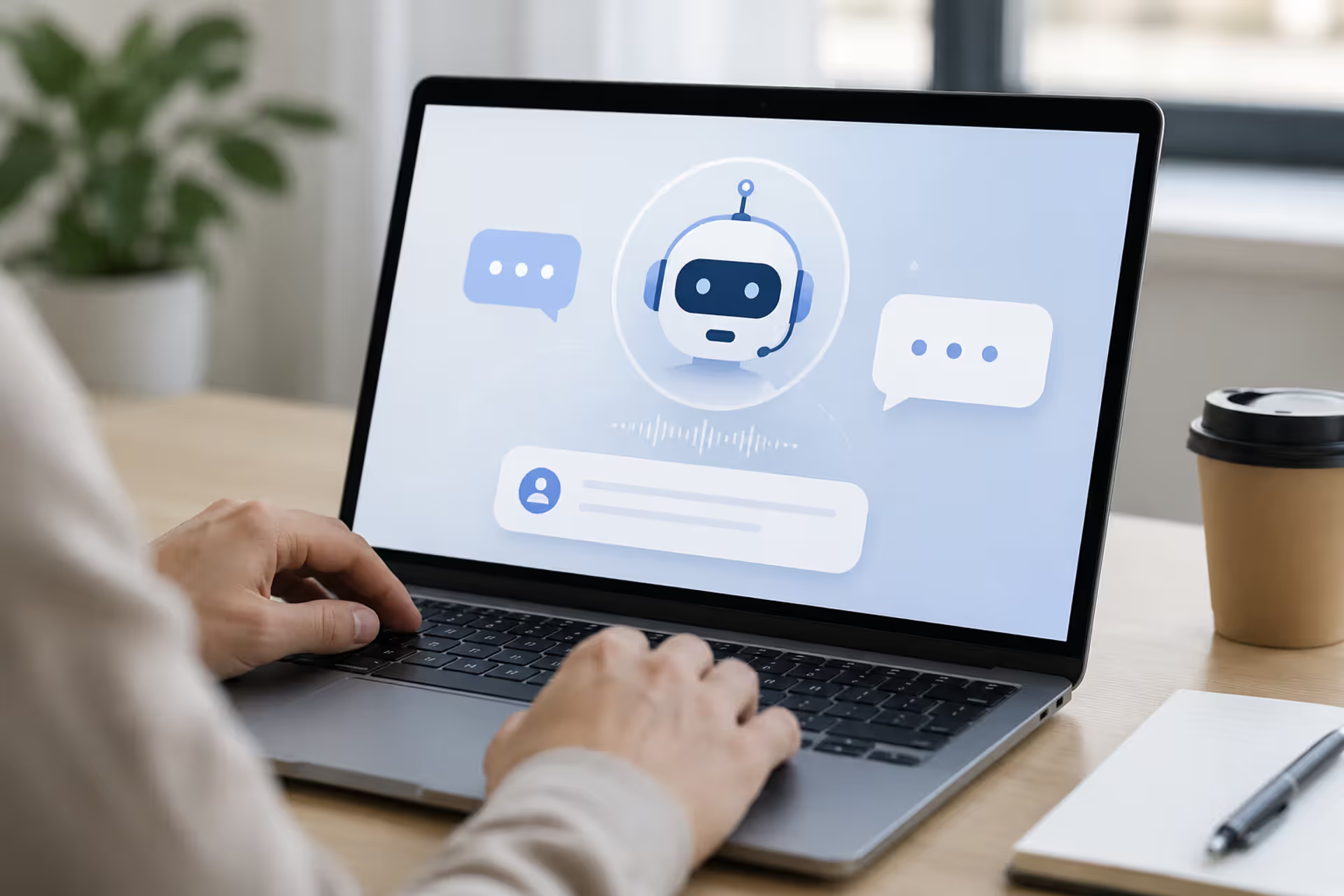
People constantly confuse "AI agent" with "chatbot." That's a problem. While an AI agent might power a chatbot, most chatbots aren't AI agents.
A chatbot is an interface—a conversational method for interacting with software. What runs behind that interface varies dramatically. Some chatbots are just decision trees: you pick option A, it shows response B. Zero intelligence, zero autonomy.
An AI agent is defined by autonomous, goal-directed operation. It perceives, decides, acts, and often learns. The interface it uses is irrelevant.
Here's the practical difference: a customer service chatbot might answer FAQs by matching your question against a database of prepared responses. Helpful? Sure. But that's not an agent. That's a search engine with conversational formatting.
An AI agent handling customer service observes the customer's issue, retrieves order history, checks inventory availability, evaluates return policy conditions, and determines the best resolution—then executes it by processing a refund or scheduling a replacement shipment. That's genuine autonomy.
Autonomy creates the clearest dividing line. Chatbots typically respond to user inputs. They're reactive. AI agents initiate actions without prompting. A monitoring agent detects an anomaly and sends an alert. A scheduling agent notices a calendar conflict and proposes alternatives. Nobody asked—it identified an issue and addressed it.
Operational scope differs substantially. Chatbots usually work within one channel (a messaging interface). AI agents often operate across multiple systems, pulling data from databases, triggering workflows, coordinating with other agents.
Decision complexity separates them further. A chatbot might route you to the right department. An agent evaluates trade-offs, optimizes outcomes, and adjusts strategies based on performance data.
Use cases reflect these differences. Chatbots handle information retrieval, basic transactions, and guided processes effectively. AI agents manage dynamic resource allocation, predictive maintenance, real-time optimization, and autonomous operation in complex environments.
Can a chatbot be powered by an AI agent? Absolutely. The most sophisticated conversational systems combine both: agent architecture for reasoning and decision-making, delivered through a chat interface for user convenience.
The ai agent vs chatbot distinction matters when evaluating solutions. Need something to answer questions and process simple requests? A well-designed chatbot might suffice. Need a system that monitors conditions, makes decisions, and acts independently? You need an AI agent.
Here's how these technologies compare across key dimensions:
Capability
AI Agents
Chatbots
Virtual Assistants
Autonomy Level
Runs independently toward defined goals
Primarily reacts to user questions
Takes initiative on specific tasks, usually seeks approval
Decision-Making
Evaluates complex trade-offs and multi-variable optimization
Uses pattern matching or basic conditional logic
Handles moderate complexity, typically with user confirmation for significant actions
Learning Ability
Often adapts and improves through experience
Generally static (unless built on agent architecture)
FAQ handling, lead qualification, appointment scheduling
Calendar management, reminders, smart home control, information retrieval
User Interaction
May operate entirely without human interaction
Conversational, user-initiated
Conversational, mixing user requests and proactive suggestions
An intelligent agent perceives its environment through sensors and acts on that environment through actuators to maximize expected utility based on a performance measure.
— Russell Stuart
Real-World Applications of Autonomous AI Agents
Autonomous AI agents aren't theoretical. They're running in production right now, handling tasks that would overwhelm or bore human workers.
Customer service has widely adopted agents. They resolve first-tier support issues without human involvement, accessing customer accounts, processing returns, modifying subscriptions, and escalating complex cases to human specialists. Some companies report average resolution times dropping from several hours to under ten minutes.
Better implementations don't just react to problems—they anticipate them. An agent notices you've contacted support three times about the same defective product and proactively offers a replacement or full refund before you ask again.
Healthcare deploys diagnostic agents that examine medical imaging, lab results, and patient histories to identify potential issues. A radiology agent might process thousands of scans daily, flagging anomalies that deserve closer physician attention. It doesn't replace the doctor—it helps them focus effort where it matters most.
Predictive agents monitor ICU patient vital signs, detecting subtle pattern shifts that precede serious medical events. Earlier warnings enable earlier interventions, which often lead to better patient outcomes.
Finance relies heavily on autonomous trading agents. These systems monitor markets, news feeds, and economic indicators, executing trades when conditions match their strategies. High-frequency trading operations use agents making decisions in microseconds—speeds no human could achieve.
Fraud detection agents examine transaction patterns in real-time, blocking suspicious activity before it completes. They adapt to emerging fraud techniques, continuously updating their detection models.
Manufacturing uses agents for predictive maintenance. Equipment sensors stream data to agents monitoring for wear indicators or impending failures. The agent schedules maintenance before breakdowns occur, reducing downtime and repair costs.
Production optimization agents adjust manufacturing processes in real-time based on raw material quality, equipment condition, and demand forecasts. They balance production speed, product quality, and resource efficiency automatically.
Logistics and supply chain management might be where autonomous AI agents deliver the clearest immediate ROI. Route optimization agents recalculate delivery schedules as traffic patterns, weather conditions, and new orders change throughout the day. Inventory agents forecast demand and trigger purchase orders, balancing stock availability against warehousing costs and supplier lead times.
Warehouse agents orchestrate robotics, determining which products to retrieve, which paths to follow, and how to pack orders for shipping efficiency.
One surprising finding: simpler agents often outperform complex ones in actual deployment. A well-calibrated rule-based agent with solid domain expertise can beat a sophisticated learning agent that lacks proper training or validation. Start simple, add complexity only when results justify it.
Author: Selena Briarwood;
Source: aleanetwork.net
The autonomous ai agents explained here represent a small sample of current deployments. As technology advances, we'll see agents managing increasingly intricate, multi-stage processes with minimal human involvement.
Frequently Asked Questions About AI Agents
What tasks do AI agents typically handle?
AI agents excel at jobs requiring autonomous decisions and actions in response to changing conditions. Common uses include customer service automation, fraud detection, supply chain optimization, predictive maintenance, personalized recommendations, autonomous trading, and real-time resource allocation. They perform best when speed, consistency, and processing massive data volumes matter more than human creativity or emotional intelligence.
Do AI agents need constant human oversight?
It depends on design and application. Some agents run completely independently within established boundaries—algorithmic trading systems or network security monitors, for example. Others require human oversight for high-stakes decisions, operating in "human-in-the-loop" mode where they recommend actions but await approval. The trend moves toward greater autonomy, but most organizations maintain human involvement for critical decisions, especially where mistakes carry serious consequences.
Is every chatbot an AI agent?
No. Many chatbots are basic scripted systems following decision trees or matching keywords to prewritten responses. These lack the autonomy and goal-directed behavior defining AI agents. However, advanced chatbots powered by AI agent architectures do exist. The distinction lies in the underlying system: does it simply respond to inputs, or does it observe, reason, and act autonomously pursuing objectives? The interface doesn't determine agent status—the architecture does.
How do narrow AI agents differ from general AI agents?
Narrow AI agents are designed for specific tasks within limited domains. A chess-playing agent, spam filter, or route-planning system each excels at one thing but can't transfer abilities elsewhere. General AI agents—sometimes called artificial general intelligence or AGI—would match human-level flexibility, learning new tasks and applying knowledge across domains. Currently, all deployed AI agents are narrow. General AI remains a research goal, not a commercial product. The agents transforming industries today are highly specialized, and that specialization actually strengthens most business applications.
Must AI agents use machine learning?
Not at all. While many contemporary AI agents incorporate machine learning for pattern recognition and adaptation, numerous effective agents run on rule-based systems, optimization algorithms, or classical planning techniques. A thermostat is a basic agent with zero machine learning. Expert systems built on carefully crafted rules can outperform learning-based agents in well-understood domains. Machine learning becomes critical when environments are too complex to model explicitly or when optimal strategy isn't known beforehand. Choose technology that fits your problem, not what sounds most cutting-edge.
What does implementing AI agents in a business actually involve?
Implementation usually starts with identifying a specific, high-value use case—don't try deploying agents everywhere at once. Define clear objectives and success metrics. Then select or build an agent architecture matching the task's complexity. Many businesses start with commercial platforms providing agent frameworks, then customize for specific needs. Integration with existing systems (databases, APIs, communication tools) often presents the toughest technical challenge. Launch with a pilot project, measure results rigorously, and scale what proves effective. The most successful implementations combine technical deployment with change management—training staff to work alongside agents and adjusting processes to leverage new capabilities.
AI agents represent a genuine shift in software capability. They don't just follow commands—they observe, analyze, execute, and learn. This autonomy enables capabilities traditional automation can't touch, from real-time optimization to adaptive problem-solving in complex environments. As these systems mature and become more accessible, businesses that understand effective deployment will gain substantial operational advantages. The technology exists now. The question is how quickly you'll put it to work.
AI visibility tools monitor how often your brand appears in AI-generated responses across ChatGPT, Perplexity, and Gemini. Unlike traditional SEO tools that track Google rankings, these platforms measure citations, mentions, and context in AI answers—helping you optimize for generative engine visibility.
An AI SDR automates prospecting, outreach, and lead qualification using machine learning and natural language processing. Discover how these systems work, when to use AI versus human SDRs, common implementation mistakes, and what tools are available.
Discover how conversational AI assistants use NLP and machine learning to understand context and hold natural dialogues. This guide covers technology fundamentals, use cases, implementation strategies, and how to avoid common challenges when deploying AI assistants for business.
AI voice agents combine speech recognition, natural language processing, and voice synthesis to conduct natural phone conversations. Learn how the technology works, what capabilities modern systems offer, and which industries benefit most from automated voice interactions.
The content on this website is provided for general informational and educational purposes only. It is intended to explain concepts related to AI tools, agents, developer infrastructure, coding assistants, APIs, and productivity workflows.
All information on this website, including articles, guides, and examples, is presented for general educational purposes. Outcomes and tool performance may vary depending on implementation, skill level, and use case.
This website does not provide professional AI consulting, development services, or guarantees of results, and the information presented should not be used as a substitute for consultation with qualified AI or software development professionals.
The website and its authors are not responsible for any errors or omissions, or for any outcomes resulting from decisions made based on the information provided on this website.