Businesses are drowning in phone calls. Customer service teams can't scale fast enough. Wait times stretch longer. Costs climb higher. That's where AI voice agents step in — automated systems that can answer calls, hold natural conversations, and solve problems without a single human agent picking up the phone.
These aren't the robotic phone trees you've grown to hate. Modern AI voice agents understand context, detect emotion, and respond in real time with human-like speech. They're transforming how companies handle everything from appointment scheduling to technical support. And they're getting better every month.
What Are AI Voice Agents
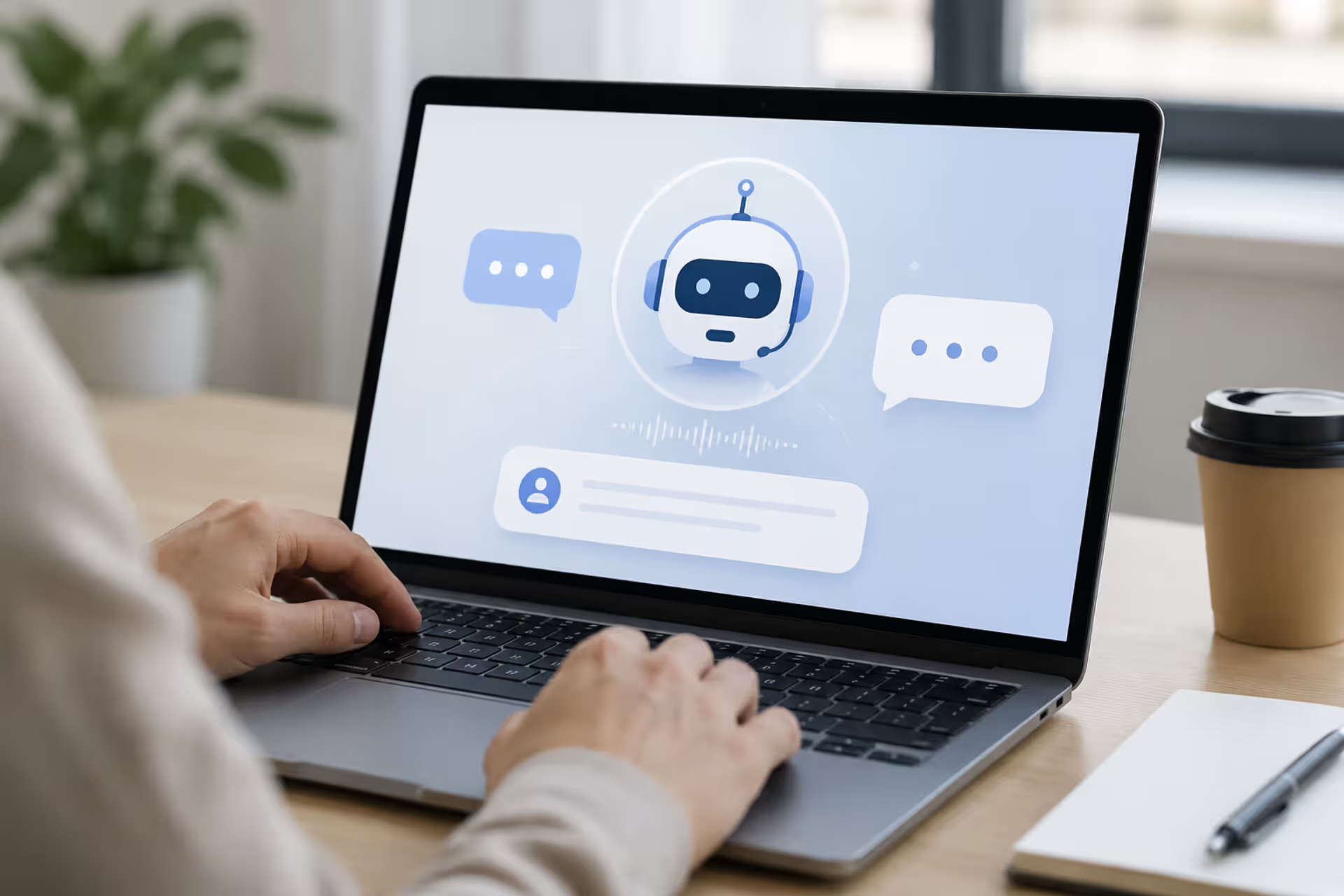
AI voice agents are software systems that use artificial intelligence to conduct spoken conversations with people over the phone or through voice interfaces. They combine speech recognition, natural language processing, and voice synthesis to understand what callers say, determine appropriate responses, and speak back in a natural-sounding voice.
Here's what makes them different from older technology. Traditional IVR (Interactive Voice Response) systems follow rigid decision trees — press 1 for sales, press 2 for support. They can't understand natural speech or handle unexpected questions. Chatbots, on the other hand, work great with text but can't process spoken language or respond with voice.
Voice enabled ai agents bridge both gaps. They hear your words, understand your intent, and respond conversationally — all in real time.
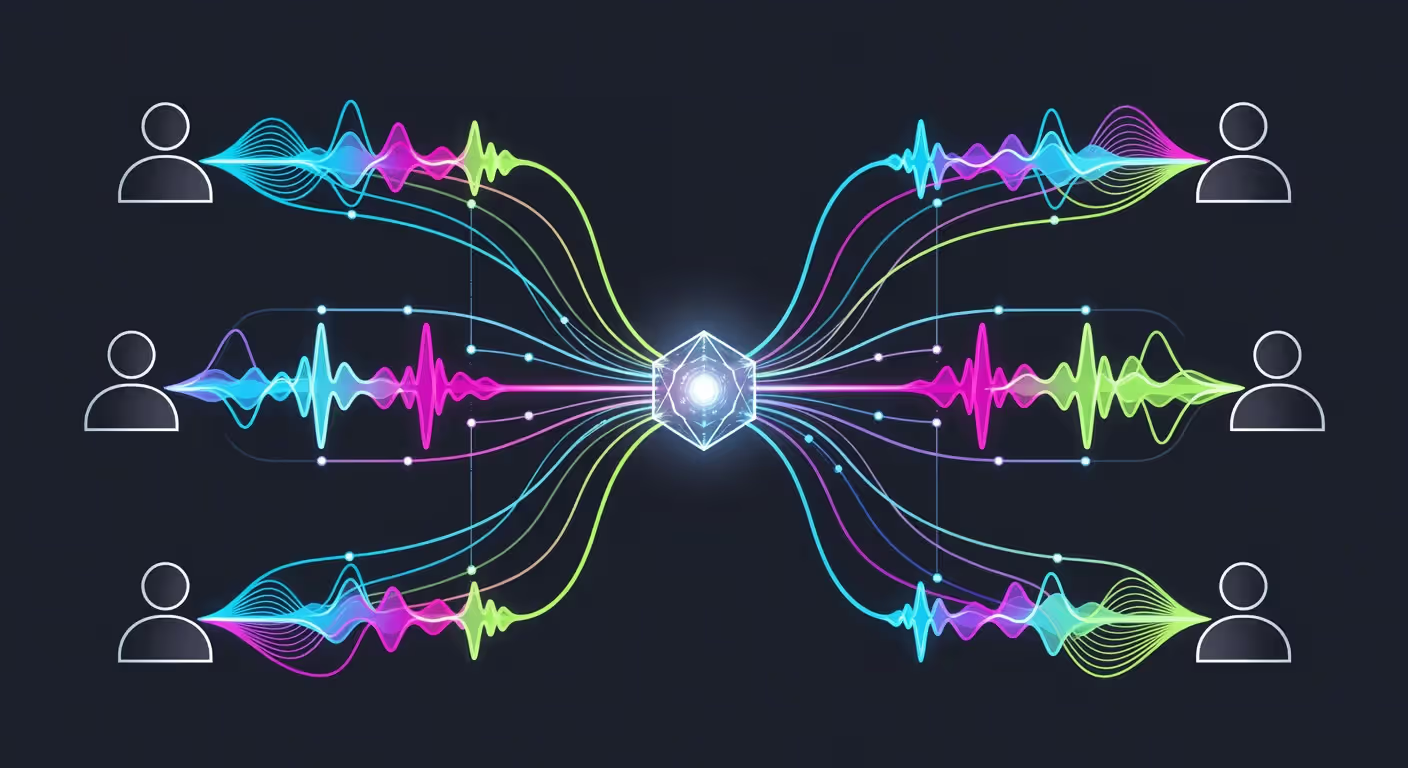
The core technology stack includes four main components. Speech-to-text engines convert audio into written words. Natural language understanding models parse meaning and intent. Dialog management systems decide how to respond. Text-to-speech synthesizers generate the spoken reply. These components work together in milliseconds to create seamless conversations.
Voice AI has moved from a novelty to a necessity. Companies that implement conversational agents see customer satisfaction scores rise while operational costs drop by 40 to 60 percent. The technology has finally crossed the threshold where it feels helpful rather than frustrating.
— Rahnama Ali
The pattern I see most often is businesses trying voice AI for one narrow use case — appointment reminders, maybe — then expanding rapidly once they realize how versatile these systems are.
How AI Voice Agent Technology Works
The magic happens in four distinct stages, each building on the last. Understanding this pipeline helps you see why modern systems perform so much better than older alternatives.
Speech Recognition and Processing
When someone speaks to an ai phone agent, the system first captures the audio stream and converts it into text. Modern speech recognition engines use deep learning models trained on millions of hours of recorded conversations. They don't just match sound patterns — they predict words based on context.
These engines handle background noise, overlapping speech, and audio quality issues that would've stumped systems from just a few years ago. They work in real time, transcribing words as you speak with latency under 300 milliseconds. That's faster than most humans process speech.
The recognition layer also tags acoustic features: speaking rate, volume changes, pauses. These signals matter for understanding emotion and intent.
Author: Adrian Westmere;
Source: aleanetwork.net
Natural Language Understanding
Raw text isn't enough. The system needs to extract meaning. Natural language understanding models analyze the transcribed text to identify intent (what the caller wants) and entities (specific details like dates, account numbers, or product names).
If someone says "I need to move my appointment from Thursday to next Monday," the NLU component identifies the intent (reschedule appointment) and extracts two date entities. It handles variations — "shift my meeting," "change my booking," "can we do Monday instead" — all map to the same intent.
Context matters here. Speech ai agent capabilities now include maintaining conversation history, so "What about Tuesday?" makes sense even without repeating "appointment" or "reschedule." The system remembers what you're discussing.
Voice Response Generation
Once the system knows what to say, it generates speech. Modern text-to-speech engines use neural networks to produce remarkably human-like voices. They add natural prosody — the rhythm, stress, and intonation that make speech sound conversational rather than robotic.
Some systems use pre-recorded phrases for common responses, blended with synthesized speech for dynamic content. Others generate everything on the fly. The best implementations adjust speaking style based on context — slower and clearer when providing complex information, more casual for simple confirmations.
Latency matters enormously here. Humans expect responses within about one second. Anything longer feels awkward. Modern systems typically achieve end-to-end response times (hearing the question, processing it, and starting to speak) under two seconds.
Key Capabilities of Modern Voice AI Agents
Today's conversational voice agent systems pack capabilities that would've seemed impossible a few years back. These features separate useful tools from frustrating experiments.
Real-time conversation handling tops the list. The system doesn't just respond to isolated questions — it maintains multi-turn conversations with context. Ask a follow-up question, interrupt mid-sentence, or change topics, and it adapts. This feels fundamentally different from menu-driven systems.
Context retention means the agent remembers what you've said throughout the conversation. You don't repeat your account number five times or re-explain your problem to different parts of the system. It carries information forward naturally.
Multi-language support has become standard. Quality systems handle dozens of languages and can detect which language the caller is speaking. Some even handle code-switching — when bilingual speakers mix languages mid-conversation.
Sentiment detection analyzes tone and word choice to gauge caller emotion. If someone sounds frustrated or angry, the system can adjust its approach, offer to escalate to a human, or provide extra empathy in its responses. This capability alone dramatically improves customer experience.
CRM and business system integration connects the voice agent to your existing tools. It can pull up customer records, check inventory, schedule appointments in your calendar system, or create support tickets. The agent becomes an extension of your business operations, not a separate silo.
Author: Adrian Westmere;
Source: aleanetwork.net
Interruption handling might seem minor but matters hugely for natural conversation. Humans interrupt each other constantly — to correct misunderstandings, add forgotten details, or change direction. Good voice agents detect interruptions, stop speaking, and process the new input without getting confused.
One common mistake: assuming these capabilities work equally well across all implementations. Quality varies dramatically. Some vendors excel at specific languages or industries while struggling with others. Testing with your actual use cases matters more than feature checklists.
Common AI Voice Agent Use Cases by Industry
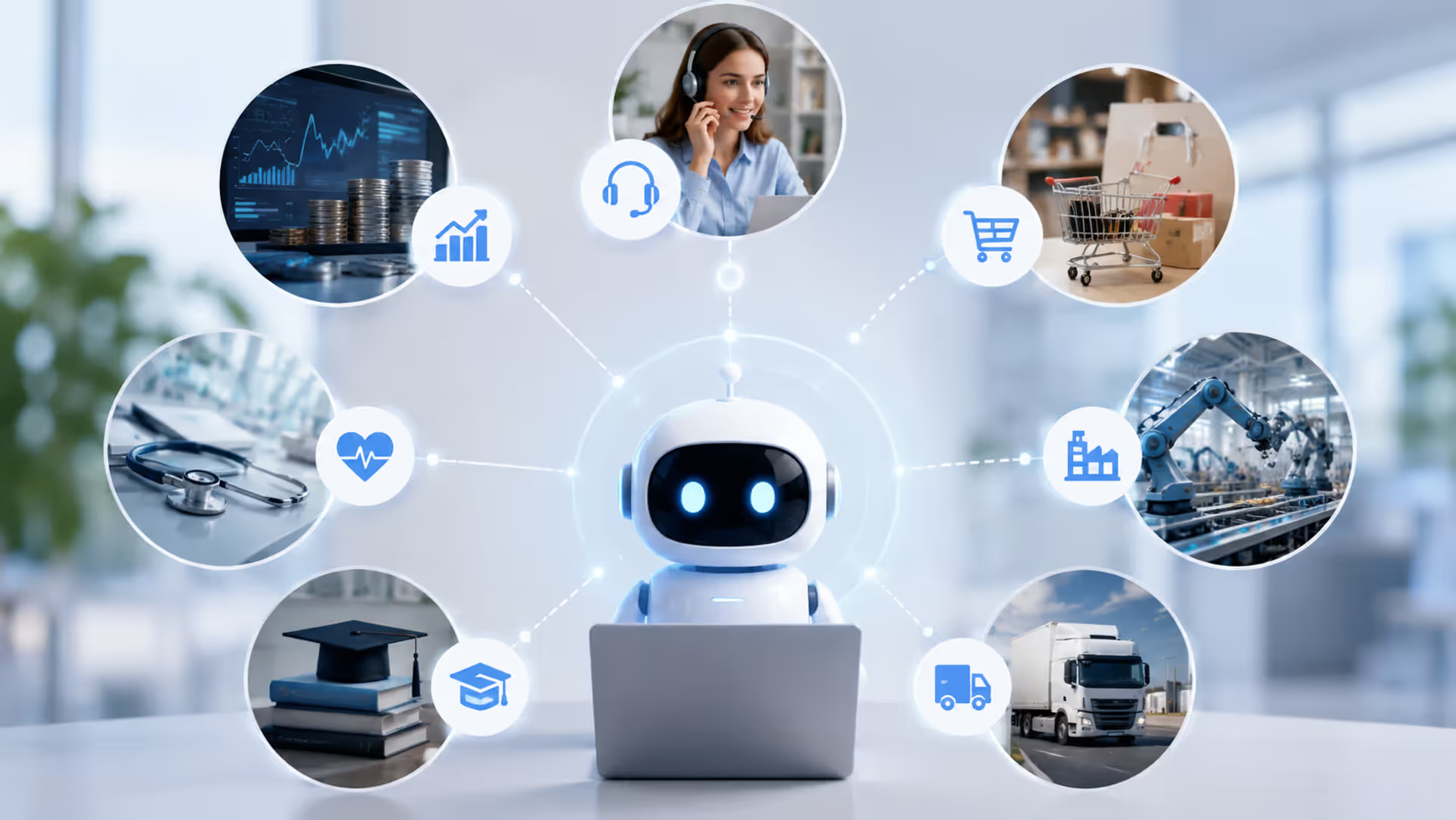
AI voice agent use cases span nearly every industry, but certain applications have proven especially valuable. Here's where businesses see the fastest returns.
Customer service automation leads adoption. Voice agents handle common questions about account status, order tracking, password resets, and policy information. They work 24/7 without breaks, handling hundreds of calls simultaneously. Retail companies use them for return policies and store hours. Banks deploy them for balance inquiries and transaction history.
A major telecommunications provider implemented voice agents for billing questions and saw 70% of those calls resolved without human intervention. Average handle time dropped from 8 minutes to 3 minutes.
Appointment scheduling works beautifully with voice AI. Medical practices, salons, auto repair shops, and professional services use agents to book, confirm, and reschedule appointments. The agent checks availability in real time, handles rescheduling requests, and sends confirmation messages.
Dental offices particularly love this application. Appointment no-shows cost them significant revenue. Voice agents that call to confirm appointments and reschedule when needed have reduced no-show rates by 30-40% for many practices.
Lead qualification helps sales teams focus on promising prospects. The voice agent calls or receives calls from potential customers, asks qualifying questions, and routes hot leads to human salespeople. Real estate agencies, insurance brokers, and B2B companies use this extensively.
The system can handle objections, answer basic questions, and schedule follow-up calls. It never gets discouraged by rejection and maintains consistent quality across thousands of interactions.
Order processing for restaurants, retail, and distribution works smoothly with voice agents. Customers call to place orders, the agent takes details, confirms selections, processes payment information, and provides delivery estimates. Pizza chains and Chinese restaurants were early adopters, but the use case has expanded to wholesale distributors and B2B ordering.
Technical support for first-level troubleshooting guides customers through common fixes. Internet service providers use voice agents to diagnose connection problems, walk customers through router resets, and check for service outages. Software companies deploy them for password resets and basic how-to questions.
The simpler option usually wins here. Voice agents handle tier-1 issues brilliantly. Complex technical problems still need human expertise.
Healthcare applications include medication reminders, post-discharge follow-ups, and symptom checking. Hospitals use voice agents to call patients after procedures, verify they're taking medications correctly, and identify complications early. This improves outcomes while reducing readmission rates.
Insurance verification, prescription refills, and test result notifications also work well. The agents navigate HIPAA compliance requirements and integrate with electronic health record systems.
Author: Adrian Westmere;
Source: aleanetwork.net
AI Phone Agents vs. Traditional Call Systems
The differences between ai phone agent technology and traditional approaches go beyond simple automation. Let's compare the options businesses typically consider.
Feature
Traditional IVR
Human Call Center
AI Voice Agent
24/7 Availability
Yes
No (or expensive)
Yes
Average Handle Time
5-8 minutes
6-10 minutes
2-4 minutes
Scalability
Limited by lines
Limited by staff
Unlimited
Cost per Call
$0.50-$2.00
$5.00-$15.00
$0.25-$1.50
Personalization Level
None
High
Medium-High
Setup Time
2-4 weeks
4-8 weeks
1-3 weeks
Traditional IVR systems excel at one thing: routing calls cheaply. But they frustrate customers with rigid menus and inability to handle natural language. They can't solve problems, only direct people to the right department. You've probably mashed the zero key trying to reach a human.
Human call centers provide the best personalization and can handle complex, emotional situations that AI still struggles with. But they're expensive, difficult to scale, and quality varies based on agent training and experience. You can't instantly add 50 agents when call volume spikes.
AI call agent systems split the difference. They handle natural conversations like humans, scale instantly like IVR, and cost far less than staffed call centers. They work around the clock without overtime pay or burnout.
The trade-off? They can't match human empathy for truly difficult situations. They struggle with heavy accents or very noisy environments more than humans do. And they need clear escalation paths to human agents for complex cases.
Most businesses land on a hybrid model. Voice agents handle routine interactions — maybe 60-80% of calls. Humans take escalations, complex problems, and high-value customers. This combination delivers better customer experience at lower cost than either approach alone.
Implementation complexity favors voice agents too. Traditional call centers require hiring, training, managing schedules, and maintaining infrastructure. IVR systems need complex call flow programming. Voice agents typically deploy faster with less specialized expertise required.
Choosing the Right Conversational Voice Agent Solution
The voice ai agent market has exploded with options. Picking the right solution requires evaluating several key dimensions.
Deployment options come in three flavors. Cloud-based solutions host everything on the vendor's infrastructure — you integrate via API and pay per usage. On-premise deployments run on your servers, giving you control but requiring more IT resources. Hybrid approaches split components between cloud and local systems.
For most businesses, cloud wins. It's faster to deploy, easier to scale, and vendors handle updates and maintenance. On-premise makes sense mainly if you have strict data residency requirements or need to integrate with isolated internal systems.
Integration requirements matter enormously. The voice agent needs to connect with your CRM, scheduling system, payment processor, knowledge base, and other tools. Check whether the vendor offers pre-built integrations for your specific platforms or if you'll need custom development.
API quality varies dramatically. Some vendors provide clean, well-documented APIs with robust error handling. Others offer minimal integration support. This impacts both initial setup time and ongoing maintenance burden.
Customization needs depend on your use case. Can you customize the voice personality? Adjust conversation flows without vendor help? Train the system on your specific terminology and products? Add new intents and responses as your business evolves?
Some platforms offer no-code interfaces for customization. Others require programming skills. Match the platform's flexibility to your team's capabilities and how often you'll need to make changes.
Pricing models range widely. Common structures include:
Per-minute usage (typically $0.02-$0.10 per minute)
Per-call pricing ($0.25-$2.00 per call regardless of length)
Monthly subscription with included volume
Setup fees plus ongoing per-use charges
Watch for hidden costs. Transcription fees, integration charges, premium voice options, and support costs can add up. Calculate total cost based on your expected call volume, not just the advertised base rate.
Vendor evaluation criteria should include:
Technical performance: Test accuracy with your actual accent mix and industry terminology. Measure latency and voice quality. Check how well it handles interruptions and background noise.
Reliability and uptime: Look for 99.9%+ uptime guarantees with financial penalties for outages. Voice systems can't have downtime during business hours.
Compliance and security: Verify SOC 2, HIPAA, PCI-DSS, or other certifications relevant to your industry. Understand data retention policies and where recordings are stored.
Support and training: What onboarding do they provide? Can you reach technical support quickly when issues arise? Do they offer ongoing optimization help?
Scalability: Can the system handle sudden volume spikes? What's the maximum concurrent calls? How quickly can you add capacity?
One counterintuitive point: the vendor with the most features often isn't the best choice. You want the system that does your specific use case excellently, not one that does everything mediocrely.
Author: Adrian Westmere;
Source: aleanetwork.net
FAQ: AI Voice Agent Questions Answered
How accurate are AI voice agents at understanding accents?
Modern voice agents typically achieve 90-95% accuracy with standard American, British, and Australian accents. Accuracy drops to 80-90% for strong regional accents or non-native speakers, though this improves as systems train on more diverse voice data. The best implementations include accent adaptation that improves recognition as the conversation progresses. If your customer base includes significant accent diversity, test specifically with those accent types before committing to a solution.
Can AI voice agents handle multiple calls simultaneously?
Yes, this is one of their biggest advantages over human agents. A single voice AI system can handle hundreds or even thousands of concurrent calls without any degradation in performance. There's no waiting in queue and no busy signals. Scalability is essentially unlimited — you just pay for the additional usage. This makes them perfect for handling seasonal spikes, product launches, or unexpected call volume surges that would overwhelm traditional call centers.
What industries benefit most from AI phone agents?
Healthcare, financial services, retail, hospitality, and telecommunications see the strongest returns. These industries handle high call volumes with many routine, repeatable interactions — appointment scheduling, account inquiries, order status, reservations, and billing questions. Any business that receives frequent calls asking similar questions will benefit. Smaller professional services like dental offices, law firms, and repair shops also gain significant value from 24/7 availability and automated scheduling.
How much does it cost to implement an AI voice agent?
Total cost depends on complexity and volume. Simple implementations start around $2,000-$5,000 for setup plus $0.02-$0.10 per minute of usage. A business handling 10,000 minutes monthly might pay $200-$1,000 per month in usage fees. More complex deployments with extensive integrations and customization can cost $20,000-$50,000 upfront plus higher per-use fees. Most businesses achieve positive ROI within 3-6 months by reducing staffing costs and improving efficiency. Cloud-based solutions typically offer the lowest entry costs with pay-as-you-grow pricing.
Do AI voice agents require human backup support?
Yes, in most implementations. Even the best voice agents need escalation paths to human agents for complex situations, angry customers, or requests outside their trained capabilities. The typical split is 60-80% of calls handled fully by AI, with the remainder escalated to humans. This hybrid approach delivers better customer experience than either solution alone. The voice agent handles routine work, freeing human agents to focus on situations requiring empathy, creativity, or complex problem-solving. You'll need fewer human agents than before, but eliminating them entirely usually hurts customer satisfaction.
How long does it take to deploy a conversational voice agent?
Basic implementations can go live in 1-2 weeks. This includes simple use cases like appointment scheduling or FAQ answering with minimal integrations. More complex deployments requiring CRM integration, custom conversation flows, and extensive training data typically take 4-8 weeks. Enterprise implementations with multiple integrations, compliance requirements, and custom development can extend to 3-4 months. The deployment timeline depends heavily on your internal processes — how quickly you can provide training data, approve conversation scripts, and complete integration testing. Vendors with pre-built templates for your industry can dramatically accelerate deployment.
Voice AI has shifted from experimental technology to practical business tool. The systems work reliably now, costs have dropped to accessible levels, and integration has become straightforward. If you're handling repetitive phone interactions manually, you're probably spending more than necessary while delivering slower service than customers expect. The question isn't whether voice agents make sense anymore — it's which implementation fits your specific needs best.
AI visibility tools monitor how often your brand appears in AI-generated responses across ChatGPT, Perplexity, and Gemini. Unlike traditional SEO tools that track Google rankings, these platforms measure citations, mentions, and context in AI answers—helping you optimize for generative engine visibility.
An AI SDR automates prospecting, outreach, and lead qualification using machine learning and natural language processing. Discover how these systems work, when to use AI versus human SDRs, common implementation mistakes, and what tools are available.
Discover how conversational AI assistants use NLP and machine learning to understand context and hold natural dialogues. This guide covers technology fundamentals, use cases, implementation strategies, and how to avoid common challenges when deploying AI assistants for business.
Explore real-world AI agents examples across customer service, sales, enterprise operations, and specialized applications. This guide covers actual deployments from companies like Klarna, Maersk, and McDonald's—complete with workflows, results, and lessons learned from enterprise implementations.
The content on this website is provided for general informational and educational purposes only. It is intended to explain concepts related to AI tools, agents, developer infrastructure, coding assistants, APIs, and productivity workflows.
All information on this website, including articles, guides, and examples, is presented for general educational purposes. Outcomes and tool performance may vary depending on implementation, skill level, and use case.
This website does not provide professional AI consulting, development services, or guarantees of results, and the information presented should not be used as a substitute for consultation with qualified AI or software development professionals.
The website and its authors are not responsible for any errors or omissions, or for any outcomes resulting from decisions made based on the information provided on this website.