Google isn't the only game in town anymore. I've watched countless marketers panic when they discovered their brands—ranking beautifully on page one for target keywords—never get mentioned when someone asks ChatGPT or Perplexity for product recommendations. Their traffic numbers looked fine. Their visibility? That's a different story.
Think about your own behavior lately. How often do you skip Google and just ask an AI assistant directly? You're not alone. These conversational platforms pull information from across the web, synthesize it into tidy paragraphs, and name-drop maybe three brands total. If yours isn't one of them, you might as well not exist for that query.
Traditional rank tracking tells you where you stand on search results pages. But when someone asks "What's the best email marketing platform for nonprofits?" and gets an AI-written response listing three competitors without mentioning you once, your #4 Google ranking becomes irrelevant. Zero clicks. Zero consideration.
That's where specialized monitoring systems enter the picture. They track whether AI platforms cite your brand, how often you appear in generated answers, and which competitors dominate the queries you care about. Google Search Console won't tell you any of this. You need different instrumentation for a fundamentally different channel.
I keep seeing the same pattern: companies wake up six months late, realizing they've been optimizing exclusively for one search ecosystem while a parallel universe of AI-mediated discovery left them behind.
What Is an AI Visibility Tool?
These platforms track brand mentions inside AI-generated responses rather than traditional search rankings. When someone asks Perplexity about project management software or queries ChatGPT for CRM recommendations, does your company get named? That's what an ai visibility tool reveals.
Traditional SEO software shows you ranking #3 for "marketing automation platforms." Fine. But when a potential customer asks Claude to compare solutions, does your brand surface in that comparison? Conventional rank trackers can't answer that question.
The gap matters because AI platforms don't work like search engines. Google shows ten blue links. You can rank seventh and still get clicks. Conversational AI typically synthesizes one answer or suggests two to four options maximum. There's no page two. Miss that initial output and you're completely invisible.
Here's what standard SEO platforms track:
Where you rank for specific keyword phrases
How many sites link to yours
Whether your site has technical problems
Traffic volumes from search engines
AI search visibility tools focus on different metrics:
Brand mentions within LLM responses
How often you get cited as a source
What context surrounds your mentions (positive, neutral, critical)
Competitive positioning when users ask identical questions
Some newer platforms combine both capabilities, though most established SEO tools haven't adapted yet. The technology requires different data collection methods entirely.
How AI Visibility Tools Work
Visibility tracking ai tools operate through a more complex process than checking keyword positions. Let me walk you through the mechanics.
First, the platform fires off thousands of questions to various AI systems—ChatGPT, Claude, Gemini, Perplexity, and others. These aren't random queries. They mirror actual questions your target audience asks about your industry.
Second, each AI generates its response. The tool captures everything: the complete text, any citations or source links, and which brands get mentioned.
Third, natural language processing analyzes each response. It identifies your brand name, product references, and competitor mentions. It also evaluates tone—is the AI recommending you enthusiastically, mentioning you neutrally, or citing you as a warning?
Fourth, when the AI includes sources, the system notes whether your content received attribution and how prominently. Being the first cited source carries more weight than appearing fifth in a list.
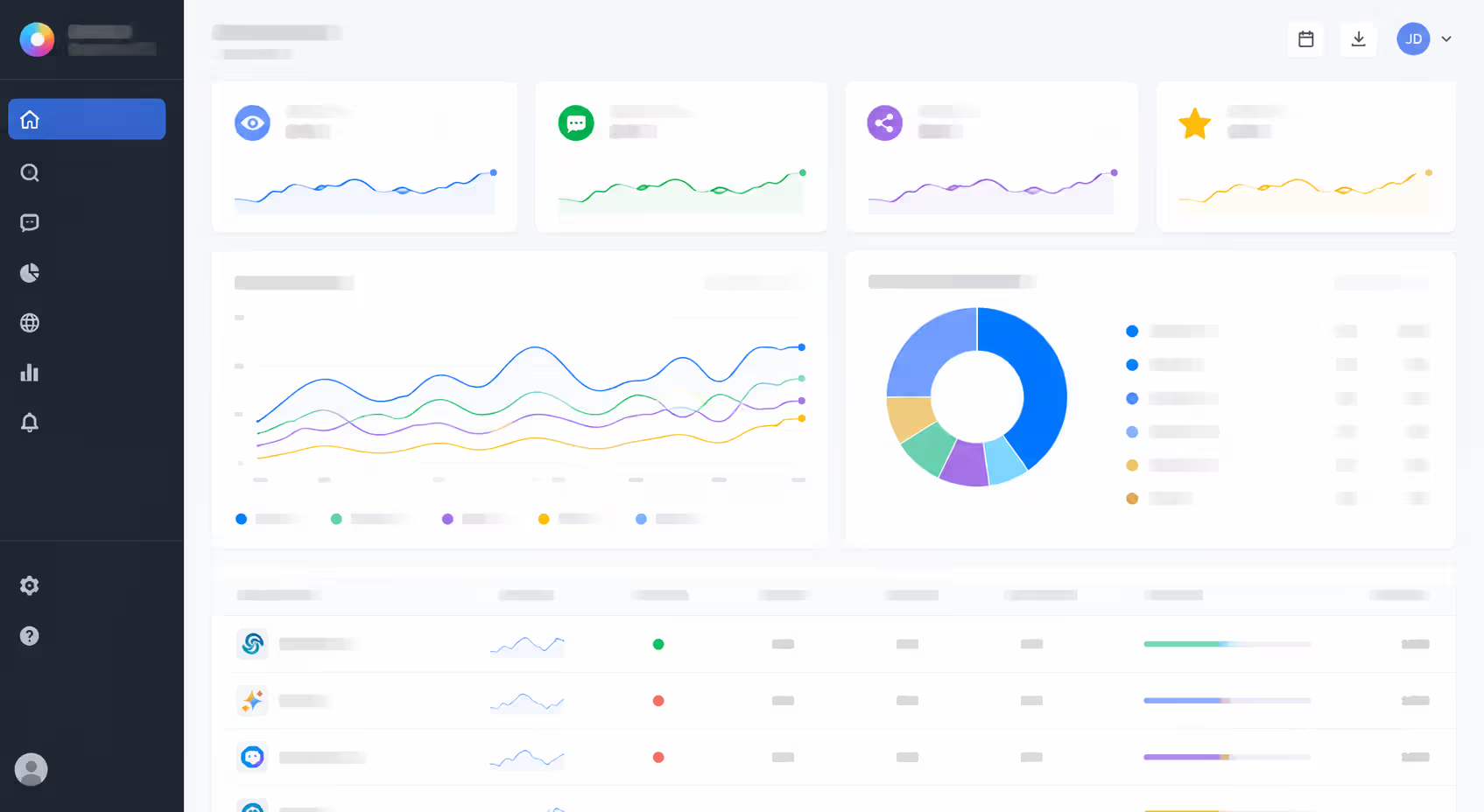
Finally, data from hundreds or thousands of queries gets aggregated into dashboards. You see your share of voice, citation frequency trends, and competitive positioning over time.
Author: Adrian Westmere;
Source: aleanetwork.net
Most platforms refresh this data daily or weekly depending on your subscription tier.
One important caveat: these tools can't perfectly replicate every user's experience. Some use API access where available. Others simulate browsing sessions. Accuracy varies, especially for conversational AI that personalizes responses based on chat history.
Understanding how ai visibility tools work helps you interpret their limitations alongside their insights.
Why AI Search Visibility Matters in 2026
Google hasn't disappeared, but user habits have shifted dramatically. Current estimates suggest roughly 40% of information-seeking queries now start with an AI assistant rather than a traditional search engine. Among people under 35, that percentage climbs even higher. In certain industries—technology, healthcare, financial services—AI-first behavior has become the default.
Agentic search changes the entire dynamic. Users aren't just asking questions anymore. They're delegating tasks. "Find three CRM options for a 25-person sales team, compare their pricing, and tell me which integrates best with HubSpot" goes way beyond a simple search query. That's task automation.
When AI agents can't find your brand or don't trust your information enough to cite it, you're excluded from consideration before the process even starts.
We're witnessing the unbundling of the search results page. In traditional SEO, being number three still got you traffic. In AI-mediated search, there's often only one recommendation. Brands that don't optimize for generative engine visibility will see their organic reach collapse, even if their Google rankings hold steady.
— Patel Avinash
This connects directly to generative engine optimization—structuring your content so large language models can easily extract, trust, and cite your information. That means clear attribution, authoritative sourcing, and formats AI can parse efficiently. Think structured data, concise explanations, and well-documented claims with credible sources.
Traditional SEO still matters. It just doesn't cover the full picture anymore. You need visibility in both ecosystems now.
Key Features of AI Visibility Tracking Tools
Capabilities vary wildly across different platforms. Some offer basic mention counting. Others provide strategic competitive intelligence. Here's what separates superficial monitoring from actionable insights:
Feature Category
Functionality
Why It Matters
Citation Monitoring
Tracks when AI platforms credit your content as a source
Shows whether AI systems view your content as authoritative enough to reference
Competitor Benchmarking
Measures rival brand mentions for the same queries you track
Reveals gaps in your coverage and identifies where competitors outperform you
Multi-Platform Tracking
Monitors ChatGPT, Perplexity, Gemini, Claude, and other AI systems
Prevents blind spots from focusing on just one platform
Sentiment Analysis
Determines whether mentions are positive, neutral, or negative
Helps you understand brand perception within AI content
Query Coverage
Tests thousands of relevant prompts to map visibility patterns
Identifies topic clusters where you dominate versus areas you're missing
Historical Trending
Shows how visibility and citations change over weeks and months
Lets you measure whether content optimization efforts actually work
Specialized platforms usually provide deeper AI-specific insights than tools trying to bolt AI tracking onto traditional SEO features. Focused functionality tends to win.
Citation Tracking Across AI Platforms
This represents the core capability. Every time an AI mentions your brand or cites your content, the system logs it. Not all citations carry equal value, though.
A direct citation with a hyperlink to your website (common in Perplexity) matters more than an unattributed passing mention (typical in ChatGPT). Advanced platforms calculate a "citation quality score" based on:
Position in the response (first mention versus buried in alternatives)
Whether a link accompanies the citation
Context around the mention (primary recommendation versus one of many options)
Platform authority and user base
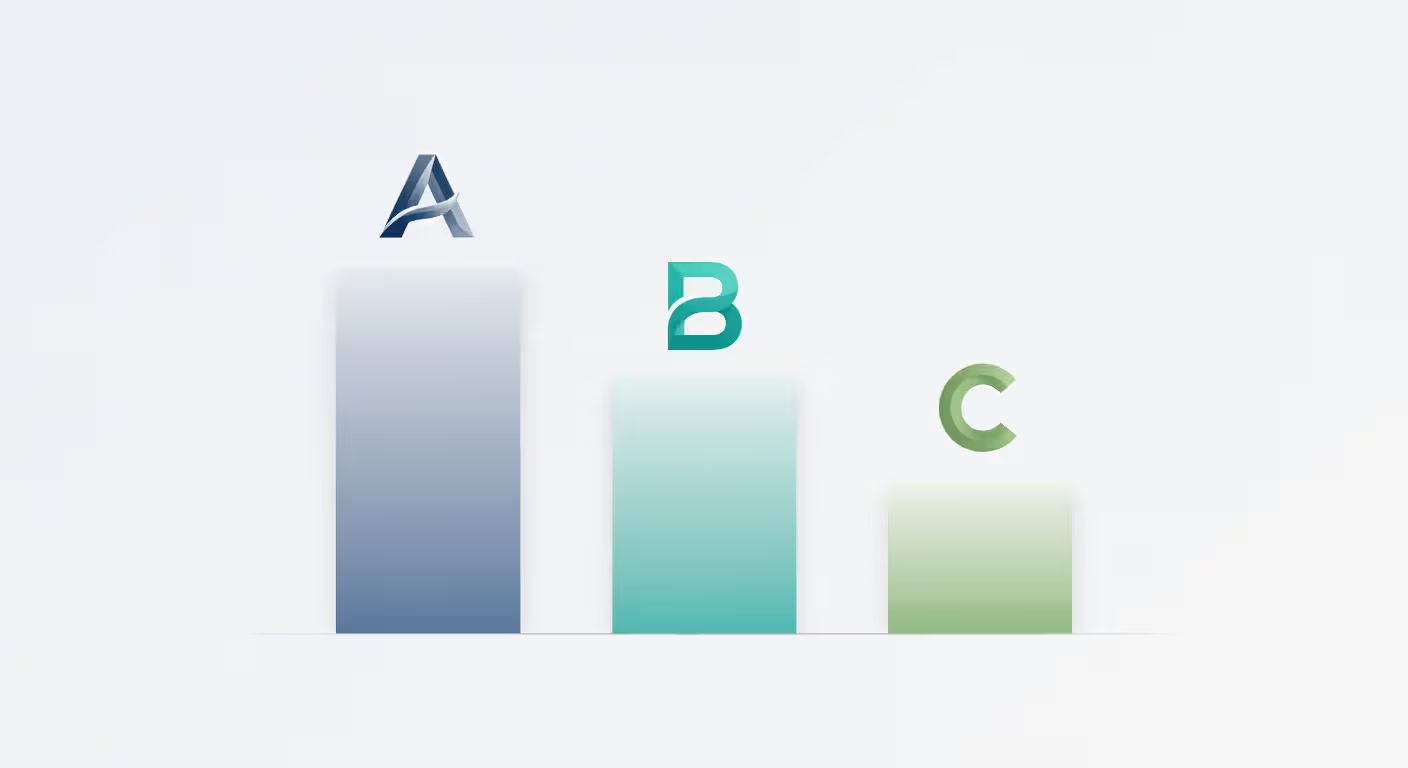
You'll see metrics like "citation rate"—the percentage of relevant queries where your brand appears. If you show up in 15% of queries about project management tools while your main competitor hits 40%, that gap demands investigation.
Competitor Visibility Analysis
Knowing your own visibility helps. Understanding your competitive position enables strategy.
Most platforms let you specify competitor domains or brand names for parallel tracking. Side-by-side analysis reveals:
Which brands appear most frequently across your query set
Specific questions where competitors surface but you don't
Topic areas where you're gaining or losing ground over time
This goes beyond vanity metrics. It exposes content gaps. When competitors consistently get mentioned for "enterprise features" while you're absent from those discussions, you've identified a content development priority.
Author: Adrian Westmere;
Source: aleanetwork.net
How to Use AI Visibility Tools to Improve Your SEO Strategy
Measurement is step one. Optimization drives results. Here's how to turn ai seo visibility data into tangible improvements.
Establish your baseline first. Before changing anything, run a comprehensive audit. Which queries mention your brand? What's your citation frequency? Where do competitors outrank you? You need this baseline to measure progress.
Identify high-value query gaps. Find questions where competitors appear but you're absent—especially high-intent queries. Questions like "best [product type] for [specific use case]" represent valuable opportunities. Missing from these responses signals a content creation priority.
Optimize existing content for AI citation. Large language models prefer content with:
Credible citations (links to authoritative sources supporting your claims)
Structured data markup where appropriate
Update your top-performing pages with these characteristics. The ai organic visibility guide principle: make it easy for AI to extract and trust your information.
Create citation-worthy assets. Original research, proprietary data, and expert roundups earn citations more consistently. AI models prioritize primary sources. Rehashing other people's content rarely generates citations.
Monitor and iterate continuously. Check visibility metrics weekly. When you publish new content or update existing pages, track whether citation rates improve. This feedback loop runs faster than waiting for Google ranking changes.
Common mistake: brands optimize only for ChatGPT while ignoring Perplexity, Gemini, and Claude. Each platform has different citation behaviors. Your strategy needs to work across all of them.
Common Mistakes When Tracking AI Organic Visibility
Even with the right tools, misinterpreting data or focusing on wrong metrics happens frequently. Avoid these traps:
Ignoring citation context. Not all mentions help you. If an AI cites your brand as a cautionary tale or negative example, that's a visibility problem, not a win. Always read the actual responses, not just mention counts.
Relying only on traditional SEO metrics. High domain authority and strong backlink profiles help, but they don't guarantee AI citations. LLMs pull from broader sources including Reddit discussions, Quora answers, and user-generated content. Your forum participation might influence citations more than your DA score.
Monitoring just one AI platform. ChatGPT and Perplexity use different training data and exhibit different citation patterns. A brand dominating one platform might be invisible in another. Track at least three major platforms.
Overreacting to short-term fluctuations. AI responses vary based on subtle phrasing differences, user context, and model updates. A 10% drop in citation rate over one week might be statistical noise, not a real trend. Look for sustained patterns over a month or more.
Using poor test queries. The prompts you test with dramatically affect results. Generic questions ("Tell me about project management software") produce different outputs than specific ones ("What's the best project management tool for remote teams under 20 people?"). Test both broad and narrow formulations.
Confusing correlation with causation. When citation rates increase after a content update, that's encouraging—but did your update cause it, or did a competitor's site go down? Try to isolate variables when possible.
Author: Adrian Westmere;
Source: aleanetwork.net
Frequently Asked Questions About AI Visibility Tools
What differentiates AI visibility tools from traditional SEO software?
Traditional SEO platforms measure your search engine performance—where you rank for keywords, your backlink profile, organic traffic volumes. AI visibility platforms track whether your brand appears in responses generated by ChatGPT, Perplexity, Gemini, and similar systems. Traditional tools show your position on search results pages. AI tools reveal whether you get mentioned at all in generated answers. These are complementary measurement systems, not replacements for each other.
Which AI platforms can these visibility tools monitor?
Most solutions track ChatGPT, Perplexity, Google Gemini, Claude, and Bing's AI features. Some also monitor emerging platforms like You.com, Brave Search's AI capabilities, and vertical-specific AI assistants. Coverage varies between vendors, so verify which systems matter most for your audience before subscribing. If your customers primarily use ChatGPT, prioritize tools with robust ChatGPT tracking.
What's the typical pricing for these tools?
Expect monthly subscriptions ranging from about $99 for basic monitoring (limited queries, single brand) to $500+ for enterprise plans with competitor analysis, unlimited queries, and API access. Some vendors charge based on query volume or tracked keyword count. Premium pricing applies for real-time data or extensive historical analysis. Most offer trial periods so you can test before committing.
Will using an AI visibility tool improve my search rankings?
Not directly. These platforms don't change your Google positions. However, they help you optimize content for better AI citations, which can indirectly boost traditional SEO. Content that earns citations often attracts backlinks and social shares—signals that do influence rankings. Think of AI visibility tools as diagnostic instruments. They identify problems; you still have to fix them.
How reliable are AI citation tracking measurements?
Accuracy depends on how the platform accesses AI systems. Tools using official APIs generally deliver more consistent results. Those simulating user sessions may hit rate limits or see variable outputs. No tool achieves perfect accuracy because AI responses change based on phrasing variations, user history, and model updates. Treat the data as directional rather than absolute. A 25% citation rate might actually be 20-30%, but trends over time remain valuable.
Do I still need this if I'm already using Google Search Console?
Yes, if you care about visibility beyond Google. Search Console tells you nothing about ChatGPT, Perplexity, or other AI platforms. As more users turn to AI for information, traditional search metrics capture a shrinking portion of the full picture. Keep using Search Console for Google-specific insights. Add an AI visibility tool to understand your complete organic reach across all discovery channels.
AI search won't replace traditional search overnight, but the balance keeps shifting. Brands monitoring visibility across both environments—and optimizing for both—will capture attention their competitors miss. Start with a baseline assessment, focus on creating citation-worthy content, and track progress across multiple platforms. The technology exists. The methodology is proven. Execution separates winners from losers.
An AI SDR automates prospecting, outreach, and lead qualification using machine learning and natural language processing. Discover how these systems work, when to use AI versus human SDRs, common implementation mistakes, and what tools are available.
Discover how conversational AI assistants use NLP and machine learning to understand context and hold natural dialogues. This guide covers technology fundamentals, use cases, implementation strategies, and how to avoid common challenges when deploying AI assistants for business.
AI voice agents combine speech recognition, natural language processing, and voice synthesis to conduct natural phone conversations. Learn how the technology works, what capabilities modern systems offer, and which industries benefit most from automated voice interactions.
Explore real-world AI agents examples across customer service, sales, enterprise operations, and specialized applications. This guide covers actual deployments from companies like Klarna, Maersk, and McDonald's—complete with workflows, results, and lessons learned from enterprise implementations.
The content on this website is provided for general informational and educational purposes only. It is intended to explain concepts related to AI tools, agents, developer infrastructure, coding assistants, APIs, and productivity workflows.
All information on this website, including articles, guides, and examples, is presented for general educational purposes. Outcomes and tool performance may vary depending on implementation, skill level, and use case.
This website does not provide professional AI consulting, development services, or guarantees of results, and the information presented should not be used as a substitute for consultation with qualified AI or software development professionals.
The website and its authors are not responsible for any errors or omissions, or for any outcomes resulting from decisions made based on the information provided on this website.