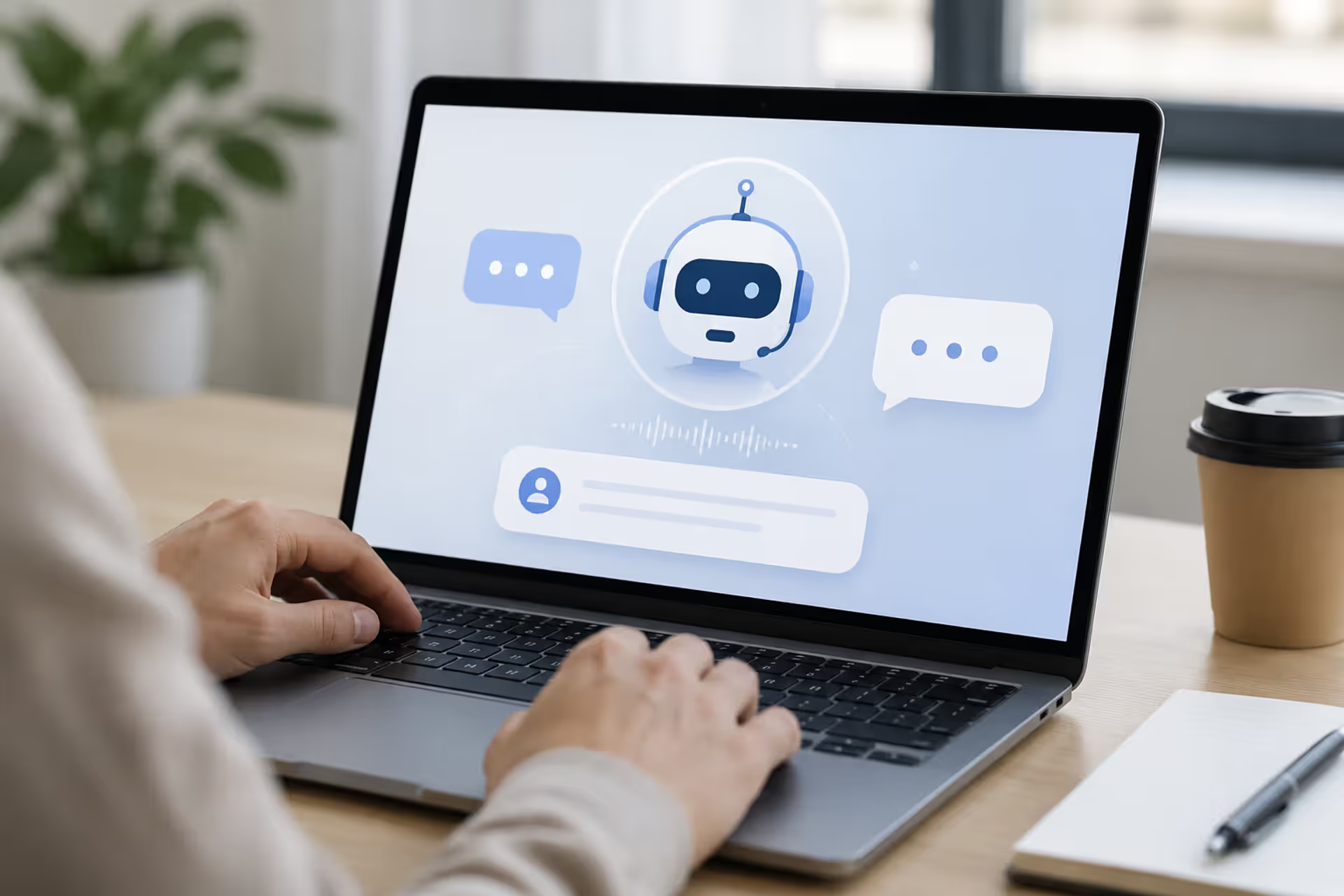
Businesses today need more than simple automated responses. They need systems that understand context, remember conversations, and actually help customers solve problems. That's where conversational AI assistants come in—technology that can hold natural dialogues, not just spit out scripted answers.
The shift from basic chatbots to true conversational AI represents a fundamental change in how companies interact with customers and employees. These systems don't just match keywords. They understand intent, manage complex dialogues, and learn from every interaction.
What Is a Conversational AI Assistant
A conversational AI assistant is software that uses natural language processing and machine learning to understand and respond to human communication in a natural, contextual way. Unlike basic chatbots that follow rigid decision trees, these systems can interpret nuanced language, maintain conversation context, and adapt their responses based on the situation.
The core components include natural language understanding (NLU) to interpret what users mean, dialogue management to track conversation flow, and natural language generation (NLG) to create human-like responses. Together, these elements create an experience that feels genuinely conversational rather than transactional.
Here's the key difference from traditional ai chatbot solutions: a basic chatbot follows if-then rules. User says "refund," bot shows refund policy. Simple. A dialogue ai assistant, on the other hand, understands that "I'm unhappy with this purchase" might mean the same thing and can ask clarifying questions to determine the best resolution.
The pattern I see most often is companies starting with basic chatbots, hitting their limitations quickly, then upgrading to true conversational AI when they realize their customers need actual understanding, not just keyword matching.
Most conversational AI assistants combine several technologies. Machine learning models trained on thousands of conversations. Knowledge bases that store information. Integration layers that connect to your business systems. Analytics engines that track performance and identify improvement opportunities.
The sophistication varies widely. Some handle simple FAQs with natural language understanding. Others manage multi-turn conversations, switch topics mid-dialogue, and pull information from multiple sources to construct detailed answers.
Author: Isabelle Norwyn;
Source: aleanetwork.net
How Conversational AI Technology Works
The technical process behind conversational ai technology happens in milliseconds, but it involves multiple sophisticated steps working together.
First, natural language processing breaks down the user's input. The system tokenizes the text (splits it into analyzable chunks), identifies parts of speech, and recognizes named entities like dates, names, or product numbers. This preprocessing turns messy human language into structured data the AI can analyze.
Next comes intent recognition. The nlp based ai assistant determines what the user actually wants. "Where's my order?" and "I haven't received my package yet" express the same intent despite different wording. Modern systems achieve 85-95% accuracy on intent classification when properly trained.
Context handling separates good systems from great ones. A language based ai assistant tracks conversation history, remembers what was discussed, and uses that information to interpret follow-up questions. When someone asks "What about the blue one?" the system knows they're referring to a product mentioned three exchanges ago.
Entity extraction identifies specific data points within the message. From "I need to change my appointment from Tuesday to Thursday at 3pm," the system extracts the original day (Tuesday), new day (Thursday), and time (3pm).
The dialogue manager decides what to do next. Does it have enough information to fulfill the request? Does it need to ask clarifying questions? Should it hand off to a human? This component orchestrates the entire conversation flow.
Response generation creates the actual reply. Simple systems pull from template libraries. Advanced ones use generative AI to construct unique responses that match the conversation's tone and context. The best balance both approaches—templates for consistency on critical topics, generation for flexibility elsewhere.
Finally, the system learns. Every interaction feeds back into the training data. Conversations that succeed reinforce the model. Failures flag areas for improvement. This continuous learning cycle is what makes these systems smarter over time.
Integration layers connect the AI to your business systems. When someone asks about their account balance, the assistant queries your database in real-time. When they want to schedule a callback, it checks your CRM and calendar systems. Without these integrations, even the smartest AI is just making conversation without taking action.
Types of Conversational AI Assistants
The landscape of AI assistants breaks down along several dimensions, each suited to different use cases and technical requirements.
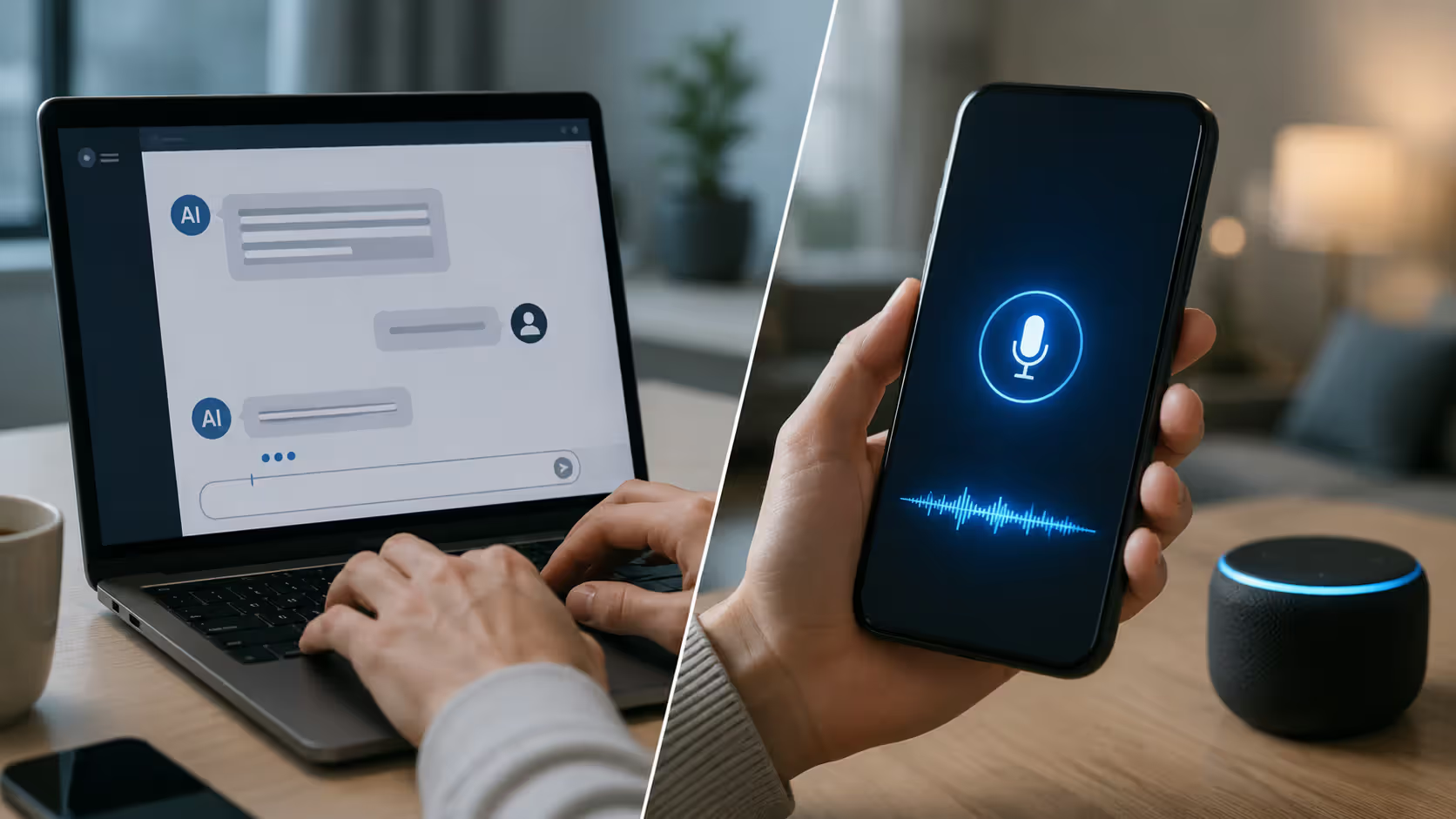
Text-based assistants handle written conversations through messaging platforms, websites, or mobile apps. They're the most common type—think chat windows on customer service sites or messaging bots in Slack. Voice-based systems process spoken language, powering phone support lines and smart speakers. Voice adds complexity (accents, background noise, speech recognition) but feels more natural for certain interactions.
The bigger distinction is rule-based versus NLP-based systems. Rule-based ai chatbot solutions follow predetermined paths. They're predictable, easy to control, and work well for narrow, well-defined tasks. Setting up an appointment? Checking a tracking number? Rules handle these efficiently.
But rules break down fast when conversations get complex. A customer might say "I got charged twice but only received one item and now I can't log into my account to check." Rule-based systems choke on multi-issue requests.
That's where nlp based ai assistant technology shines. These systems understand the multiple intents (billing issue, delivery problem, access issue) and can prioritize, ask clarifying questions, or route to appropriate specialists. They handle the messy reality of how people actually communicate.
Then there's the general-purpose versus specialized split. General assistants try to handle anything—like consumer virtual assistants that manage calendars, answer trivia, control smart homes, and play music. Specialized dialogue ai assistant platforms focus on specific domains: healthcare, banking, e-commerce, HR.
Specialized usually beats general for business applications. A healthcare assistant trained on medical terminology, HIPAA compliance, and clinical workflows will outperform a general system every time. Domain expertise matters.
Author: Isabelle Norwyn;
Source: aleanetwork.net
Here's a comparison of the main types:
Feature
Rule-Based Chatbots
NLP-Based AI Assistants
Advanced Dialogue AI
Natural Language Understanding
Keyword matching only
Understands intent and entities
Full semantic understanding with context
Context Awareness
None—each message independent
Remembers within single conversation
Maintains context across sessions
Learning Capability
Manual updates only
Improves with supervised training
Continuous self-learning from interactions
Implementation Complexity
Low—flowchart design
Moderate—requires training data
High—needs significant AI expertise
Best Use Cases
Simple FAQs, form filling
Customer support, lead qualification
Complex problem-solving, multi-domain assistance
Most businesses start in the middle column and move right as their needs grow. You don't need advanced dialogue AI to answer "What are your hours?" But you might need it to handle "I ordered three items last Tuesday but only two arrived, one was damaged, and I was charged for shipping twice even though I have a premium membership."
Hybrid approaches combine multiple types. Use rules for high-confidence, straightforward requests. Route ambiguous or complex queries to NLP systems. Escalate to humans when the AI hits its limits. The simpler option usually wins here—don't over-engineer if rules solve 80% of your use cases.
Common Use Cases for AI Assistants
Customer Service and Support
This is where ai assistant for customer service technology delivers the clearest ROI. Companies report 60-80% of routine inquiries handled without human intervention, freeing support teams to tackle complex issues that actually need human judgment.
The typical deployment handles order tracking, account questions, password resets, basic troubleshooting, and policy information. A well-trained conversational ai assistant resolves these in seconds rather than the minutes (or hours) customers wait for human agents.
But the real value isn't just deflection. It's 24/7 availability. Instant response times. Consistent answers. And the ability to handle thousands of simultaneous conversations during peak periods without adding headcount.
One retail client saw their average resolution time drop from 8 minutes to 90 seconds for common issues. Customer satisfaction scores actually increased because people got help immediately instead of waiting in queue.
The common mistake? Deploying support AI before you have clean knowledge bases and clear processes. If your human agents give inconsistent answers, your AI will too—just faster and at greater scale.
Sales and Lead Qualification
Conversational AI on websites and landing pages engages visitors immediately, asks qualifying questions, and routes promising leads to sales teams with full context from the conversation.
The before/after here is stark. Before: visitor fills out a form, waits hours or days for follow-up, interest cools. After: instant engagement, real-time answers to objections, hot leads delivered to sales with conversation history attached.
These assistants can handle product recommendations based on needs, schedule demos, answer pricing questions, and even process simple transactions. They're particularly effective for B2B companies with complex products where buyers need education before they're ready to talk to sales.
Conversion rates typically improve 15-40% when AI assistants replace static forms. People prefer conversation to filling out fields. And the AI can be persistent without being pushy—following up with abandoned visitors, re-engaging based on behavior, nurturing leads over time.
Internal Employee Support
IT helpdesks, HR inquiries, and internal process questions consume massive amounts of time in large organizations. Employee-facing conversational AI assistants handle password resets, benefits questions, policy lookups, and process guidance.
The ROI calculation is straightforward. If your IT team spends 30% of their time resetting passwords and answering "How do I..." questions, automating those requests effectively gives you 30% more IT capacity.
HR assistants answer benefits questions, explain policies, guide employees through processes like expense reporting or time-off requests, and even help with onboarding. New employees can ask questions anytime without feeling like they're bothering their manager or HR rep.
One enterprise deployment reported their internal AI assistant handled 45,000 employee interactions per month, with 72% fully resolved without human escalation. That's roughly six full-time positions worth of work automated.
Author: Isabelle Norwyn;
Source: aleanetwork.net
Key Features to Look for in a Conversational AI Solution
Natural language understanding quality matters most. Test the system with real examples from your domain. Can it handle typos, slang, and industry jargon? Does it understand when customers phrase the same request ten different ways? Ask vendors for accuracy metrics on intent recognition and entity extraction.
Multi-channel support means deploying once and reaching customers everywhere—website chat, mobile app, SMS, WhatsApp, Facebook Messenger, voice channels. Good conversational ai design allows you to build once and deploy across channels without rebuilding for each platform.
Integration capabilities determine whether your AI can actually do things or just talk about them. It needs to connect with your CRM, helpdesk, e-commerce platform, knowledge base, and business systems. Pre-built connectors for popular platforms save months of development time.
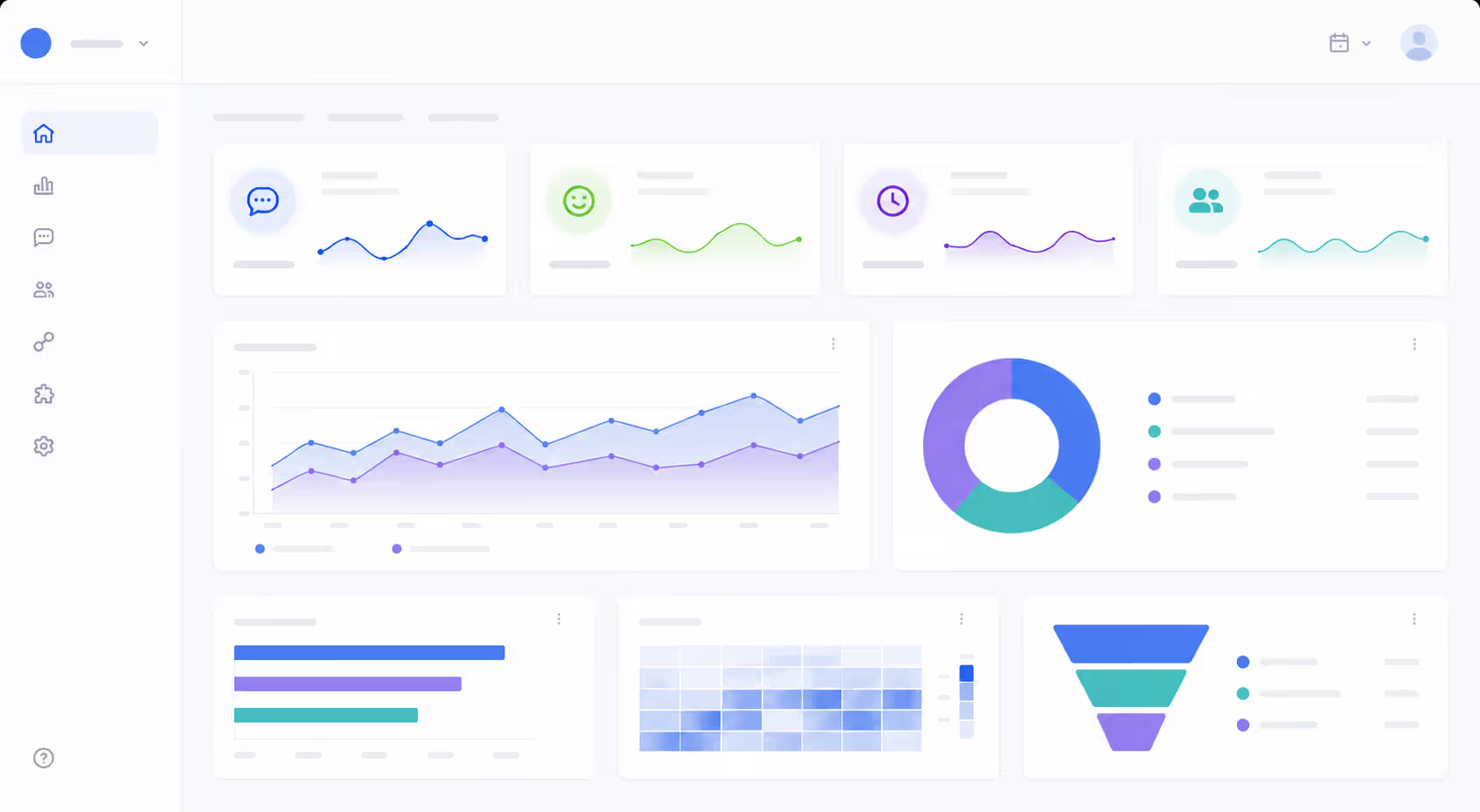
Analytics and reporting show you what's working and what's not. You need visibility into conversation volumes, resolution rates, common intents, failure points, and user satisfaction. The best systems identify conversation patterns that indicate training gaps or process problems.
Customization options let you match the assistant to your brand voice and specific needs. Can you adjust personality and tone? Add custom logic for your unique processes? Train the system on your specific terminology and use cases?
Don't overlook conversation design tools. Non-technical team members should be able to update responses, add new intents, and refine conversation flows without developer involvement. If every change requires engineering tickets, you'll never keep the system current.
Security and compliance features are non-negotiable for regulated industries. Look for data encryption, access controls, audit trails, and compliance certifications (HIPAA, SOC 2, GDPR, etc.). Where is conversation data stored? How long is it retained? Who can access it?
Scalability matters even if you're starting small. Can the platform handle 10x your current volume? What about 100x? Cloud-native solutions generally scale better than on-premise deployments, but verify performance guarantees in the contract.
By 2027, conversational AI will become the primary customer service channel for roughly a quarter of organizations, fundamentally shifting how businesses design their customer experience strategies and allocate support resources.
— Raghavan Srinivasan
How to Choose the Right AI Assistant for Your Business
Start with clear business objectives. Are you trying to reduce support costs? Increase sales conversions? Improve employee productivity? Your primary goal shapes everything else—the type of system you need, features that matter most, and how you'll measure success.
Map your use cases specifically. Don't just say "customer support." List the actual questions and tasks: password resets, order status checks, return processing, technical troubleshooting. Prioritize by volume and complexity. The 20% of use cases that represent 80% of volume should drive your requirements.
Assess your technical resources honestly. Do you have AI expertise in-house? Development capacity for integrations? Or do you need a fully managed solution with professional services included? This varies significantly between platforms—some require data science teams, others work out of the box.
Evaluate your data situation. Training effective nlp based ai assistant systems requires conversation data, knowledge bases, and historical interaction logs. If you don't have clean training data, you'll need a vendor who can help you create it or a system that learns quickly from limited examples.
Consider your timeline. Building custom AI from scratch takes 6-12 months. Implementing a platform solution might take 6-12 weeks. Simple chatbot builders can launch in days. Match the approach to your urgency and resources.
Vendor evaluation should include proof-of-concept testing with your actual data. Most reputable vendors offer pilots or trials. Test with real examples from your business, not sanitized demo scenarios. How does it handle your specific terminology? Your common edge cases?
Check references from similar companies. A system that works brilliantly for e-commerce might struggle with healthcare. Talk to customers in your industry about implementation challenges, ongoing maintenance requirements, and actual results versus promises.
Total cost of ownership includes licensing, implementation services, integration development, ongoing training and maintenance, and internal resources required. A cheaper platform that needs extensive customization might cost more than a premium solution that works out of the box.
The vendor's roadmap matters because conversational ai technology evolves rapidly. Are they investing in new capabilities? How often do they release updates? Will you benefit from improvements or get stuck on a legacy version?
Support and training options can make or break implementation. What does onboarding look like? Is training included? What's the support model—email tickets, phone support, dedicated success manager? Response time commitments?
Common Implementation Challenges and How to Avoid Them
Training data quality determines your AI's effectiveness, but most companies underestimate the work required. You need hundreds or thousands of example conversations, properly labeled with intents and entities. Garbage in, garbage out applies ruthlessly here.
The solution is starting with a focused scope. Don't try to handle every possible question on day one. Launch with your top 10-20 use cases, get those working well, then expand. It's better to handle 20 topics excellently than 100 topics poorly.
User adoption requires change management, not just technology deployment. Customers need to discover the assistant and trust it works. Employees need to understand how it changes their workflow. Without adoption, even perfect technology delivers zero value.
Promote the assistant prominently. If it's hidden behind three clicks, no one will use it. Make it the default first touchpoint. Set expectations clearly—tell users what the assistant can help with. And give them an easy path to human help when needed.
Integration complexity trips up many implementations. Your AI needs real-time access to customer data, order systems, knowledge bases, and other tools. Each integration is a potential failure point and maintenance burden.
Prioritize integrations ruthlessly. Which systems are absolutely necessary for your core use cases? Start there. Nice-to-have integrations can wait until you've proven value with the essentials. And use pre-built connectors whenever possible rather than custom development.
Maintaining conversation quality over time requires ongoing attention. Language evolves. Products change. New issues emerge. An assistant that works great at launch will degrade without continuous training and updates.
Build a feedback loop from day one. Monitor conversations regularly. Track where the AI fails or produces poor responses. Review low satisfaction ratings. Use these insights to refine training data and update responses. Plan for at least a few hours per week of conversation review and optimization.
The common mistake is treating implementation as a project rather than a program. Launch isn't the finish line. It's the starting line. Budget for ongoing optimization, not just initial deployment.
Conversational ai design requires balancing automation with human escalation. Over-automating frustrates users when the AI can't help. Under-automating wastes the technology's potential. Finding the right balance takes iteration.
Start conservative. Automate high-confidence scenarios and escalate everything else. As you learn what works, gradually expand the AI's scope. Monitor escalation rates and reasons—they tell you where to focus training efforts.
Measuring success needs clear metrics defined upfront. Common ones include automation rate (percentage of conversations handled without human help), resolution rate (percentage where the user's issue was actually solved), user satisfaction scores, and cost per interaction.
But don't forget business metrics. Did support costs decrease? Did sales conversions increase? Did employee productivity improve? Technology metrics matter, but business outcomes matter more.
Author: Isabelle Norwyn;
Source: aleanetwork.net
Challenge
Common Pitfall
How to Avoid It
Training Data Quality
Starting with insufficient or poorly labeled data
Begin with focused scope, invest in proper data labeling, use active learning to improve efficiently
User Adoption
Assuming "if you build it, they will come"
Prominent placement, clear capability communication, easy escalation paths, marketing the assistant to users
Integration Complexity
Trying to integrate everything at once
Prioritize must-have integrations, use pre-built connectors, phase additional integrations over time
Conversation Quality
Set-it-and-forget-it approach after launch
Regular conversation review, continuous training updates, feedback loops from users and agents
Scope Creep
Attempting to handle every possible scenario immediately
Launch with top use cases, expand based on data and user needs, measure before adding complexity
FAQ: Conversational AI Assistant Questions Answered
What's the difference between a chatbot and a conversational AI assistant?
Basic chatbots follow scripted rules and decision trees. They match keywords and provide pre-programmed responses. Conversational AI assistants use natural language processing and machine learning to understand intent, maintain context, and generate appropriate responses even for questions they haven't been explicitly programmed to handle. The difference is like comparing a phone menu system to talking with a knowledgeable person.
How much does a conversational AI assistant cost?
Pricing varies widely based on complexity and deployment model. Simple chatbot builders start around $50-200 per month for small businesses. Mid-tier platforms typically range from $1,000-10,000 monthly depending on conversation volume and features. Enterprise solutions with advanced AI capabilities can cost $25,000-100,000+ monthly, though they handle millions of interactions. Implementation costs add $10,000-500,000 depending on customization requirements. Most vendors now offer usage-based pricing tied to conversation volume.
Do I need technical expertise to implement conversational AI?
It depends on the platform and your requirements. No-code chatbot builders let non-technical users create basic assistants through visual interfaces. Mid-tier platforms typically need some technical resources for integrations and training. Advanced implementations with custom AI models require data science and development expertise. Many vendors offer managed services and professional implementation support if you lack internal resources. Start by assessing your use cases and available skills, then choose a platform that matches your capabilities.
Can conversational AI handle multiple languages?
Yes, though quality varies by language and platform. Major languages like Spanish, French, German, and Chinese are well-supported by most enterprise platforms. Less common languages may have limited capabilities or require additional training. The best approach for multilingual support is choosing a platform with proven performance in your target languages and testing thoroughly before deployment. Some systems auto-detect language and switch seamlessly, while others require separate configurations per language.
How long does it take to deploy a conversational AI assistant?
Simple chatbots can launch in days using template-based builders. Standard platform implementations typically take 6-12 weeks including planning, training, integration, and testing. Complex enterprise deployments with extensive integrations and custom AI training may require 3-6 months. The timeline depends on scope, data availability, integration complexity, and internal resource availability. Most successful implementations start small with core use cases and expand over time rather than attempting everything at once.
What industries benefit most from conversational AI assistants?
Retail and e-commerce see strong ROI from handling order inquiries, product recommendations, and customer support. Financial services use AI for account inquiries, transaction support, and fraud alerts. Healthcare organizations deploy assistants for appointment scheduling, patient intake, and basic medical information. Technology companies automate technical support and troubleshooting. Telecommunications, travel, and hospitality also benefit significantly. Really, any industry with high-volume customer interactions or repetitive internal support requests can gain value from conversational AI.
The opportunity with conversational AI isn't just automating existing processes—it's reimagining how your organization interacts with customers and employees. The technology has matured beyond experimental to genuinely useful, with clear paths to ROI for most businesses. Start focused, measure results, and expand based on what works. The companies winning with AI assistants aren't necessarily the ones with the biggest budgets or fanciest technology. They're the ones that match the right solution to clear business needs and commit to continuous improvement.
AI visibility tools monitor how often your brand appears in AI-generated responses across ChatGPT, Perplexity, and Gemini. Unlike traditional SEO tools that track Google rankings, these platforms measure citations, mentions, and context in AI answers—helping you optimize for generative engine visibility.
An AI SDR automates prospecting, outreach, and lead qualification using machine learning and natural language processing. Discover how these systems work, when to use AI versus human SDRs, common implementation mistakes, and what tools are available.
AI voice agents combine speech recognition, natural language processing, and voice synthesis to conduct natural phone conversations. Learn how the technology works, what capabilities modern systems offer, and which industries benefit most from automated voice interactions.
Explore real-world AI agents examples across customer service, sales, enterprise operations, and specialized applications. This guide covers actual deployments from companies like Klarna, Maersk, and McDonald's—complete with workflows, results, and lessons learned from enterprise implementations.
The content on this website is provided for general informational and educational purposes only. It is intended to explain concepts related to AI tools, agents, developer infrastructure, coding assistants, APIs, and productivity workflows.
All information on this website, including articles, guides, and examples, is presented for general educational purposes. Outcomes and tool performance may vary depending on implementation, skill level, and use case.
This website does not provide professional AI consulting, development services, or guarantees of results, and the information presented should not be used as a substitute for consultation with qualified AI or software development professionals.
The website and its authors are not responsible for any errors or omissions, or for any outcomes resulting from decisions made based on the information provided on this website.