Artificial intelligence can make things up. Not because it's broken or buggy, but because that's how it's built. When you ask an AI a question it doesn't really know the answer to, it won't say "I don't know." Instead, it'll confidently generate something that sounds right but isn't. That's AI hallucination—and it's one of the biggest challenges facing anyone who relies on these systems.
The pattern I see most often is this: someone trusts an AI-generated answer without checking it, acts on that information, and only later discovers the facts were wrong. Sometimes the stakes are low. Other times, they're not. Understanding what causes these hallucinations and how to spot them isn't optional anymore—it's a basic skill for working with AI.
Understanding AI Hallucination in Machine Learning
What is AI hallucination, exactly? It's when an AI model generates information that seems plausible but is factually incorrect, fabricated, or nonsensical. The term comes from the medical world, where hallucinations are perceptions without basis in reality. AI hallucinations work similarly—the model "perceives" patterns and produces output without grounding in actual data or truth.
This isn't the same as a simple error. Errors happen when a system gets something wrong by accident—a calculation mistake, a parsing failure, a corrupted file. AI model hallucination is different. The system is working exactly as designed. It's predicting the next most likely word, pixel, or token based on patterns it learned during training. When those patterns lead it into unfamiliar territory, it keeps going anyway, filling gaps with statistically probable guesses.
Large language models don't "know" anything in the way humans do. They recognize patterns in text. When you ask ChatGPT or Claude a question, they're not looking up facts in a database. They're generating sequences of words that match patterns they've seen before. If the training data contained accurate information about your topic, great. If not, the model improvises—and improvisation without knowledge creates hallucinations.
The confidence is what makes this dangerous. An AI won't hedge or express uncertainty unless specifically prompted to do so. It delivers fabricated information with the same authoritative tone it uses for verified facts. You can't tell the difference from the writing style alone.
Why Do AI Models Hallucinate
Several factors converge to create hallucinations. Understanding AI hallucination causes helps you predict when they're most likely to happen.
Training Data Gaps and Biases
Every AI model learns from a training dataset. That dataset is never complete. It can't be—no dataset contains all human knowledge, and even if it did, much of that knowledge would be contradictory, outdated, or wrong.
When you ask about something that wasn't well-represented in the training data, the model has two choices: admit ignorance or guess. Most models are optimized to always provide an answer, so they guess. They piece together fragments from related topics, blend them with linguistic patterns, and output something that reads smoothly but has no factual foundation.
Biases compound this problem. If the training data overrepresents certain viewpoints, time periods, or cultural contexts, the model will hallucinate in ways that reflect those biases. Ask about a historical event from a non-Western perspective, and you might get answers that default to Western narratives—not because the model is prejudiced, but because that's what dominated its training examples.
Model Architecture Limitations
LLM hallucination explained at the technical level comes down to how these systems process context. Transformer models—the architecture behind GPT, Claude, and similar systems—have a context window. That's the amount of text they can "remember" at once. Anything outside that window effectively doesn't exist for the model.
When a conversation or document exceeds the context window, the model starts losing track of earlier information. It might contradict itself, forget key details you mentioned, or invent new "facts" to bridge the gap. The longer the interaction, the higher the hallucination risk.
Probabilistic generation creates another issue. These models work by predicting probability distributions over possible next tokens. They sample from those distributions, which introduces randomness. Two identical prompts can produce different outputs. Sometimes that randomness leads to creative, useful variation. Other times it produces hallucinations.
Temperature settings control this randomness. Higher temperatures increase creativity but also increase hallucination risk. Lower temperatures make output more predictable and factual—but even at temperature zero, hallucinations still happen when the model's training didn't cover the topic adequately.
Common Examples of AI Hallucination
Author: Adrian Westmere;
Source: aleanetwork.net
Real-world AI model hallucination examples show how this plays out across different systems and use cases.
ChatGPT has confidently cited academic papers that don't exist. Users ask for sources on niche topics, and the model generates realistic-looking citations—complete with author names, journal titles, publication years, and DOIs. Everything looks legitimate. But when you try to find the paper, it doesn't exist. The model learned the pattern of academic citations and generated one that fits the pattern without checking whether the specific paper is real.
Google's Bard (now Gemini) famously hallucinated in its first public demo. It claimed the James Webb Space Telescope took the first pictures of an exoplanet outside our solar system. That wasn't true—the European Southern Observatory's Very Large Telescope did that years earlier. The mistake was broadcast in marketing materials before anyone caught it.
Image generators hallucinate differently. They create visual artifacts that violate physical reality: hands with six fingers, text that's almost readable but gibberish, reflections that don't match the scene, architectural impossibilities. These happen because the model learned visual patterns without understanding the underlying physics or anatomy.
GitHub Copilot and other code assistants sometimes generate functions that look syntactically correct but contain security vulnerabilities or logic errors. They've learned patterns of code structure without understanding what the code does. A function might compile and run but produce wrong results or create exploitable weaknesses.
Medical AI systems have hallucinated diagnoses by finding patterns in images that weren't actually there. One study found that a model trained to detect pneumonia was actually detecting whether the X-ray came from a specific hospital—it learned to hallucinate based on subtle equipment signatures rather than medical features.
The severity varies. Sometimes a hallucination is harmless—a chatbot invents a funny but wrong etymology for a word. Other times it's dangerous—a legal AI cites non-existent case law, or a medical system suggests a contraindicated treatment.
Types of Hallucination in Generative AI
Hallucination in generative AI falls into several distinct categories, each with different causes and risks.
Factual fabrication is the most common type. The model generates specific claims—dates, names, numbers, events—that are simply false. It might tell you a company was founded in 2015 when it actually started in 2018, or attribute a quote to the wrong person. These hallucinations are confident and specific, which makes them particularly convincing.
Source attribution errors happen when the model gets the information roughly right but misattributes where it came from. It might accurately describe a scientific finding but credit it to the wrong researchers, journal, or year. The underlying fact is true; the citation is hallucinated.
Contextual misunderstanding occurs when the model misinterprets what you're asking. You ask about "Python" meaning the programming language, but it responds about the snake. Or you reference a specific technical meaning of a term, and it responds with the general usage. The answer isn't necessarily false—it's just answering a different question than you asked.
Logical inconsistency is when the model contradicts itself within a single response or conversation. It might say a process has three steps, then list five. Or it establishes a premise in one paragraph and violates it in the next. These hallucinations reveal the model's lack of true reasoning—it generates text that flows well locally but doesn't maintain global coherence.
Visual artifacts appear in image, video, and audio generation. Impossible geometries, anatomical errors, lighting that violates physics, textures that blend incorrectly. The model learned correlations between visual features without learning the rules that govern physical reality.
Here's a comparison of how these types differ:
Hallucination Type
Description
Risk Level
Common in Which AI Systems
Detection Difficulty
Factual Fabrication
Specific false claims presented as fact
High
Language models, chatbots
Medium—requires fact-checking
Source Attribution Errors
Correct information, wrong source
Medium
Research assistants, citation tools
High—the core fact seems right
Contextual Misunderstanding
Answering the wrong interpretation of a question
Low to Medium
General chatbots, search assistants
Low—usually obvious from context
Logical Inconsistency
Self-contradiction within output
Medium
Long-form content generators
Low—readers notice contradictions
Visual Artifacts
Physically impossible or anatomically wrong visuals
Low to High
Image generators, video synthesis
Low—visually apparent
How to Reduce AI Hallucination in Your Workflows
You can't eliminate hallucinations entirely, but you can significantly reduce their frequency and impact. The simpler option usually wins here—start with basic techniques before implementing complex solutions.
Prompt Design Techniques
How you ask the question matters enormously. Vague prompts invite hallucinations because they leave the model too much room to improvise.
Be specific about what you want and what you don't want. Instead of "Tell me about recent AI developments," try "List three specific AI product launches from major tech companies in the first quarter of 2026, with company names and product names." The second version constrains the model to concrete, verifiable facts.
Ask the model to cite sources, even if it can't actually browse the web. Prompts like "Explain X and indicate which parts of your answer are based on common knowledge versus specific sources" can trigger more careful responses. The model will still hallucinate sometimes, but less often.
Request confidence levels explicitly: "Answer this question and rate your confidence from 1-10 for each major claim." This won't prevent hallucinations, but it helps you identify which parts of the response to verify first.
Use chain-of-thought prompting for complex questions. Ask the model to "think step by step" or "explain your reasoning before giving the answer." This forces the model to generate intermediate reasoning, which often reduces logical inconsistencies and factual errors.
Give the model an out. Include phrases like "If you're not certain, say so" or "It's fine to answer 'I don't have reliable information on that.'" Many models will take that option when appropriate, reducing confident hallucinations.
Implementing Retrieval-Augmented Generation
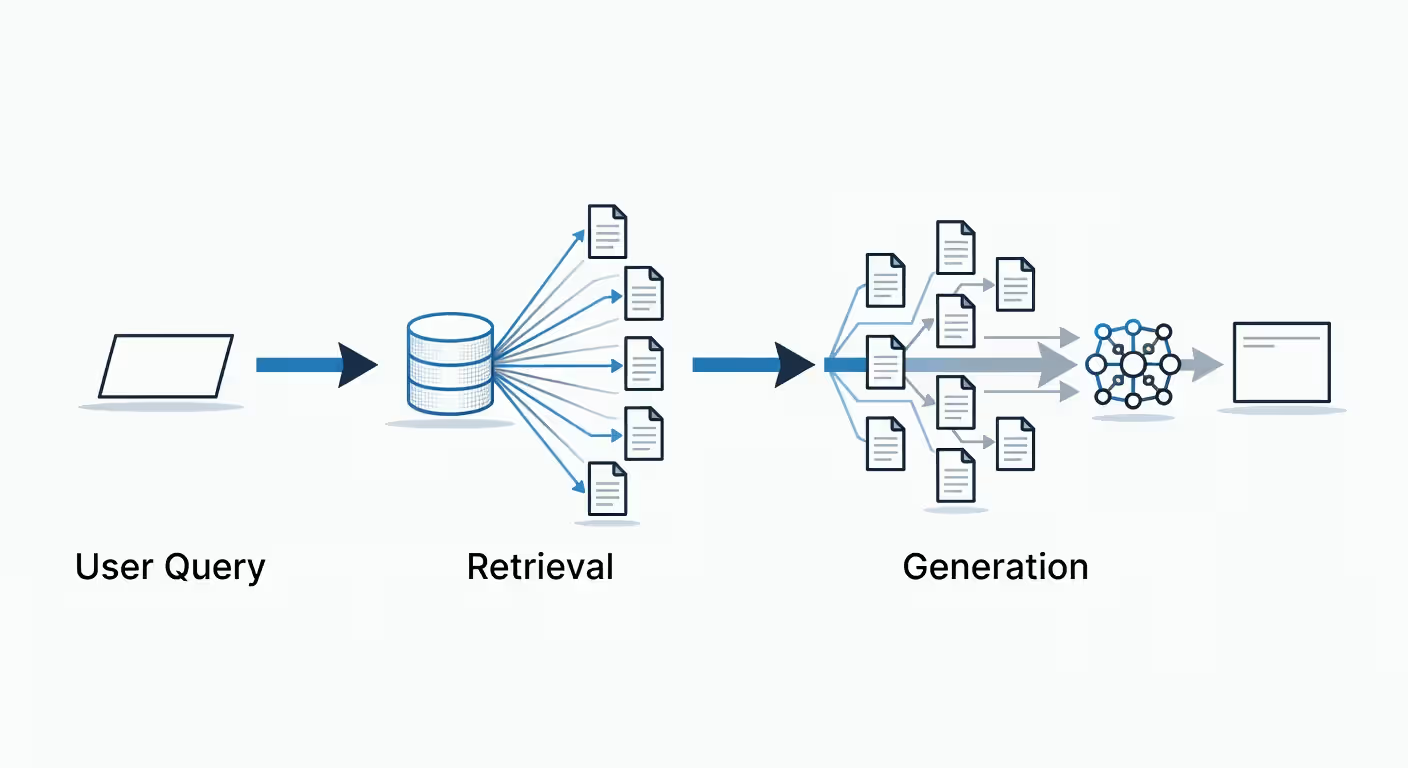
RAG systems are currently the most effective way to reduce hallucinations for knowledge-intensive tasks. Instead of relying solely on the model's training, you give it access to a curated knowledge base.
Here's how it works: when a user asks a question, the system first searches a database of trusted documents. It retrieves the most relevant passages and feeds them into the model's context window along with the question. The model then generates an answer based on those specific documents rather than just its training.
Author: Adrian Westmere;
Source: aleanetwork.net
This dramatically reduces factual fabrication because the model is working from concrete source material. It can still misinterpret those sources, but it can't invent facts that aren't there.
The quality of your knowledge base determines RAG effectiveness. Garbage in, garbage out. Curate your documents carefully, keep them updated, and structure them for easy retrieval. Chunk documents into semantically meaningful pieces—not too small (loses context) or too large (retrieval becomes imprecise).
Implement citation mechanisms. Make the system show which retrieved passages it used for each part of its answer. This lets users verify claims against the source material and catches hallucinations that slip through.
RAG isn't perfect. The retrieval step can fail—if the right document isn't in your knowledge base, or if the search doesn't find it, the model falls back on its training and might hallucinate. But it's still a massive improvement over pure generation.
Other prevention methods:
Fine-tuning on domain-specific data reduces hallucinations in specialized applications. If you're building a medical AI, fine-tune it on curated medical literature. This doesn't eliminate hallucinations, but it shifts the model's probability distributions toward more accurate patterns for your domain.
Human-in-the-loop systems catch hallucinations before they reach end users. Have a person review AI outputs for high-stakes applications. This is labor-intensive but necessary for legal, medical, financial, and safety-critical uses.
Ensemble methods run the same prompt through multiple models and compare outputs. If they agree, confidence is higher. If they disagree, that's a red flag for potential hallucination. This is expensive—you're paying for multiple API calls—but effective for important queries.
Structured output formats reduce certain types of hallucinations. If you need data extraction, ask for JSON with specific fields rather than free-form text. The structure constrains what the model can generate, leaving less room for creative fabrication.
Here's how different prevention methods compare:
Method
Implementation Difficulty
Cost
Effectiveness
Best Use Case
Prompt Engineering
Low
Free
Medium
General use, quick improvements
RAG Systems
Medium to High
Medium
High
Knowledge-intensive tasks, customer support
Fine-tuning
High
High
Medium to High
Domain-specific applications
Human-in-the-loop
Low
High (labor)
Very High
High-stakes decisions, legal/medical
Ensemble Methods
Medium
High (API costs)
Medium to High
Critical queries, validation
Structured Outputs
Low to Medium
Free
Medium
Data extraction, form filling
Detecting Hallucinations Before They Cause Problems
Author: Adrian Westmere;
Source: aleanetwork.net
Prevention is better than detection, but you won't catch everything at the prompt level. You need validation layers.
Watch for overly specific details in areas where the model shouldn't have precision. If you ask about an obscure historical event and get exact dates, times, and quotes, be suspicious. Real knowledge often comes with uncertainty; hallucinations are often suspiciously confident.
Check for consistency. Ask the same question multiple ways or across multiple conversations. If you get substantially different answers, at least one is likely hallucinated. Real facts remain stable across retellings.
Verify anything that matters. This sounds obvious, but it's where most people fail. They trust the AI's confident tone and skip verification. For any claim that will inform a decision, check it against authoritative sources. Use the AI to draft, but don't use it as your sole source of truth.
Automated detection tools are emerging. Some analyze the model's internal confidence scores (when available) to flag uncertain outputs. Others use separate AI models trained specifically to identify hallucinations in generated text. These tools aren't perfect—they have false positives and false negatives—but they're improving.
The challenge with large language models is that they're designed to be confident storytellers, not fact-checkers. They'll give you a coherent answer even when they have no reliable information to draw from.
— Bender Emily
Cross-reference with external databases when possible. If the AI generates a product name, check if it exists. If it cites a paper, look up the DOI. If it mentions a statistic, trace it back to the original source. This is tedious but necessary for important applications.
Train your team to recognize red flags. Unusual names that sound generic or formulaic ("Dr. John Smith, researcher at the University of Technology"), citations with suspiciously round numbers for page ranges, quotes that are too perfectly on-topic—these are common hallucination patterns.
Build feedback loops. When you discover a hallucination, document it. If you're using RAG or fine-tuning, use these examples to improve your system. If you're using commercial APIs, understanding their failure modes helps you write better prompts and implement better validation.
FAQ: AI Hallucination Questions Answered
Can AI hallucination be completely eliminated?
No. Hallucinations are a fundamental characteristic of how current generative AI works, not a bug that can be fixed. These models generate outputs based on statistical patterns, and they'll always occasionally produce plausible-sounding but false information. You can reduce hallucination frequency significantly through techniques like RAG, careful prompting, and validation layers, but you can't get to zero. The goal is risk management, not elimination.
Are some AI models more prone to hallucination than others?
Yes, significantly. Smaller models with less training data hallucinate more frequently than larger, more extensively trained ones. Models fine-tuned on specific domains hallucinate less within those domains but potentially more outside them. Newer architectures with better context handling and reasoning capabilities show lower hallucination rates. Open-source models vary widely in quality—some match commercial offerings, others hallucinate constantly. The model's intended use case also matters; a model optimized for creative writing will hallucinate more than one optimized for factual accuracy.
How do I know if an AI response is hallucinated?
Look for warning signs: excessive confidence on obscure topics, suspiciously specific details without caveats, citations you can't verify, internal contradictions, or answers that seem too perfectly tailored to your question. The most reliable method is external verification—check important claims against authoritative sources. For ongoing work, ask the same question multiple ways; inconsistent answers indicate hallucination. Some AI platforms now offer confidence scores or citations, which help but aren't foolproof.
Does hallucination happen more with complex or simple questions?
Complex questions don't necessarily cause more hallucinations, but they make hallucinations harder to detect. Simple factual questions ("When was X founded?") either hit the model's training data or don't—binary hallucination risk. Complex questions requiring synthesis across multiple topics give the model more opportunities to hallucinate in subtle ways, blending accurate and false information into a coherent-sounding answer. The pattern varies by model and topic coverage.
Is AI hallucination getting worse or better over time?
Better, but slowly. Each generation of models shows measurable improvement in factual accuracy and hallucination rates. Techniques like RLHF (reinforcement learning from human feedback) and RAG have reduced hallucinations significantly since early GPT models. However, as AI gets used for more complex and specialized tasks, we're also discovering new types of hallucinations we didn't test for before. The absolute rate is improving; the practical impact depends on how we deploy these systems.
What's the difference between an AI error and a hallucination?
An error is when the system malfunctions—crashes, returns garbage output, or fails to respond. A hallucination is when the system works exactly as designed but generates false information. Errors are usually obvious; hallucinations are insidious because they look like normal, correct output. You can fix errors with debugging and patches. Hallucinations require fundamental changes to how you prompt, validate, and architect your AI systems. Errors break workflows; hallucinations corrupt them silently.
The key to working safely with AI isn't avoiding it—that ship has sailed. It's understanding its limitations and building appropriate guardrails. Treat AI-generated content as drafts, not final answers. Verify claims that matter. Use RAG when accuracy is critical. And remember that confidence and correctness are completely unrelated in AI outputs. That confident, articulate response might be entirely made up.
Computer vision enables machines to interpret visual data like humans do—only faster and more accurately. This comprehensive guide explains the technology behind facial recognition, autonomous vehicles, medical imaging, and more, breaking down how it works and where it's applied.
Retrieval Augmented Generation combines information retrieval with language models to create AI systems that provide accurate, source-backed answers. This guide explains how RAG works, its architecture, and practical implementation steps for building production systems.
Discover what makes transformer models the foundation of modern AI. This guide explains attention mechanisms, architecture components, and why transformers outperform RNNs for language tasks, with real-world examples from ChatGPT to BERT.
Generative AI creates new content rather than analyzing existing data. Learn how neural networks and transformers power tools like ChatGPT and DALL-E, explore different model types, and understand real-world applications across industries from healthcare to marketing.
The content on this website is provided for general informational and educational purposes only. It is intended to explain concepts related to AI tools, agents, developer infrastructure, coding assistants, APIs, and productivity workflows.
All information on this website, including articles, guides, and examples, is presented for general educational purposes. Outcomes and tool performance may vary depending on implementation, skill level, and use case.
This website does not provide professional AI consulting, development services, or guarantees of results, and the information presented should not be used as a substitute for consultation with qualified AI or software development professionals.
The website and its authors are not responsible for any errors or omissions, or for any outcomes resulting from decisions made based on the information provided on this website.