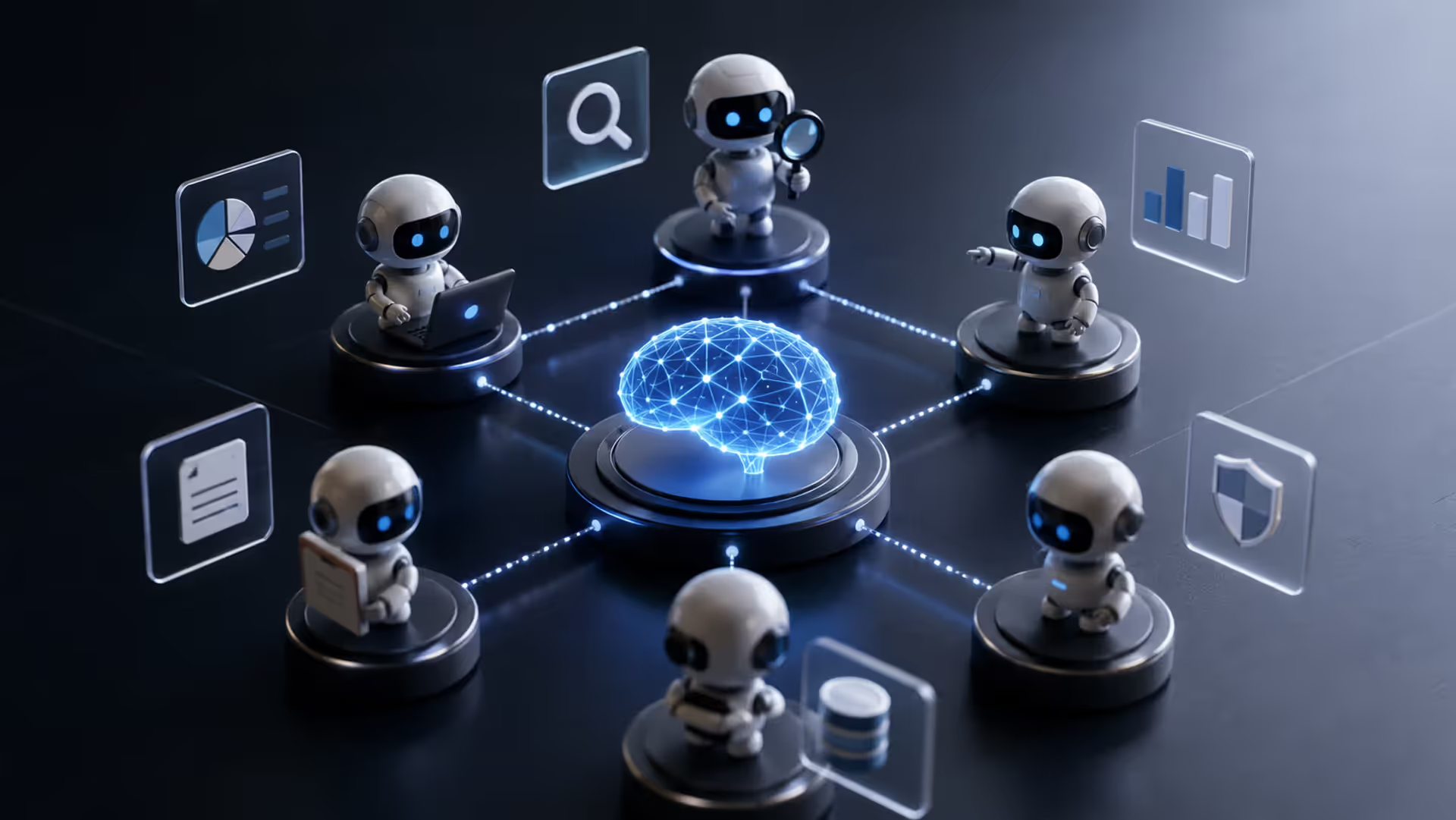
Multi agent systems are changing how we think about artificial intelligence. Instead of one powerful brain tackling a problem, imagine dozens or hundreds of smaller AI agents working together, each handling a piece of the puzzle. They communicate, coordinate, and sometimes even compete to reach solutions that a single agent never could.
This isn't science fiction. These systems already coordinate warehouse robots, manage power grids, and help autonomous vehicles navigate city streets. The pattern I see most often is organizations hitting a wall with traditional AI, then discovering that distributed intelligence solves problems centralized systems can't touch.
What Are Multi Agent Systems
A multi agent system is a network of autonomous AI agents that interact within a shared environment to achieve individual or collective goals. Each agent operates independently, perceives its surroundings, makes decisions, and acts—but the magic happens when they work together.
Think of it this way: a single AI is like one expert consultant. Brilliant, but limited by one perspective and processing capacity. Multi agent systems are like a team of specialists who share information and coordinate their efforts.
The core characteristics set these systems apart:
Autonomy – Each agent operates without constant human control. It decides when to act based on its programming and environment.
Social ability – Agents communicate with each other using defined protocols. They can request information, negotiate, or share discoveries.
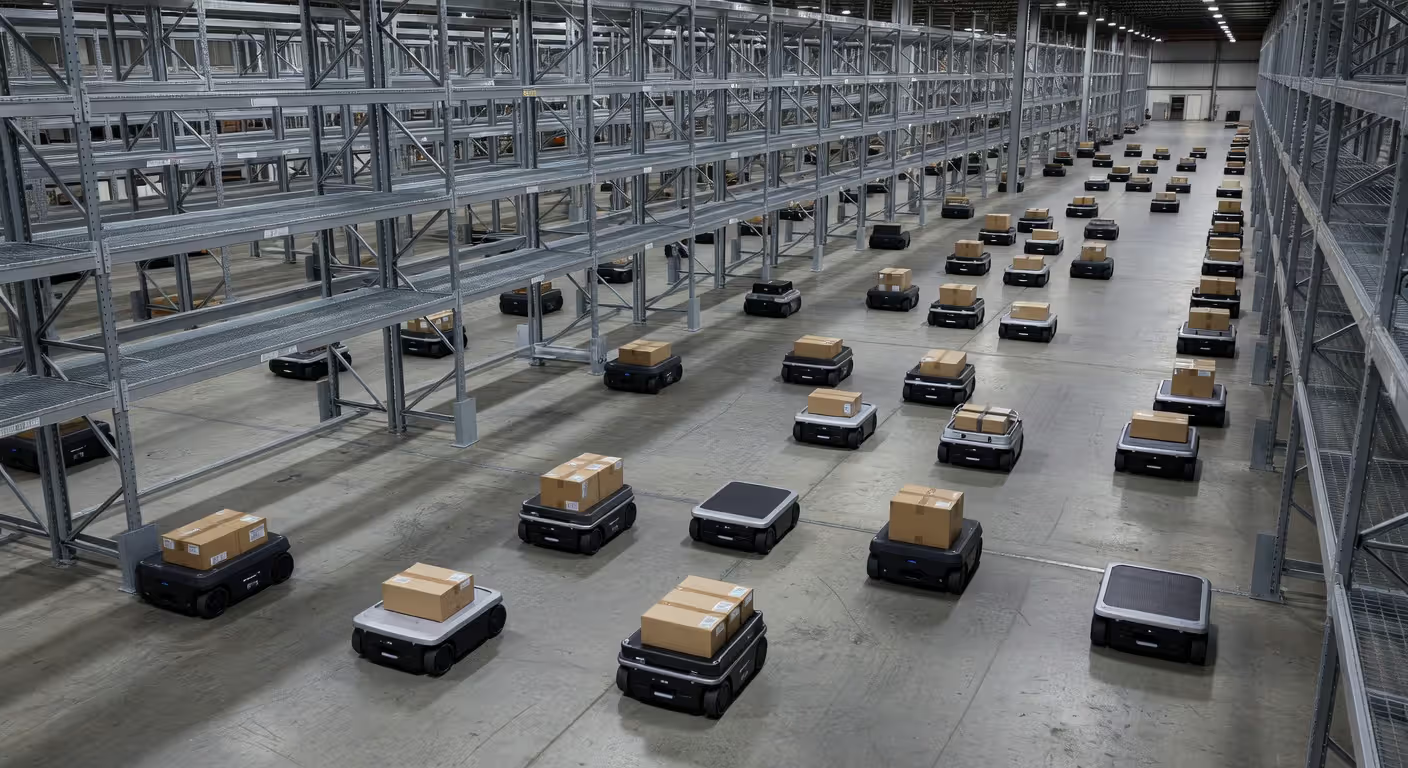
Reactivity – Agents perceive their environment and respond to changes. A warehouse robot notices an obstacle and adjusts its path.
Proactiveness – Agents don't just react. They pursue goals, anticipate problems, and take initiative.
The basic components include the agents themselves (the decision-makers), the environment (where they operate), communication channels (how they talk), and coordination mechanisms (rules for working together).
Here's the key difference from single-agent AI: traditional systems centralize intelligence. One model, one decision point. Multi agent systems distribute intelligence across many decision-makers. This creates resilience—if one agent fails, others continue. It enables specialization—different agents can have different expertise. And it scales better for complex, dynamic problems.
Author: Selena Briarwood;
Source: aleanetwork.net
How Multi Agent Architecture Works
Multi agent architecture operates on layers. At the bottom, individual agents interact with the environment—sensors pick up data, actuators perform actions. The middle layer handles reasoning and decision-making within each agent. The top layer manages inter-agent coordination and communication.
The environment matters enormously. It can be physical (factory floor, roadway) or virtual (software ecosystem, simulation). Agents perceive it through sensors or data feeds, then modify it through actions. The environment's state constantly changes based on agent actions and external factors.
Agent Communication Methods
Agents can't collaborate without talking. Communication methods vary by system needs.
Direct messaging is the simplest approach. Agent A sends a message directly to Agent B. Fast and straightforward, but it doesn't scale well when you have hundreds of agents.
Blackboard systems use shared memory spaces. Agents post information to a common area and read what others have written. Think of it as a bulletin board where everyone can contribute and check for updates.
Publish-subscribe models let agents broadcast messages to topics. Other agents subscribe to topics they care about. This decouples senders from receivers—an agent doesn't need to know who's listening.
Contract Net Protocol handles task allocation through bidding. One agent announces a task, others bid to perform it based on their capabilities and availability. The announcer awards the contract to the best bidder.
The communication language matters too. FIPA-ACL (Foundation for Intelligent Physical Agents - Agent Communication Language) provides standardized message formats and speech acts like "inform," "request," "propose," and "agree."
Coordination Mechanisms
Getting agents to work together smoothly requires coordination rules.
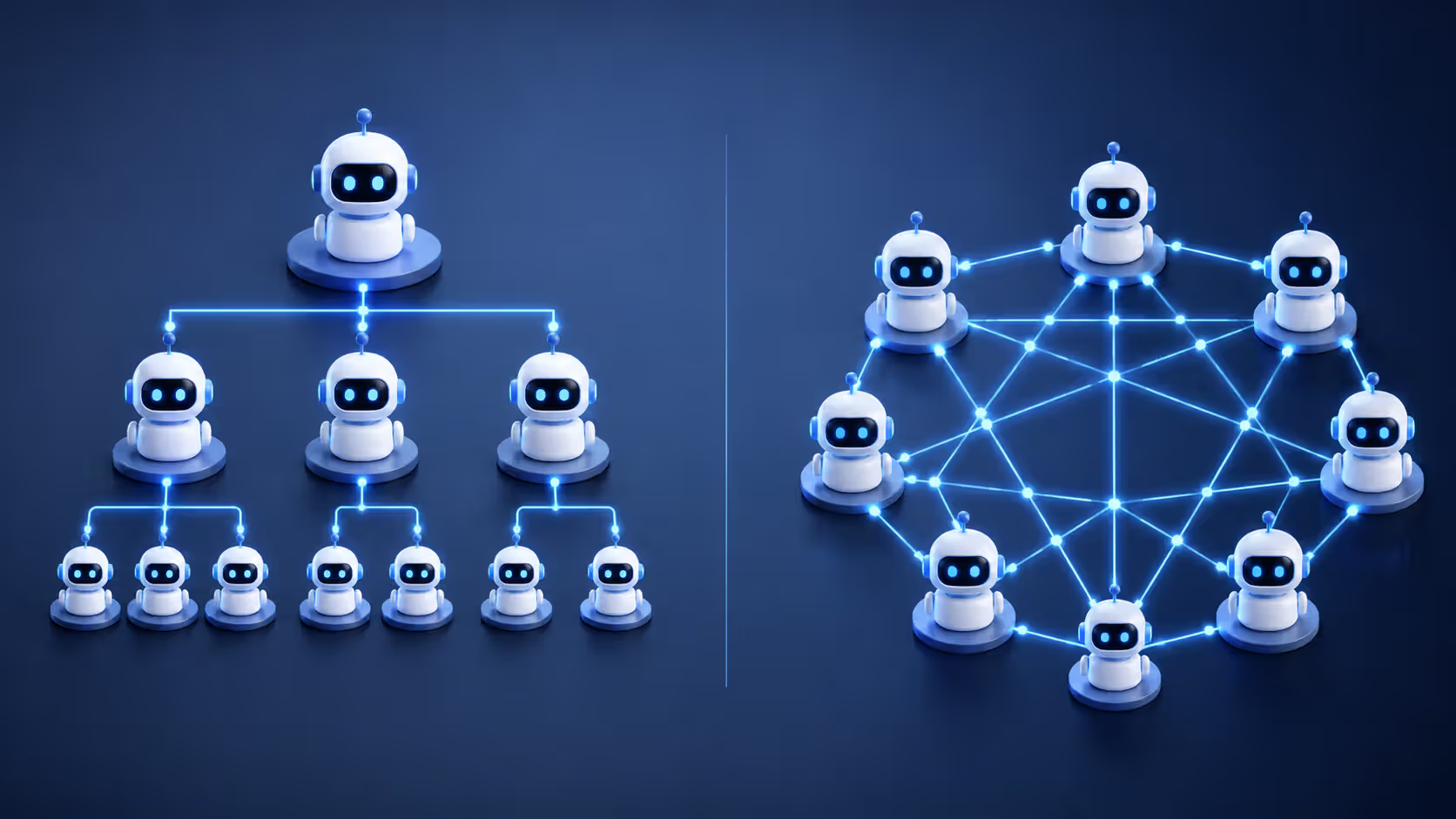
Centralized coordination uses a master agent or controller that assigns tasks and resolves conflicts. Simple to implement, but creates a single point of failure.
Decentralized coordination distributes decision-making. Agents negotiate directly with peers. More robust, but potentially slower and more complex.
Market-based mechanisms treat tasks as commodities. Agents have resources and goals, they trade and negotiate to optimize outcomes. This works well when agents have competing interests.
Voting and consensus protocols help agents reach collective decisions. Each agent casts a vote, and the group follows majority or consensus rules.
Behavioral coordination relies on simple rules that create complex group behavior. Swarm systems often use this—each agent follows basic principles, and sophisticated patterns emerge from their interactions.
Types of Multi Agent AI Systems
Not all multi agent systems work the same way. The architecture depends on whether agents cooperate or compete, how they're organized, and what problem they're solving.
Cooperative agents share common goals. A team of search-and-rescue drones all want to find survivors quickly. They share information about searched areas, coordinate coverage patterns, and help each other. Success for one is success for all.
Competitive agents have conflicting goals. In algorithmic trading, different agents compete for profitable trades. Game-playing AI agents try to outmaneuver opponents. One agent's gain is another's loss.
Mixed systems combine both. Autonomous vehicles cooperate to optimize traffic flow but compete for parking spaces or lane positions.
Swarm intelligence takes inspiration from nature—ant colonies, bird flocks, bee hives. Individual agents follow simple rules without central control. Complexity emerges from their interactions. Swarm AI agents excel at exploration, optimization, and adaptation. They're robust because no single agent is critical.
A common mistake is thinking swarm systems are always better. They're not. Swarms handle dynamic, unpredictable environments well but can be slower at tasks requiring complex reasoning or precise coordination.
Hierarchical structures organize agents in levels. High-level agents make strategic decisions and delegate to lower-level agents who handle tactical execution. Military command structures work this way. It provides clear authority and efficient information flow but can be rigid.
Flat structures treat all agents as peers. No bosses, no hierarchy. This maximizes flexibility and resilience but can struggle with large-scale coordination.
Hybrid models mix approaches. You might have cooperative swarms operating within a hierarchical framework, or competitive agents that occasionally cooperate on shared challenges.
Author: Selena Briarwood;
Source: aleanetwork.net
Distributed AI Agents and Collaboration Strategies
Agent collaboration is where multi agent systems prove their worth. Distribution spreads computational load, enables parallel processing, and provides fault tolerance.
Information sharing forms the foundation. Agents exchange observations, discoveries, and state updates. The challenge is deciding what to share and when. Too much communication creates overhead and congestion. Too little leaves agents working with incomplete information.
Task allocation determines who does what. Several strategies exist:
Market mechanisms let agents bid on tasks based on their capabilities and current workload. A logistics system might have delivery agents bid on package routes.
Role assignment gives agents specific responsibilities. One agent scouts, another coordinates, a third executes. Roles can be fixed or dynamic.
Self-organization allows agents to claim tasks based on local information and simple rules. This works well in unpredictable environments where centralized planning fails.
Consensus building helps agents agree on shared beliefs or decisions. Byzantine fault tolerance algorithms let agents reach consensus even when some agents fail or provide incorrect information. Blockchain systems use this for distributed ledger agreement.
Conflict resolution handles situations where agents have incompatible goals or resource constraints. Negotiation protocols let agents bargain and compromise. Priority systems give certain agents precedence. Mediation introduces neutral third-party agents to broker solutions.
Collaborative problem-solving approaches include:
Distributed constraint satisfaction breaks a problem into variables and constraints distributed among agents. They iteratively share information and adjust values until finding a solution satisfying all constraints.
Coalition formation groups agents into teams for specific tasks. Agents evaluate potential coalitions, negotiate membership, and coordinate within their group.
Distributed planning has agents contribute to a shared plan. They identify dependencies, synchronize actions, and adapt when conditions change.
The simpler option usually wins here. Sophisticated coordination sounds impressive but adds complexity and failure points. Many successful systems use straightforward protocols that agents can execute reliably.
Multi Agent Systems Examples Across Industries
Real-world applications demonstrate the versatility of multi agent systems.
Autonomous vehicles use multi agent coordination for traffic management. Each vehicle is an agent sensing its environment and planning its route. They communicate to negotiate lane changes, coordinate at intersections, and optimize traffic flow. Vehicle-to-vehicle (V2V) communication prevents collisions and reduces congestion.
Supply chain management employs agents representing suppliers, manufacturers, distributors, and retailers. They negotiate contracts, coordinate shipments, and respond to disruptions. When a supplier faces delays, agents quickly find alternatives and adjust schedules across the network.
Smart grids balance electricity supply and demand using distributed agents. Generator agents, storage agents, and consumption agents communicate to optimize energy distribution, integrate renewable sources, and prevent blackouts. Each home's smart meter can act as an agent negotiating energy usage based on price signals.
Robotics in warehouses and factories coordinates multiple robots as agents. Amazon's fulfillment centers use hundreds of robots that navigate autonomously, avoid collisions, and collaborate on order fulfillment. Agents handle path planning, task assignment, and traffic control without central micromanagement.
Gaming AI creates realistic non-player characters (NPCs) that coordinate tactics. In strategy games, enemy units work together—scouts gather intelligence, defenders protect assets, attackers coordinate strikes. This produces challenging, believable opponents.
Healthcare diagnostics uses specialist agents for different diagnostic aspects. One agent analyzes lab results, another interprets imaging, a third reviews patient history. They share findings and collectively suggest diagnoses, mimicking how medical teams consult.
Author: Selena Briarwood;
Source: aleanetwork.net
Industry
Use Case
Agent Type
Key Benefit
Autonomous Vehicles
Traffic coordination and collision avoidance
Cooperative agents with competitive elements
Reduced accidents, optimized traffic flow
Supply Chain
Dynamic logistics and inventory management
Cooperative agents with negotiation
Faster adaptation to disruptions
Smart Grid
Energy distribution and load balancing
Distributed cooperative agents
Improved efficiency, renewable integration
Healthcare
Multi-specialist diagnostic consultation
Cooperative specialist agents
More comprehensive diagnoses
Robotics
Warehouse automation and fulfillment
Swarm agents with task allocation
Scalable operations, fault tolerance
Finance
Algorithmic trading and market making
Competitive agents with cooperation protocols
Price discovery, liquidity provision
Gaming
Coordinated NPC behavior and tactics
Hierarchical cooperative agents
Realistic, challenging gameplay
Financial markets use trading agents that analyze data, execute trades, and manage risk. Market-making agents provide liquidity by offering to buy and sell. They compete for profits but collectively create functioning markets.
The pattern across industries is similar: complex, dynamic problems that resist centralized solutions benefit most from distributed intelligence.
Multi-agent systems represent a paradigm shift from monolithic AI to distributed intelligence. The future of artificial intelligence isn't about building bigger brains—it's about building systems where many smaller intelligences collaborate, compete, and create solutions that emerge from their interactions rather than from central design.
— Wooldridge Michael
Common Challenges in Agent Collaboration AI
Multi agent systems aren't magic bullets. They introduce challenges that single-agent systems don't face.
Scalability becomes problematic as agent populations grow. Communication overhead increases exponentially—with ten agents, there are 45 possible pairwise connections. With a hundred agents, that jumps to 4,950. Broadcast messages create network congestion. Coordination complexity grows faster than agent count.
Solutions include hierarchical organization (reducing communication paths), local communication (agents only talk to neighbors), and information filtering (sharing only relevant updates).
Communication overhead consumes bandwidth and processing power. Agents spend time sending, receiving, and parsing messages instead of doing useful work. In real-time systems like autonomous vehicle coordination, communication delays can be dangerous.
The trade-off is always between information completeness and communication cost. You can't eliminate communication in collaborative systems, but you can optimize what's shared and when.
Emergent behavior unpredictability is both a feature and a bug. When agents interact following simple rules, complex patterns emerge. Sometimes that's exactly what you want—swarm optimization finds solutions no designer anticipated. Other times, emergent behavior creates problems.
Agents might deadlock, waiting on each other indefinitely. They might oscillate, repeatedly undoing each other's actions. Or they might converge on suboptimal solutions because of feedback loops in their interactions.
Testing and validation become harder. You can't predict all possible interaction patterns. Simulation helps, but simulations don't capture every real-world complexity.
Security concerns multiply with distributed systems. Each agent is a potential attack vector. Malicious agents can provide false information, refuse to cooperate, or actively sabotage collective goals.
Byzantine fault tolerance helps—systems continue functioning even when some agents behave arbitrarily. Reputation systems track agent reliability. Cryptographic protocols verify message authenticity.
But security adds overhead and complexity. It's another trade-off.
Coordination complexity grows with task interdependencies. When agent actions affect each other, sequencing and synchronization matter. Distributed planning requires agents to reason about other agents' intentions and capabilities.
Partial observability makes this harder—agents don't see the full system state. They work with incomplete, possibly outdated information. Maintaining consistency across distributed beliefs is computationally expensive.
One counterintuitive point: adding more agents doesn't always improve performance. Beyond a certain point, coordination overhead outweighs the benefits of distribution. Finding the optimal agent count for a given problem requires experimentation.
FAQ: Multi Agent Systems Questions Answered
What is the difference between multi agent systems and traditional AI?
Traditional AI typically uses a single model or algorithm to process inputs and generate outputs. All intelligence is centralized in one system. Multi agent systems distribute intelligence across multiple autonomous agents that interact and coordinate. Think of it as one expert versus a team of specialists. Single-agent AI excels at well-defined problems with centralized data. Multi agent systems handle complex, distributed problems where no single viewpoint is sufficient and where resilience and scalability matter.
How do swarm AI agents differ from cooperative AI agents?
Swarm AI agents are a specific type of cooperative agent inspired by natural swarms like ant colonies or bird flocks. They follow simple, local rules without central coordination, and sophisticated group behavior emerges from their interactions. Cooperative AI agents is a broader category—any agents working toward shared goals. Cooperative agents might use complex reasoning, hierarchical structures, or centralized coordination. Swarms specifically emphasize decentralization, simplicity at the individual level, and emergence. All swarm agents are cooperative, but not all cooperative agents use swarm intelligence.
What programming languages are used for multi agent systems?
Python dominates because of its rich ecosystem of AI and networking libraries. Frameworks like Mesa, SPADE, and PettingZoo provide multi agent development tools. Java remains popular, especially with JADE (Java Agent Development Framework) and Repast for simulations. For performance-critical applications, C++ offers speed and control. Specialized agent-oriented languages like Jason (based on AgentSpeak) and NetLogo (for modeling) serve specific niches. The choice depends on your application—Python for rapid development and research, Java for enterprise systems, C++ for real-time robotics or simulations requiring maximum performance.
Can multi agent systems work without central control?
Absolutely. Decentralized multi agent systems operate without any central controller. Each agent makes autonomous decisions based on local information and interactions with nearby agents. Swarm intelligence systems exemplify this—no agent is in charge, yet the group exhibits coordinated behavior. Peer-to-peer networks, blockchain consensus mechanisms, and many robotic swarms function this way. Decentralization provides robustness (no single point of failure) and scalability (no bottleneck at a central controller). The trade-off is potentially slower convergence and less predictable behavior compared to centralized systems.
What industries benefit most from distributed AI agents?
Industries dealing with distributed, dynamic environments gain the most. Transportation and logistics benefit enormously—autonomous vehicles, fleet management, and supply chain coordination all involve multiple decision-makers in changing conditions. Energy sectors use distributed agents for smart grids and renewable integration. Manufacturing employs them for flexible production and warehouse automation. Finance uses agent-based trading and risk management. Telecommunications optimizes network routing with agents. Healthcare is exploring multi agent diagnostics and hospital resource allocation. The common thread is complexity, distribution, and the need for adaptive coordination that centralized systems struggle to provide.
How do agents handle conflicting goals in multi agent architecture?
Several mechanisms manage conflicts. Negotiation protocols let agents bargain and compromise—each agent proposes solutions, they exchange offers, and hopefully converge on mutually acceptable outcomes. Priority systems assign weights or rankings to agents, so higher-priority agents get preference when conflicts arise. Voting mechanisms aggregate agent preferences to make collective decisions. Market-based approaches treat conflicting goals as economic problems—agents bid for resources or tasks, and prices balance supply and demand. Mediator agents can arbitrate disputes between other agents. In competitive systems, conflicts might not be resolved—agents simply compete, and the system design ensures acceptable outcomes despite opposition.
Multi agent systems represent a fundamental shift in how we build intelligent systems. Instead of creating monolithic AI that tries to handle everything, we're learning to design ecosystems of specialized agents that collaborate, negotiate, and sometimes compete to solve problems beyond any individual agent's capability.
The technology is already here, coordinating warehouses, managing power grids, and enabling autonomous vehicles. As systems grow more complex and distributed, multi agent approaches will become not just useful but necessary. The future isn't one superintelligent AI—it's thousands of agents working together in ways we're only beginning to understand.
AI visibility tools monitor how often your brand appears in AI-generated responses across ChatGPT, Perplexity, and Gemini. Unlike traditional SEO tools that track Google rankings, these platforms measure citations, mentions, and context in AI answers—helping you optimize for generative engine visibility.
An AI SDR automates prospecting, outreach, and lead qualification using machine learning and natural language processing. Discover how these systems work, when to use AI versus human SDRs, common implementation mistakes, and what tools are available.
Discover how conversational AI assistants use NLP and machine learning to understand context and hold natural dialogues. This guide covers technology fundamentals, use cases, implementation strategies, and how to avoid common challenges when deploying AI assistants for business.
AI voice agents combine speech recognition, natural language processing, and voice synthesis to conduct natural phone conversations. Learn how the technology works, what capabilities modern systems offer, and which industries benefit most from automated voice interactions.
The content on this website is provided for general informational and educational purposes only. It is intended to explain concepts related to AI tools, agents, developer infrastructure, coding assistants, APIs, and productivity workflows.
All information on this website, including articles, guides, and examples, is presented for general educational purposes. Outcomes and tool performance may vary depending on implementation, skill level, and use case.
This website does not provide professional AI consulting, development services, or guarantees of results, and the information presented should not be used as a substitute for consultation with qualified AI or software development professionals.
The website and its authors are not responsible for any errors or omissions, or for any outcomes resulting from decisions made based on the information provided on this website.