You've used ChatGPT. Maybe GitHub Copilot helped you write code last week. Perhaps you've experimented with AI writing assistants at work. All these tools share a common engine: large language models.
So what's actually happening under the hood? How does software trained on text predict what you want to read next—and why does it sometimes fail spectacularly?
At their core, LLMs are prediction machines. Feed them a sequence of words, and they'll forecast which word belongs next. Stack millions of these predictions together, and you get essays, code, translations, or chatbot responses. Simple concept. Staggering execution.
ChatGPT's 2022 launch brought this technology to mainstream attention. Before that, most people had never heard of large language models. Now? Understanding what is a large language model matters whether you're a marketer, developer, student, or just someone trying to work more efficiently.
What Is a Large Language Model?
Think of an LLM as software that's absorbed billions of text examples—Wikipedia, novels, GitHub repositories, news articles, scientific papers—and learned which words typically follow others in different contexts.
The "large" label isn't marketing fluff. We're talking about systems with hundreds of billions of adjustable parameters (internal settings that shift during training) and training datasets measured in terabytes. GPT-3 has 175 billion parameters. GPT-4's exact size remains secret, but estimates suggest over a trillion.
Here's an llm definition that cuts through the jargon: it's a neural network that examines the text you've given it, then predicts the statistically most likely next chunk (called a token—roughly a word or word fragment). Chain these predictions together, and you get full responses.
Language models are essentially compression algorithms for text. They learn to compress human knowledge and patterns into billions of parameters, then decompress that knowledge when generating responses.
— Karpathy Andrej
You've definitely interacted with these systems:
GPT-4 (OpenAI) runs ChatGPT and integrates into Microsoft Office products. Beyond text, its multimodal version processes images—describe a photo, analyze a chart, or explain a meme.
Claude (Anthropic) specializes in extended conversations and document processing. Its 200,000-token context window can hold roughly 150,000 words—enough for entire novels.
Gemini (Google) blends language capabilities with search integration and handles text, images, and video simultaneously.
Here's what trips people up: these systems haven't experienced reality. They've never tasted coffee, felt rain, or understood heartbreak through lived experience. Instead, they've mapped statistical relationships between billions of word sequences. When Claude discusses coffee, it's recombining patterns from thousands of coffee-related texts it encountered during training—not recalling a morning espresso.
Author: Isabelle Norwyn;
Source: aleanetwork.net
The large language model explained in one sentence: sophisticated autocomplete on a scale that produces surprisingly human-sounding output.
How LLMs Work: The Basic Process
Type a question into ChatGPT. What happens in the milliseconds before you see a response?
Input phase: Your text gets chopped into tokens. The word "understanding" might split into "under," "stand," and "ing." Why? Because the model learned common word fragments, not every possible complete word. These tokens convert to numbers—the only language neural networks speak.
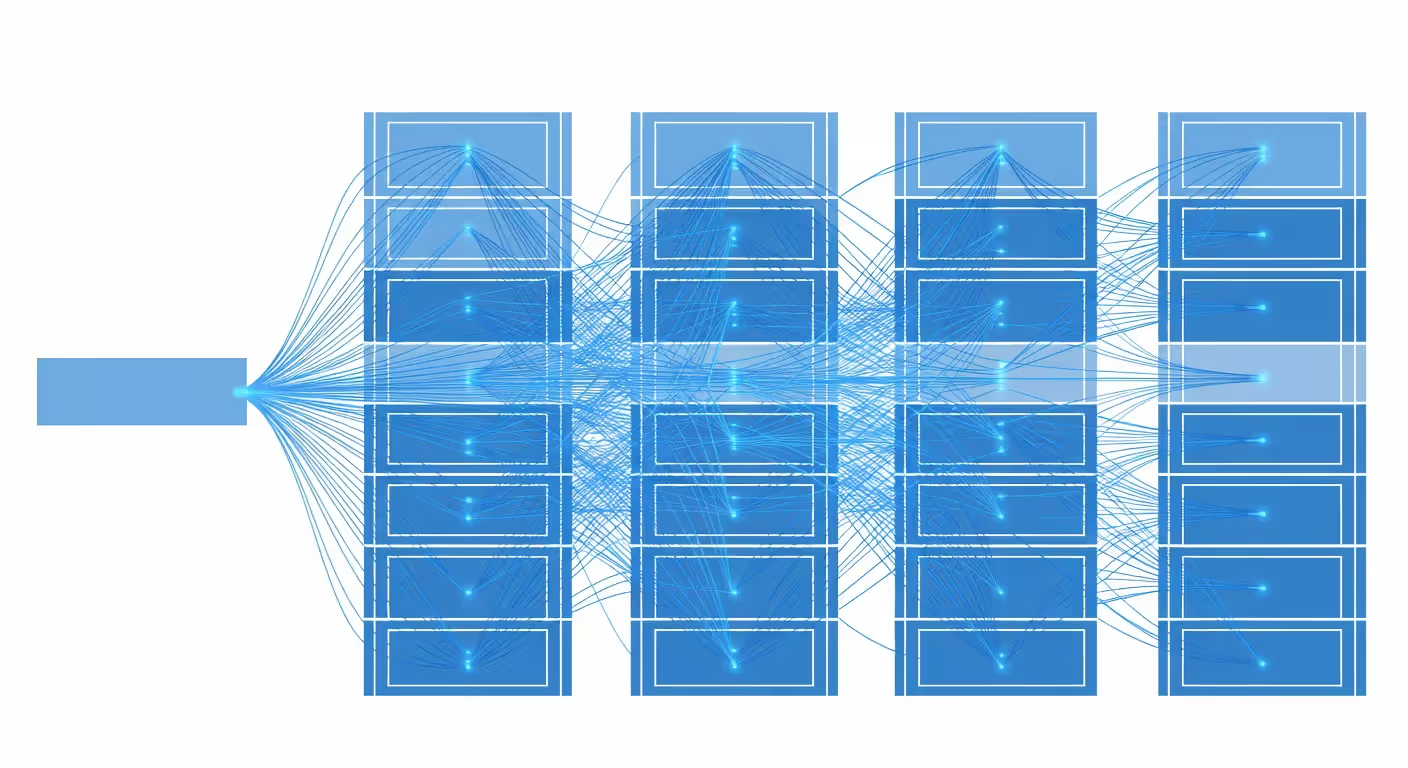
Processing phase: Those numbers flow through dozens of transformer layers (more on that architecture shortly). Each layer applies mathematical operations, comparing your input against patterns the model absorbed during training. The system builds probability distributions: which token has the highest chance of coming next?
Output phase: The model picks a token based on those probabilities—with some controlled randomness to prevent robotic repetition. That token becomes text on your screen. Then the model feeds it back into the input, predicts the next token, and repeats. This loop continues until it hits a natural stopping point or reaches a length limit.
Each token generation takes milliseconds. That's why chat interfaces display responses word-by-word rather than all at once.
Context windows create hard boundaries. They define how much previous conversation the model can reference simultaneously. GPT-4 Turbo handles 128,000 tokens (roughly 96,000 words). Feed it more than that, and it forgets earlier content—like trying to remember a conversation while someone keeps erasing your notes.
Training: How LLMs Learn Language
LLMs begin as blank slates—neural networks with randomly initialized parameters that produce gibberish. Training transforms them through two distinct phases.
Pre-training exposes the model to massive text collections: Common Crawl's web scrape (billions of pages), Books3 (180,000+ books), GitHub code, Wikipedia in 300+ languages, scientific papers, patents, and more. The task seems simple: predict the next token. The model reads "The capital of France is ___" and learns "Paris" should follow. Repeat this billions of times across diverse text, and the model internalizes grammar rules, factual associations, reasoning patterns, and—unfortunately—biases present in its training corpus.
This phase demands months of computation across thousands of specialized GPUs. Training GPT-4 reportedly cost over $100 million in compute resources alone. The model adjusts its billions of parameters to minimize prediction errors, slowly discovering linguistic structure.
Fine-tuning narrows the model's behavior. Developers use smaller, curated datasets to teach specific skills. Supervised fine-tuning shows the model examples of ideal responses—questions paired with high-quality answers. Reinforcement learning from human feedback (RLHF) has people rank multiple outputs from the same prompt, teaching the model which responses humans prefer. This phase transforms a raw language predictor into a helpful assistant.
That's llm training explained without drowning in technical details. The actual process involves countless decisions about data filtering, training duration, learning rates, and optimization algorithms.
One insight that surprises people: more data doesn't automatically improve results past certain thresholds. A model trained on 500 billion carefully filtered, high-quality tokens often outperforms one trained on a trillion tokens of noisy, low-quality text. Garbage in, garbage out—even at massive scale.
Architecture: The Transformer Model Behind LLMs
Every major LLM today uses transformer architecture, introduced in Google's 2017 "Attention Is All You Need" paper. Before transformers, AI struggled with long-range dependencies—connecting a pronoun at the end of a paragraph to its antecedent at the beginning.
Transformers solved this with attention mechanisms. Here's the llm architecture overview minus the calculus:
Imagine reading "The cat, which was orange and had white paws, sat on the mat." Your brain automatically links "cat" with "was," "had," and "sat," despite intervening words. Attention mechanisms do something analogous, computing relevance scores between every token pair in the input. Which words matter most for understanding each other word?
Author: Isabelle Norwyn;
Source: aleanetwork.net
Models stack many transformer layers—GPT-4 has dozens. Early layers might capture basic syntax: subject-verb agreement, punctuation patterns. Deeper layers recognize abstract concepts: analogies, cause-and-effect relationships, argumentative structure.
Self-attention lets each token simultaneously "look at" every other token in the context window. This parallelization makes transformers dramatically faster to train than older sequential architectures that processed one word at a time.
Feed-forward networks within each layer apply learned transformations to attention outputs, adding another round of pattern recognition.
Residual connections create shortcuts that let information bypass layers, preventing degradation as data flows through dozens of transformations.
You don't need to understand the linear algebra. The key insight: transformers excel at finding patterns in sequences by letting every input element influence every output element, weighted by learned importance scores.
Foundation Models vs LLMs: What's the Difference?
People use these terms interchangeably. They shouldn't.
Foundation models are large AI systems trained on broad datasets that can adapt to many downstream tasks. They provide a foundation for building specialized applications. This category includes language processors, image generators, multimodal systems, and more.
LLMs are foundation models specifically designed for language tasks. Every LLM qualifies as a foundation model. Not every foundation model processes language.
The foundation model vs llm distinction becomes clearer with examples:
DALL·E (OpenAI) generates images from text descriptions. Foundation model? Yes. LLM? No—it outputs pixels, not words.
Stable Diffusion (Stability AI) creates images through diffusion processes. Another foundation model outside the LLM category.
GPT-4 handles language processing as its primary function. It's both a foundation model and an LLM.
Whisper (OpenAI) transcribes speech to text with remarkable accuracy. Foundation model for audio, not technically an LLM despite its language output.
Modern products often combine multiple foundation models. ChatGPT with vision uses GPT-4 (an LLM) plus separate image processing models. Gemini handles text, images, and video through different specialized components working together.
Here's how these categories compare:
Model Type
Primary Function
Training Data
Example Use Cases
Examples
Traditional AI Models
Single narrow task
Small, task-specific datasets (thousands to millions of examples)
Large datasets in specific modality (millions of examples)
Image generation, speech recognition, video synthesis, music creation
DALL·E, Whisper, Stable Diffusion, MusicLM
Multimodal Foundation Models
Multiple data types processed simultaneously
Mixed datasets spanning text, images, audio, video
Visual question answering, document analysis with charts, video understanding
GPT-4V, Gemini Pro, Claude 3 with vision
Foundation models represent a strategic shift in AI development. Instead of training separate specialized models for each task (translation, summarization, question-answering), developers build one powerful base model and adapt it. This approach cuts costs and often improves performance across diverse applications.
Common Uses of Large Language Models
LLMs have escaped research labs and infiltrated daily workflows across industries.
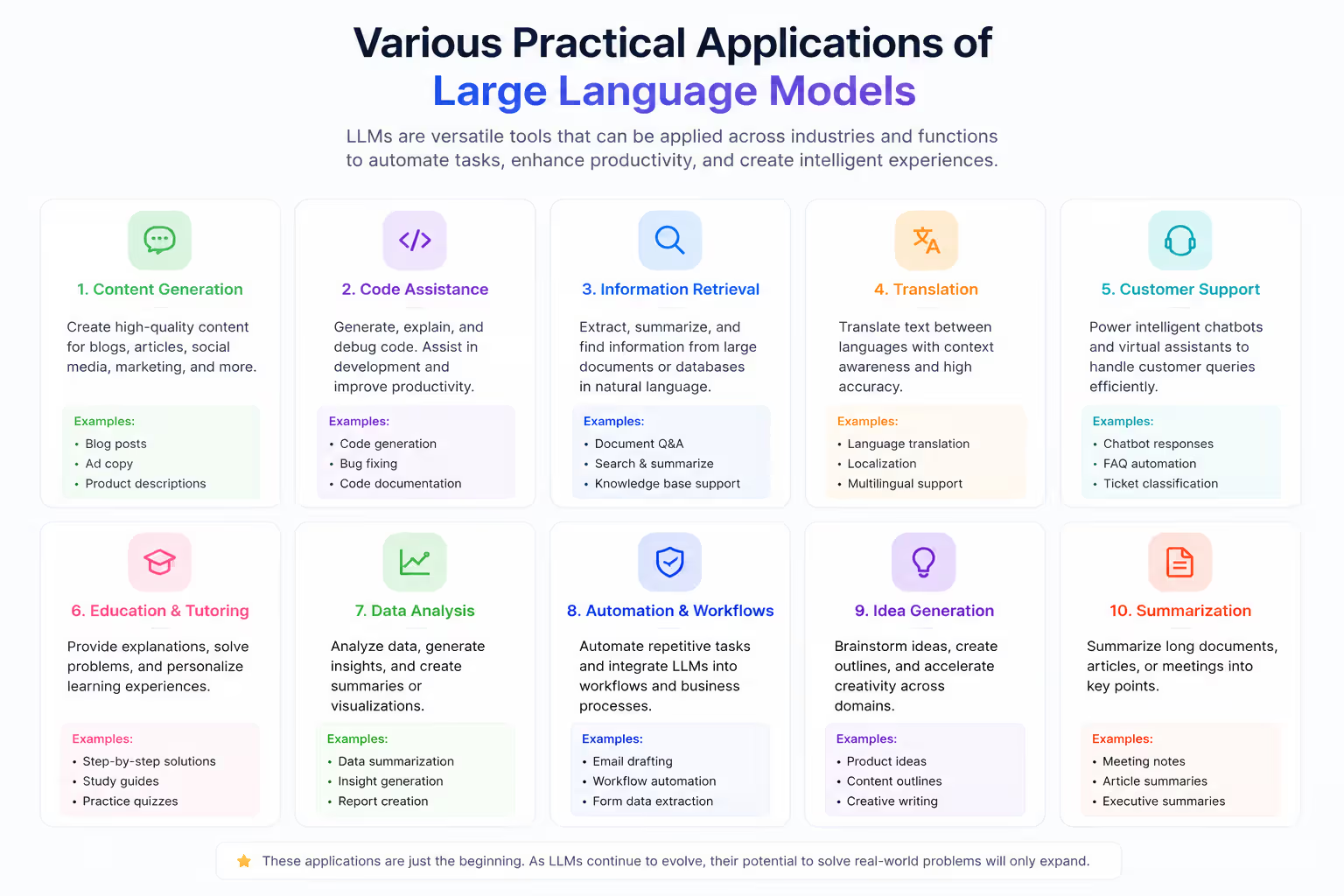
Content creation covers blog drafts, marketing copy, social media posts, product descriptions, and email responses. The model generates initial drafts that humans refine and fact-check. Marketing teams I've consulted with report 50-70% time savings on first-draft production—though editing still takes substantial effort.
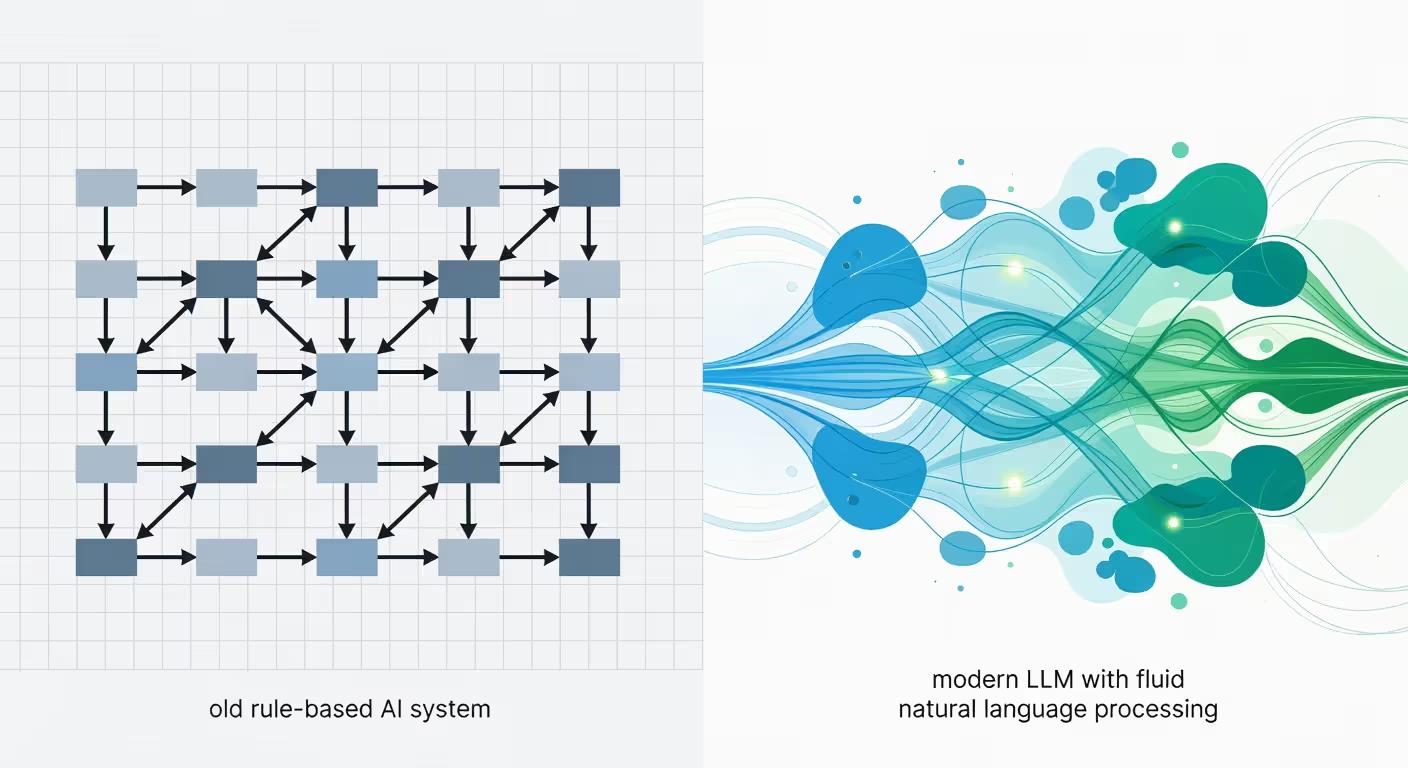
Conversational AI powers customer service bots, virtual assistants, and technical support systems. Unlike older rule-based chatbots that broke when users asked unexpected questions, LLM-powered systems handle novel queries by drawing on their broad training. They manage routine inquiries while escalating complex issues to humans.
Code assistance tools like GitHub Copilot autocomplete functions, explain legacy code, debug errors, convert code between languages, and generate entire programs from plain English descriptions. Developer surveys show 30-40% productivity gains on repetitive coding tasks, though complex architecture still requires human expertise.
Translation and localization benefit from LLMs' multilingual training. They translate while preserving context, idioms, and tone better than older word-by-word systems. A French marketing slogan gets translated with cultural sensitivity, not just literal word substitution.
Summarization condenses lengthy documents—research papers, legal contracts, meeting transcripts, quarterly reports—into digestible overviews. This saves hours for professionals drowning in information overload.
Data extraction pulls structured information from unstructured text. An LLM can read hundreds of invoices and extract vendor names, dates, amounts, and line items into a spreadsheet—tasks that previously required manual data entry or brittle template-matching systems.
Author: Isabelle Norwyn;
Source: aleanetwork.net
Education and tutoring applications explain complex concepts, answer follow-up questions, generate practice problems, and adapt explanations to different knowledge levels. A student struggling with calculus can ask for multiple explanations until one clicks.
The biggest mistake I see: treating LLM output as finished work. These tools excel at generating starting points and suggestions. They require human oversight for accuracy, appropriateness, and quality. The sweet spot is human-AI collaboration—using the LLM to handle grunt work while humans provide judgment, creativity, and verification.
Limitations and Challenges of LLMs
Despite their impressive capabilities, LLMs have fundamental weaknesses you need to understand before depending on them.
Hallucinations occur when models confidently generate false information. Since they optimize for plausible-sounding text rather than truth, they'll invent citations, fabricate statistics, or create nonexistent historical events if doing so produces coherent responses. Ask about an obscure 18th-century poet, and the model might invent a detailed biography rather than admit uncertainty.
Bias mirrors training data. The internet overrepresents certain demographics, contains stereotypes, and reflects historical prejudices. Models absorb these patterns. Researchers have documented gender bias in job-related text generation, racial bias in sentiment analysis, and political bias in opinion-based responses. The model doesn't have opinions—it replicates patterns from its training corpus.
Computational cost creates barriers. Training GPT-4 reportedly required over $100 million in compute resources. Running inference at scale demands expensive GPU infrastructure—serving millions of ChatGPT users costs OpenAI an estimated $700,000+ daily. This concentrates power among well-funded organizations and raises environmental concerns about energy consumption.
Lack of genuine comprehension means LLMs manipulate symbols without understanding meaning. They can't verify facts against reality, reason about cause-and-effect from first principles, or update their knowledge without complete retraining. They're pattern matchers, not thinking entities. Ask "Why is the sky blue?" and they'll recombine explanations from their training data—not reason through Rayleigh scattering from scratch.
Data cutoff issues freeze knowledge at training time. A model trained in early 2024 doesn't know about events from late 2024 or 2025. Some systems add retrieval mechanisms to access current information, but the base model remains static. Ask about last week's news, and you'll get "I don't have information about events after [training cutoff date]."
Context window limits restrict simultaneous information processing. Even with 128,000-token windows, analyzing ten 50-page documents together remains challenging. The model can't truly "remember" everything—it processes what fits in its context window and forgets the rest.
Inconsistency appears across similar prompts. Ask the same question twice with minor wording changes, and you might get contradictory answers. The randomness that makes outputs creative also makes them unpredictable. This inconsistency makes LLMs unsuitable for applications requiring deterministic behavior.
Security vulnerabilities include prompt injection (crafting inputs that override the model's instructions), data leakage (extracting memorized training data through carefully designed queries), and adversarial attacks (inputs that cause systematic failures or inappropriate outputs).
The pattern I observe repeatedly: organizations overestimate LLM reliability and underestimate the need for human verification. These tools augment human capabilities brilliantly. They don't replace human judgment.
Comparison of Model Capabilities: Before and After LLMs
Traditional AI systems required extensive feature engineering and task-specific training. You'd build separate models for sentiment analysis, translation, summarization, and question-answering—each needing its own labeled dataset, custom architecture, and months of development.
Before LLMs: A customer service system might use keyword matching to route inquiries ("refund" → billing department), template-based responses for common questions ("Your order ships in 3-5 business days"), and human escalation for anything remotely complex. Adding a new product line meant manually creating new templates, updating keyword dictionaries, and testing routing logic. Development time: 3-6 months.
After LLMs: The same system uses one model that understands natural language variations, handles unexpected questions through pattern matching against its training, maintains conversation context across multiple exchanges, and adapts to new products by updating a prompt rather than retraining. Response quality improved while development time dropped to 2-4 weeks.
This flexibility emerges from scale and generalization. The model encountered so many language patterns during training that it handles novel situations by analogy to similar examples.
Author: Isabelle Norwyn;
Source: aleanetwork.net
But there's a tradeoff. Traditional systems were predictable and explainable. You could trace exactly why the system routed a query to billing or generated a specific response. LLMs are powerful but opaque black boxes. You can't easily determine why the model generated a particular response or guarantee it won't occasionally produce something wildly inappropriate.
FAQ: Large Language Model Questions Answered
Are LLMs actually intelligent?
No, not by any meaningful definition of intelligence. LLMs lack consciousness, self-awareness, and genuine understanding. They recognize statistical patterns in text and generate likely continuations—pattern matching at extraordinary scale. This produces useful output for countless tasks, but it's not thinking. The model can't verify its statements against reality, doesn't have goals or motivations, and can't learn from individual conversations without complete retraining. When Claude gives you a thoughtful-sounding answer, it's recombining patterns from billions of training examples, not reasoning through the problem.
How much data does it take to train an LLM?
Modern LLMs train on trillions of tokens—equivalent to millions of books. GPT-3 used approximately 45TB of compressed text data. Newer models use even more, though companies rarely publish exact figures. Training also requires thousands of GPU-hours over weeks or months. For perspective: reading all of Wikipedia would take a human several years of continuous reading. An LLM processes comparable text volumes in weeks during training. This massive scale enables models to capture subtle language patterns, rare word combinations, and domain-specific terminology.
Can LLMs learn after they're trained?
Not in any practical sense. The base model's parameters freeze after training. It can't update its knowledge from conversations, correct mistakes based on user feedback, or absorb new information without formal retraining. Some systems use retrieval-augmented generation (RAG) to access external databases, creating the appearance of learning, but the model itself remains static. Fine-tuning can adapt a trained model to new tasks, but this still requires a structured training process with curated data—it's not learning from casual use. If you correct ChatGPT in one conversation, it won't remember that correction in your next chat.
Why do LLMs sometimes give wrong answers?
Multiple factors contribute. First, they optimize for plausible-sounding text, not accuracy. If misinformation appeared frequently in training data, the model might reproduce it confidently. Second, they can't fact-check against external sources unless specifically designed with retrieval capabilities. Third, they sometimes "hallucinate" details to complete coherent responses when they lack relevant information—making up citations or statistics rather than admitting uncertainty. Fourth, ambiguous questions can lead to technically correct answers that miss your actual intent. Always verify important information from LLM outputs against authoritative sources.
Do all LLMs work the same way?
The core mechanism—transformer architecture predicting next tokens—is nearly universal among modern LLMs. But substantial differences exist in training data composition, model size, fine-tuning approaches, and architectural details. Some models prioritize longer context windows; others optimize for speed or specialize in domains like code or scientific text. Training philosophies differ: some emphasize helpfulness and capability, others prioritize safety and harmlessness. These variations mean different LLMs excel at different tasks, even though they share foundational technology. GPT-4 might excel at creative writing while Claude handles long document analysis better.
What's the difference between an LLM and a chatbot?
An LLM is the underlying technology—the AI model itself. A chatbot is an application built using an LLM (or other technology). ChatGPT is a chatbot powered by GPT-4, an LLM. The chatbot includes the user interface, conversation management system, safety filters, system prompts that shape responses, and often additional features like web search or image generation. Older chatbots used rule-based systems or simpler AI without LLMs. Modern chatbots leverage LLMs for more natural, flexible conversations, but the chatbot is the complete product while the LLM is the engine powering it—like the difference between a car and its engine.
Understanding llm explained fundamentals helps you use these tools more effectively and set realistic expectations. LLMs represent a significant leap in AI capability, but they're specialized tools with specific strengths and weaknesses. They excel at recognizing and generating language patterns while lacking genuine comprehension or reasoning ability. The technology continues evolving rapidly, but the core principle—predicting likely text based on learned statistical patterns—remains central to how these systems operate.
Computer vision enables machines to interpret visual data like humans do—only faster and more accurately. This comprehensive guide explains the technology behind facial recognition, autonomous vehicles, medical imaging, and more, breaking down how it works and where it's applied.
Retrieval Augmented Generation combines information retrieval with language models to create AI systems that provide accurate, source-backed answers. This guide explains how RAG works, its architecture, and practical implementation steps for building production systems.
Discover what makes transformer models the foundation of modern AI. This guide explains attention mechanisms, architecture components, and why transformers outperform RNNs for language tasks, with real-world examples from ChatGPT to BERT.
Generative AI creates new content rather than analyzing existing data. Learn how neural networks and transformers power tools like ChatGPT and DALL-E, explore different model types, and understand real-world applications across industries from healthcare to marketing.
The content on this website is provided for general informational and educational purposes only. It is intended to explain concepts related to AI tools, agents, developer infrastructure, coding assistants, APIs, and productivity workflows.
All information on this website, including articles, guides, and examples, is presented for general educational purposes. Outcomes and tool performance may vary depending on implementation, skill level, and use case.
This website does not provide professional AI consulting, development services, or guarantees of results, and the information presented should not be used as a substitute for consultation with qualified AI or software development professionals.
The website and its authors are not responsible for any errors or omissions, or for any outcomes resulting from decisions made based on the information provided on this website.