Building AI agents used to require stitching together LLM APIs by hand, coding your own memory management, and crossing your fingers that your tool-calling logic wouldn't explode. Today, agentic AI frameworks do the grunt work for you.
These frameworks give developers a foundation for building autonomous agents—software that can think through problems, tap into external tools, retain context across conversations, and tackle complex objectives without someone holding its hand at every step. What once demanded PhD-level engineering chops now fits into a weekend project for someone comfortable with Python.
Here's the problem: you've got dozens of frameworks fighting for attention. Some prioritize developer experience. Others chase the latest research papers. Choose poorly and you'll spend months refactoring when you could've been shipping features.
This guide breaks down how agent frameworks actually operate under the hood, which ones lead the open-source pack, and how to match your project requirements to the right tool—without getting swept up in the hype machine.
What Are Agentic AI Frameworks?
Agentic AI frameworks are software libraries built specifically for creating autonomous AI agents. Traditional machine learning frameworks like TensorFlow or PyTorch help you train models. Agent frameworks orchestrate pre-trained language models to accomplish specific goals.
Think of them as the runtime environment for AI agents.
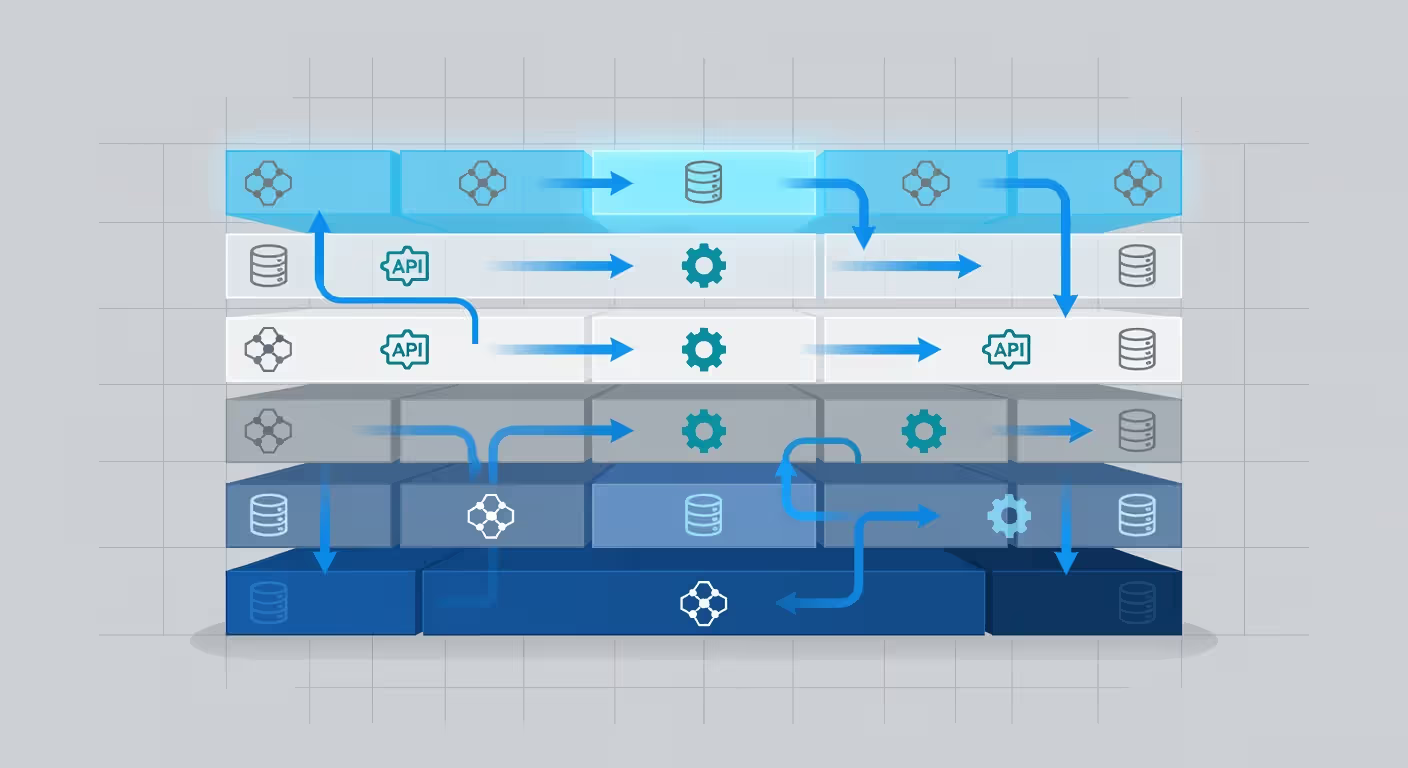
These tools provide infrastructure that lets agents break down problems, invoke external services, remember past interactions, and adjust their approach based on results. TensorFlow helps you build a neural network. An agent framework helps you build a system that decides what to do next based on changing conditions.
The fundamental distinction is agency. Conventional frameworks run the exact code you specify. Agent frameworks let the language model determine which operations to execute based on the objective you've defined.
Core features include:
Reasoning cycles. Agents don't just answer—they strategize, act, review outcomes, and course-correct. The framework orchestrates this process.
Tool connectivity. Agents can hit REST APIs, query SQL databases, execute Python scripts, or scrape web pages. The framework manages discovery, execution, and failure handling.
Memory architecture. Working memory tracks the current objective. Persistent memory stores knowledge between sessions. The framework determines what information to retain and when to surface it.
Multi-agent systems. Sophisticated frameworks enable multiple agents to work together, split responsibilities, and exchange information.
You're not training neural networks here. You're assembling them into systems that exhibit intelligent behavior.
Author: Adrian Westmere;
Source: aleanetwork.net
How AI Agent Frameworks Work
Agent frameworks generally follow a consistent architectural blueprint. Understanding this pattern helps when you need to debug problems or extend capabilities.
The typical agent execution flow looks like this:
Stage one: Goal definition. You provide the agent with an objective: "Research the three highest-rated sushi restaurants in Portland and email me a comparison."
Stage two: Strategy formation. The language model decomposes the objective into discrete steps. It might plan: search restaurant reviews, filter by rating and location, extract key details, format comparison, send email.
Stage three: Tool matching. For each step, the agent selects appropriate tools. Restaurant search requires a Yelp API call. Email delivery needs SMTP access.
Stage four: Action. The framework invokes the chosen tool using parameters the LLM generated. The tool returns data.
Stage five: Result analysis. The agent examines what came back. Did the operation succeed? Does it need additional information?
Stage six: Next move. Based on what it learned, the agent either continues forward, pivots to a different strategy, or marks the task complete.
The framework handles this loop automatically. You specify available tools and the end goal. The language model figures out the route.
Technically, most frameworks rely on function calling (sometimes called tool calling) from LLM providers. The model generates structured JSON that specifies which function to run and what arguments to pass. The framework interprets this output, runs the function, and pipes results back into the model.
Memory implementations vary widely. Some frameworks use basic conversation buffers. Others embed historical interactions into vector stores and retrieve relevant context through semantic search. The most common pattern I've encountered: recent messages stay in a buffer while older context gets pulled on-demand.
Prompt engineering happens behind the curtain. Frameworks inject system prompts that teach the model how to think through problems, format tool requests, and recover from failures. You can typically customize these prompts, though the defaults usually work fine.
One thing people get wrong: expecting the agent to always choose the perfect sequence of actions. It won't. Language models are probabilistic by nature. The identical task might follow different paths across runs. Strong frameworks let you log decision trees so you can identify patterns and tune prompts or tool documentation.
Popular Open Source AI Agent Frameworks
The open-source landscape has consolidated around several major frameworks. Each brings distinct advantages and compromises.
LangChain holds the largest market share. It began as a straightforward LLM wrapper and grew into a comprehensive agent orchestration system. LangChain excels at getting prototypes running fast—you can have a functional agent in under an hour. The drawback: the API is massive. Documentation sometimes trails new releases. Best suited for teams that value flexibility and can handle navigating a complex codebase.
LlamaIndex (previously called GPT Index) specializes in data access and knowledge organization. When your agent needs to pull from documents, SQL databases, or graph stores, LlamaIndex makes it straightforward. It's the default pick for agentic RAG projects. The framework is more prescriptive than LangChain, which helps or hurts depending on your requirements.
AutoGPT introduced the concept of fully autonomous agents to the mainstream. You set an objective and it runs until success or failure. It's less framework, more proof-of-concept, but it sparked countless production implementations. AutoGPT works great for experiments and demos. For production deployments, you'll probably want tighter control than it provides by default.
CrewAI targets multi-agent coordination. You assign roles (analyst, writer, reviewer) and CrewAI manages their collaboration. It's especially effective for content workflows where different agents own different pipeline stages. The learning curve is gentler than LangChain, though the applicable use cases are more specific.
LangGraph (also from the LangChain creators) models agent behavior as state graphs. You define nodes (operations) and edges (transitions), then the framework executes your graph. This approach gives you predictable, auditable control over agent actions—critical when you need deterministic behavior. The compromise: reduced autonomy, increased manual configuration.
Haystack from deepset started in NLP pipelines and search. It wasn't originally an agent framework, but version 2.x added agent features. Haystack stands out when you're building search-enhanced applications or need deep integration with Elasticsearch and similar platforms.
The shift from training models to orchestrating them represents the next phase of AI engineering. Frameworks that abstract the complexity of multi-step reasoning and tool use will define who can build useful AI systems at scale.
— Ng Andrew
Python-Based Agent Frameworks
Python dominates agent framework development. Almost every significant framework prioritizes Python or only supports Python.
Why the Python monopoly? The entire LLM ecosystem runs on Python. OpenAI's client library, Anthropic's SDK, Hugging Face—Python gets first-class support everywhere. Data science tooling lives in Python. Vector database clients are Python-first. The stack just integrates better when everything speaks Python.
This creates momentum. More Python frameworks generate more tutorials, more integrations, more Stack Overflow answers. If you're building agents today, you're probably writing Python.
JavaScript frameworks are catching up, though. LangChain.js now matches the Python version for many common scenarios. Vercel's AI SDK simplifies agent development in Next.js projects. But for backend-intensive workflows, data pipelines, or research work, Python remains the standard.
Python frameworks have another edge: seamless integration with the broader machine learning ecosystem. Need to fine-tune a model? Drop in Hugging Face Transformers. Need custom embeddings? Add Sentence Transformers. Need to parse PDFs? Use PyMuPDF. Everything connects without friction.
The path of least resistance usually wins. If your team already writes Python, stick with Python frameworks. Don't switch languages chasing a trendy framework.
LLM Agent Framework Comparison
Here's a breakdown comparing the leading frameworks:
Framework
Language
Ideal Use Case
Model Compatibility
License Type
GitHub Activity
LangChain
Python, JS
Broad applications, fast prototyping
OpenAI, Anthropic, Google, local
MIT
100k+ stars, very active
LlamaIndex
Python, TS
Knowledge retrieval, RAG systems
OpenAI, Anthropic, Google, local
MIT
35k+ stars, active
AutoGPT
Python
Full autonomy experiments, demos
OpenAI, limited local support
MIT
160k+ stars, moderate activity
CrewAI
Python
Team-based agents, content creation
OpenAI, Anthropic, local options
MIT
15k+ stars, growing
LangGraph
Python
Controlled workflows, compliance needs
Matches LangChain support
MIT
5k+ stars, rapidly growing
Haystack
Python
Search applications, NLP tasks
OpenAI, Cohere, Hugging Face
Apache 2.0
14k+ stars, steady
Community momentum matters more than most people realize. Larger communities ship bug fixes faster, build more third-party connectors, and increase the odds someone's already solved your exact problem.
Model support is converging across frameworks—most now work with OpenAI, Anthropic, Google, and local models through standardized interfaces. The real differences emerge in how well they handle provider-specific features like streaming responses, function calling formats, and rate limit management.
AI Agent Tools and SDK Components
Agent frameworks depend on an ecosystem of supporting tools and SDKs.
LLM client libraries provide the foundation. The OpenAI Python package, Anthropic's client, Google's Vertex AI SDK—these handle authentication, request construction, and response handling. Most frameworks wrap these clients instead of making raw HTTP calls.
Vector stores persist embeddings for semantic search and memory systems. Common options include Pinecone, Weaviate, Qdrant, and Chroma. LlamaIndex and LangChain integrate with all major vector databases. Your choice depends on scale (handling millions of vectors?) and hosting preference (managed service versus self-hosted).
Pre-built tool collections offer ready-made integrations. LangChain's tool catalog includes web search (SerpAPI, DuckDuckGo), code execution (Python REPL), file system operations, and API wrappers for hundreds of services. You can build custom tools too—just write a function and describe what it does.
Workflow orchestrators coordinate complex multi-step processes. Some frameworks (LangGraph) include orchestration. Others assume you'll use external systems like Apache Airflow or Prefect for production deployments.
Monitoring and tracing tools record agent behavior. LangSmith (from the LangChain team), Weights & Biases, and Helicone log every model call, tool execution, and decision branch. Debugging agents without visibility into their decision-making is essentially impossible.
Prompt versioning platforms manage and test prompts. Prompt engineering requires iteration. Tools like PromptLayer and HumanLoop let you A/B test different prompts and revert changes that break functionality.
The SDK ecosystem moves fast. New vector databases appear monthly. LLM providers ship features that break existing code. The frameworks that last are those that abstract dependencies cleanly.
Author: Adrian Westmere;
Source: aleanetwork.net
Agentic RAG Implementation
Retrieval-augmented generation just got an upgrade. Traditional RAG follows a simple pattern: you ask a question, the system fetches relevant documents, the LLM generates an answer. That's it.
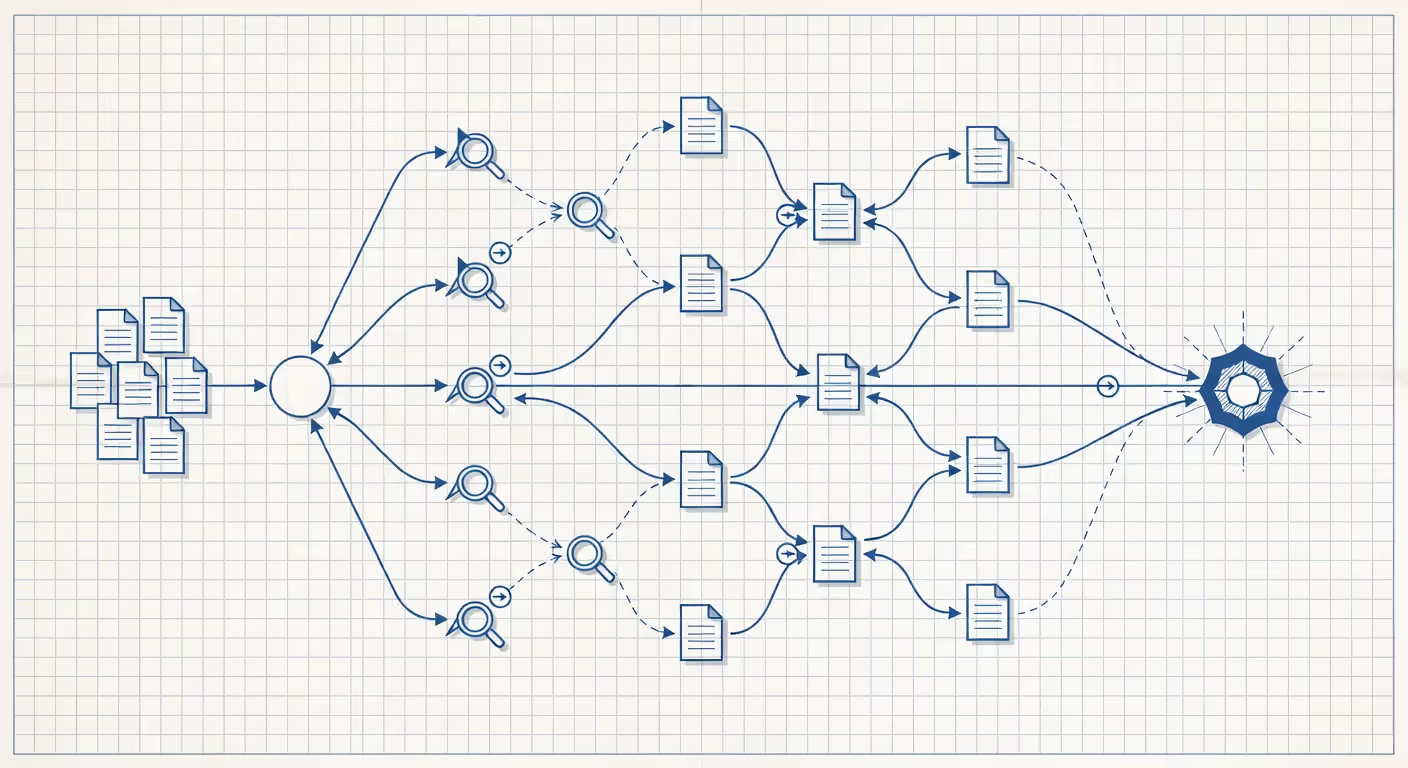
Agentic RAG iterates. The agent determines what to retrieve, evaluates whether the information answers the question, and fetches more if the answer is incomplete. It can rephrase queries, search across multiple sources, and combine information from several retrieval rounds.
Here's the process in practice:
Phase one: Question decomposition. The agent analyzes your question and identifies required information. For "How did Apple's revenue change between 2022 and 2025?", it recognizes: need quarterly reports, need year-over-year calculations, need revenue-specific data.
Phase two: Source selection. The agent chooses which knowledge bases to query. Financial filings? News archives? Analyst reports? It might hit multiple sources simultaneously.
Phase three: Adaptive retrieval. When initial results are incomplete, the agent rephrases queries or tries different sources. It's not a one-shot operation—it's an interactive search process.
Phase four: Information synthesis. After gathering sufficient data, the agent composes the final answer, includes source citations, and highlights information gaps.
LlamaIndex makes agentic RAG relatively painless. You connect data sources (PDFs, databases, APIs) and the framework handles query routing and iterative retrieval. LangChain supports this pattern too but requires more manual setup.
Common applications include:
Research tools that aggregate findings from multiple academic papers and generate summaries.
Support systems that search knowledge bases, historical tickets, and product documentation.
Financial analysis that queries earnings calls, market data, and news feeds.
The critical distinction from standard RAG: the agent actively controls retrieval. It's not passively fetching context—it's deliberately hunting for the information needed to answer your question accurately.
One warning: agentic RAG adds latency. Each retrieval iteration increases response time. If you need sub-second answers, traditional RAG might be more appropriate. But for complex questions where accuracy trumps speed, agentic RAG delivers better results.
Author: Adrian Westmere;
Source: aleanetwork.net
Choosing the Right Framework for Your Project
Framework selection depends on what you're shipping and who's building it.
For prototypes and MVPs: LangChain or CrewAI work well. Both let you move quickly. LangChain offers more pre-built tools. CrewAI simplifies multi-agent setups.
For document-heavy applications: LlamaIndex wins. When your agent spends most of its time querying documents or structured data, LlamaIndex's connectors and indexing approaches save significant development time.
For production systems with compliance requirements: LangGraph or Haystack make sense. You need predictable behavior, complete audit trails, and granular control over decisions. Full autonomy becomes a liability in regulated environments.
For research or experimentation: AutoGPT or custom builds give you freedom. Production frameworks impose structure that can limit exploration. Sometimes you need to break conventions to discover new approaches.
For teams learning AI development: CrewAI or LangChain with extensive use of pre-built components reduces friction. Learning curve matters. A framework that gets your team to a working demo in three days beats one that takes three weeks to understand.
Scalability deserves consideration. Can the framework support thousands of concurrent agents? Does it handle distributed execution? Most frameworks run in a single process by default. Scaling means wrapping them in task queues (Celery, RQ) or serverless platforms (AWS Lambda, Modal).
Cost management matters too. Agents can burn through API budgets surprisingly fast. Look for frameworks supporting streaming (improves perceived speed), caching (eliminates duplicate calls), and local model fallbacks (for routine tasks that don't need frontier models).
Team expertise beats feature checklists. A framework your developers already understand ships faster than a "superior" framework they need to learn from scratch.
Common Mistakes When Building with Agent Frameworks
Everyone makes these errors. Here's how to sidestep the worst ones.
Error one: Over-complicating version one. You don't need multi-agent orchestration, vector databases, and custom embeddings for your initial release. Start simple. Single agent, single task, hardcoded tools. Add complexity only when simplicity fails.
Error two: Neglecting prompt engineering. The framework can't compensate for poor prompts. Vague tool descriptions lead to wrong tool selection. System prompts that ignore error handling result in crashes on edge cases. Invest time crafting good prompts.
Error three: Missing cost controls. Agents can loop endlessly, hammer expensive APIs, or use GPT-4 when GPT-3.5 suffices. Set maximum iterations. Cache responses aggressively. Route simple tasks to cheaper models. Check spending daily.
Error four: Ignoring observability. When an agent breaks, you need the decision trace. Which tools got called? What did they return? Why did it choose that path? Debugging blind wastes days.
Error five: Trusting agent outputs without checks. Agents hallucinate details. They call APIs with invalid parameters. They misread tool results. Always validate outputs before taking action—especially actions involving money, data deletion, or external integrations.
Error six: Skipping evaluation frameworks. How do you know if changes improve or degrade performance? You need test cases and metrics. Track success rate, average iterations per task, cost per completion, and user feedback. Frameworks won't measure this automatically.
Error seven: Treating frameworks as magic boxes. You will need to read source code eventually. Abstractions leak. When they do, you need to understand what's actually happening. Choose frameworks with readable implementations.
The pattern I see repeatedly: teams add complexity prematurely, then spend months stripping it back. Start with the minimum viable agent. Add features when you hit actual constraints, not theoretical ones.
Author: Adrian Westmere;
Source: aleanetwork.net
Choosing Between Managed and Self-Hosted Solutions
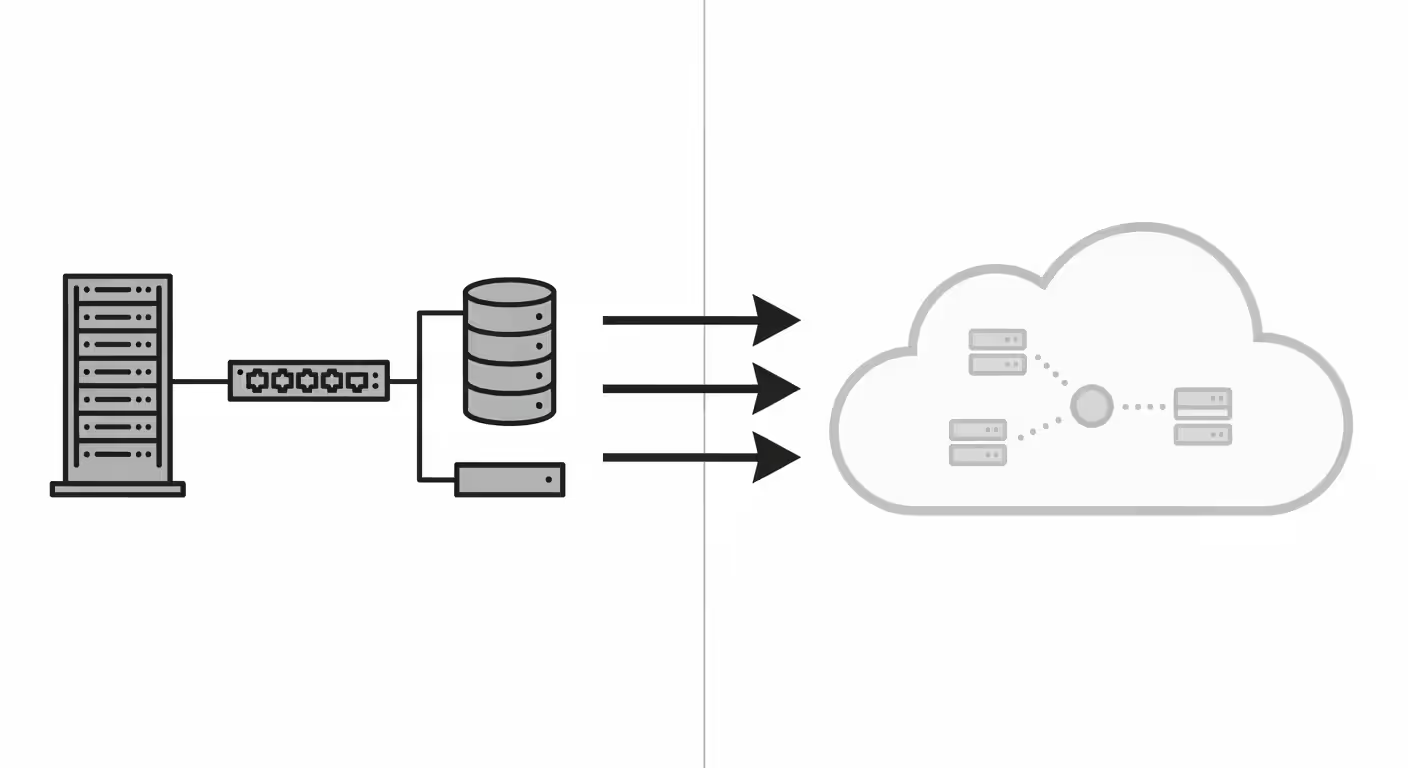
Most frameworks default to self-hosting—you run the code and manage the infrastructure. But managed alternatives are appearing.
Self-hosting advantages: Complete control. No vendor lock-in. You can use local models, proprietary tools, and sensitive data without external transmission. Costs scale with compute resources, not usage volume.
Self-hosting disadvantages: You own deployment, scaling, monitoring, and security. When an agent misbehaves at 3 AM, you're getting paged.
Managed service advantages: Infrastructure handled by someone else. Platforms like LangSmith, Fixie, and Dust provide hosted runtimes with built-in monitoring and auto-scaling. You focus on agent logic instead of DevOps.
Managed service disadvantages: Vendor lock-in risks. Reduced control over data routing. Unpredictable cost spikes. Feature availability depends on the vendor's roadmap.
For early projects, self-hosting usually makes sense. You learn faster with direct control. For production systems at scale, managed platforms can save engineering hours—if you trust the vendor and the pricing works for your business model.
Hybrid approaches are common. Run agents self-hosted while using managed services for vector databases (Pinecone), monitoring (LangSmith), or LLM APIs (OpenAI).
FAQ: Agentic AI Frameworks Questions Answered
What separates an AI agent framework from a regular API?
A regular API is a tool you invoke with specific inputs to receive specific outputs. You write the control logic. An AI agent framework gives a language model the ability to decide which APIs to invoke, in what sequence, based on a goal you specify. The framework manages orchestration—you provide available tools and the objective, but the agent determines the execution path. Think of APIs as individual tools in a toolbox. An agent framework is the contractor who decides which tool to grab for each part of the job.
Which framework should someone new to agents start with?
CrewAI or LangChain make good starting points. CrewAI has a friendlier learning curve and clearer documentation for multi-agent scenarios. LangChain offers more resources—tutorials, community forums, Stack Overflow threads—but the API surface is larger and can overwhelm newcomers. If you're comfortable piecing together information from multiple sources, start with LangChain. If you want quick wins in your first session, try CrewAI. Both have strong Python support and active communities.
Can non-programmers use these frameworks?
No. These are code libraries, not visual builders or no-code platforms. You'll write Python (or JavaScript), define functions, handle exceptions, and debug issues. That said, you don't need senior engineer skills. If you can write basic Python scripts, install packages with pip, and read API documentation, you can build simple agents. Complexity scales with ambition. A basic document retrieval agent is beginner-friendly. A multi-agent system with custom memory and tool integrations requires intermediate to advanced programming skills.
Can I use these open source frameworks in commercial products?
Yes, in most cases. LangChain, LlamaIndex, AutoGPT, CrewAI, and LangGraph all use permissive licenses (MIT or Apache 2.0) allowing commercial use without restrictions. You can build products, charge customers, and deploy at any scale. The catch: the frameworks themselves are free, but the services they connect to aren't. LLM providers charge per API call. Vector databases and monitoring tools often have paid tiers. Always verify the license before building commercial products, but major frameworks won't block you.
What makes agentic RAG different from regular RAG?
Regular RAG retrieves documents once based on your query, then generates a response. It's a single fetch-and-answer cycle. Agentic RAG lets the agent iterate. It retrieves information, evaluates sufficiency, and retrieves again if needed—potentially from different sources or with reformulated queries. The agent drives the retrieval process, deciding what to fetch and when enough information has been gathered. This makes agentic RAG slower but more comprehensive. Use regular RAG when speed matters and queries are straightforward. Use agentic RAG for complex questions requiring multiple sources or follow-up searches.
Can one framework work with different language models?
Yes. Most frameworks support multiple LLM providers through abstraction layers. You can route tasks to different models—GPT-4 for complex reasoning, GPT-3.5 for routine queries, a local Llama model for privacy-sensitive operations. LangChain and LlamaIndex handle this through model routing configurations. Some frameworks even let agents select which model to use based on task requirements. The complexity: managing multiple API keys, rate limits, and response format variations. Start with a single model. Add others when you have clear justification—cost reduction, latency improvement, or capability requirements.
Working with agentic AI frameworks means adopting a different development mindset. You're not writing deterministic code anymore. You're composing systems that reason, adapt, and occasionally surprise you—sometimes positively, sometimes not. The frameworks that survive long-term will balance power with predictability, autonomy with control. Choose one framework, build something small, and refine it. The best way to learn agent frameworks is watching your agents fail, understanding why, and fixing the root cause.
AI visibility tools monitor how often your brand appears in AI-generated responses across ChatGPT, Perplexity, and Gemini. Unlike traditional SEO tools that track Google rankings, these platforms measure citations, mentions, and context in AI answers—helping you optimize for generative engine visibility.
An AI SDR automates prospecting, outreach, and lead qualification using machine learning and natural language processing. Discover how these systems work, when to use AI versus human SDRs, common implementation mistakes, and what tools are available.
Discover how conversational AI assistants use NLP and machine learning to understand context and hold natural dialogues. This guide covers technology fundamentals, use cases, implementation strategies, and how to avoid common challenges when deploying AI assistants for business.
AI voice agents combine speech recognition, natural language processing, and voice synthesis to conduct natural phone conversations. Learn how the technology works, what capabilities modern systems offer, and which industries benefit most from automated voice interactions.
The content on this website is provided for general informational and educational purposes only. It is intended to explain concepts related to AI tools, agents, developer infrastructure, coding assistants, APIs, and productivity workflows.
All information on this website, including articles, guides, and examples, is presented for general educational purposes. Outcomes and tool performance may vary depending on implementation, skill level, and use case.
This website does not provide professional AI consulting, development services, or guarantees of results, and the information presented should not be used as a substitute for consultation with qualified AI or software development professionals.
The website and its authors are not responsible for any errors or omissions, or for any outcomes resulting from decisions made based on the information provided on this website.