DevOps has evolved from tech industry buzzword to essential business strategy. Yet most companies stumble through their first implementation, investing heavily in platforms and tools while missing the fundamental shifts that actually drive results. The pattern repeats everywhere: leadership renames the operations group, purchases enterprise software licenses, then watches as deployment cycles remain just as painful and slow. Genuine transformation demands more than cosmetic changes—it requires reimagining collaboration, responsibility, and delivery across your entire organization. This guide focuses on practices that create measurable improvements, turning unpredictable release chaos into reliable, repeatable delivery systems that teams can trust.
What Is DevOps and Why It Matters
DevOps merges development and operations into a collaborative model where both disciplines share ownership of the complete software lifecycle. Rather than maintaining separate teams with conflicting incentives, this approach creates unified groups responsible for building, deploying, and maintaining applications together.
The business impact is substantial. Research tracking thousands of organizations shows that mature DevOps practitioners ship updates 200 times more frequently while recovering from production problems 24 times faster than their traditional counterparts. These aren't aspirational targets—they're documented outcomes from companies that commit to the full transformation.
Beyond raw velocity, DevOps reduces the financial damage from failed releases, increases employee retention, and accelerates your ability to respond when market conditions shift. While you're planning quarterly releases, competitors with modern practices are testing customer reactions to new features weekly. That gap doesn't just slow you down—it actively erodes your market position.
Understanding the devops principles overview means recognizing this goes far beyond purchasing software. You cannot simply acquire your way to better outcomes. Success requires fundamental changes in how teams communicate, make decisions, and accept accountability for the systems they create.
Core DevOps Principles Every Team Should Follow
Five foundational principles separate successful implementations from expensive failures. Skip even one, and you're essentially running traditional development with fancier tooling.
Collaboration over silos. Development, operations, security, and quality assurance must function as a unified team with aligned objectives. This means establishing common goals, tracking shared metrics, and accepting collective responsibility for results. When production systems fail, the entire team owns the problem—not just whoever received the alert.
Automation over manual processes. Any task performed more than twice becomes a candidate for automation. Testing, deployment, infrastructure provisioning, and monitoring should all execute without human intervention. The goal isn't eliminating positions—it's removing tedious, mistake-prone activities that waste talented people's time on repetitive work.
Continuous improvement over perfection. Release small, incremental changes frequently rather than accumulating features for massive updates. Each release generates learning opportunities. Higher deployment frequency directly correlates with faster learning about what actually delivers value.
Fast feedback loops over delayed reviews. Teams require immediate signals when problems emerge. Automated test suites identify defects in minutes instead of weeks. Monitoring systems flag performance degradation before customers notice. Shorter feedback cycles mean cheaper, easier fixes.
Shared responsibility over handoffs. The "you build it, you run it" philosophy extends beyond clever slogans. When developers carry responsibility for production behavior, code quality improves dramatically. When operations engineers participate in design decisions, systems become inherently more maintainable.
These devops guidelines overview appear straightforward. Implementation proves challenging. The most common failure pattern involves teams enthusiastically adopting automation while completely ignoring cultural principles. That's precisely why initiatives lose momentum.
Author: Isabelle Norwyn;
Source: aleanetwork.net
Building a DevOps Culture in Your Organization
Culture determines whether technical practices take root or wither. You can mandate DevOps adoption from executive levels, but when your culture still penalizes mistakes and celebrates individual heroics, fundamental behaviors won't shift.
Breaking down organizational silos begins with physical or virtual proximity. Seat developers alongside operations engineers. Have them participate in each other's planning sessions. Form cross-functional squads where everyone pursues identical objectives. When developers have never spoken with the people deploying their code, collaboration has already failed.
Fostering psychological safety creates environments where people can acknowledge errors without fear. The worst DevOps cultures bury problems until they explode catastrophically. The best ones surface issues immediately because team members trust they won't face punishment for raising concerns. Blameless retrospectives after incidents focus teams on learning rather than finger-pointing.
Leadership buy-in isn't optional—it's foundational. Executives must recognize that transformation requires sustained investment in time, training, and tools. They need to support teams through the awkward transition period where you're maintaining legacy processes while constructing new ones. When leadership demands accelerated results without providing necessary resources, burnout becomes inevitable.
Communication practices must evolve alongside technical changes. Replace synchronous status meetings with asynchronous updates. Use real-time messaging for quick questions instead of email threads. Document decisions in shared, searchable locations. The objective is minimizing latency between asking questions and receiving answers.
One organization I studied invested six months purely in devops culture and practices before modifying a single tool. They conducted workshops, rotated personnel between teams, and established new communication norms. When technical implementation finally began, progress accelerated dramatically because the cultural foundation was solid.
Trust takes time. Operations teams scarred by broken deployments won't immediately trust developers to handle their own releases. Developers accustomed to change advisory boards blocking their work won't immediately embrace continuous delivery. You build trust through accumulated small victories—successful deployments, faster incident resolution, shared accomplishments.
The devops team practices that succeed are those that simplify collaboration rather than complicating it. If your new process demands three additional meetings and five approval checkpoints, you're regressing.
DevOps Workflow Practices That Drive Results
Theory provides direction. Execution delivers outcomes. These workflow practices form the operational heart of effective DevOps.
Continuous Integration and Continuous Delivery
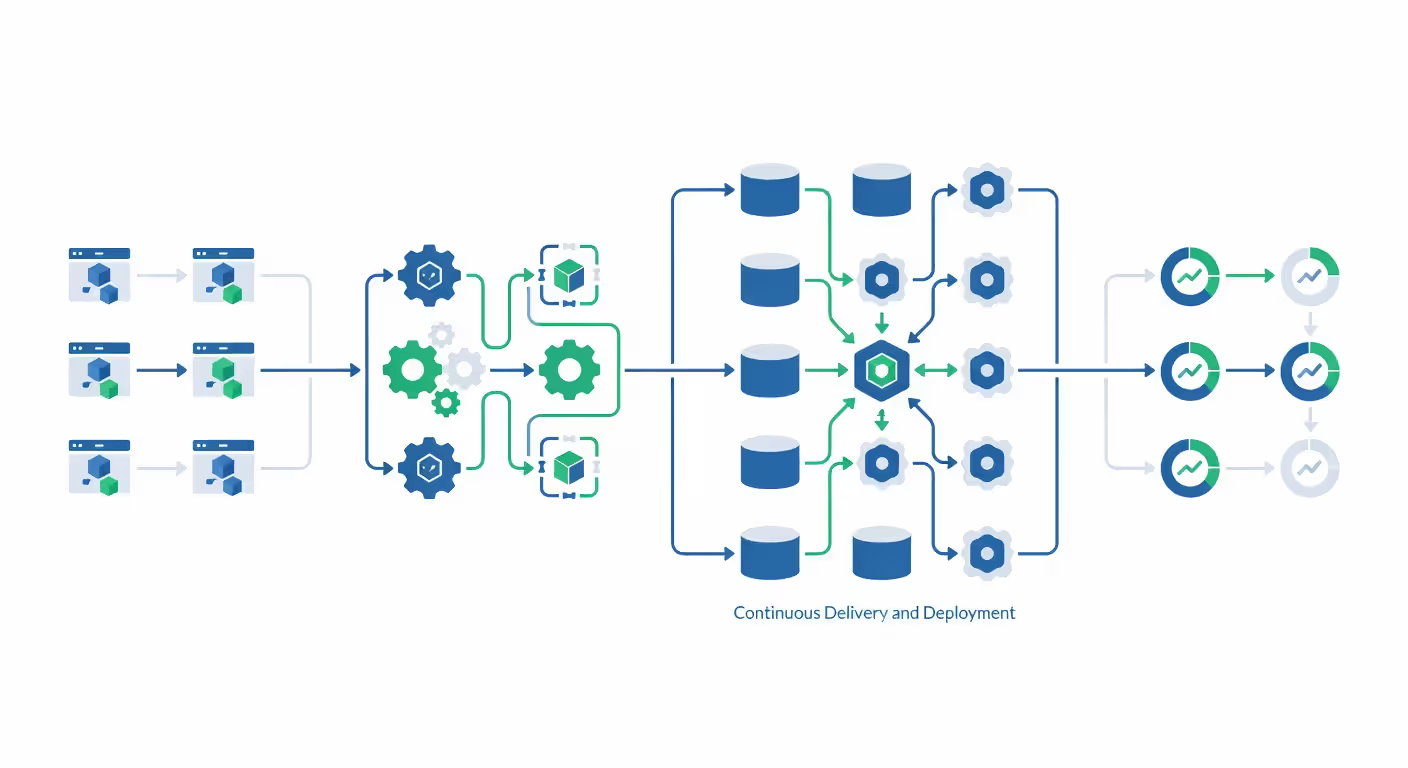
Continuous Integration establishes a practice where developers integrate their work into shared codebases many times daily. Every integration triggers automated compilation and testing. When failures occur, teams identify them within minutes and pinpoint the exact change responsible.
The alternative is integration nightmare scenarios: developers work independently for weeks, then spend days untangling merge conflicts and hunting down bugs that emerged from interactions between changes. CI eliminates this waste entirely.
Continuous Delivery extends the concept further. Any modification that passes your automated test suite becomes deployment-ready for production environments. You might choose not to release every change immediately, but the technical capability exists. This differs from continuous deployment, where the final approval step disappears entirely and every passing change goes live automatically.
Here's a concrete example: A developer commits new code at 10 AM. Automated testing completes within 15 minutes. Passing tests trigger automatic deployment to staging environments. Additional validation runs there. When those checks pass, the code awaits production deployment. Total elapsed time from commit to production-ready status: 30 minutes.
Compare this to traditional workflows where code accumulates in queues for days awaiting scheduled release windows. The devops workflow best practices emphasize speed and automation over manual gates and approval bureaucracy.
Infrastructure as Code
Infrastructure as Code (IaC) treats servers, networks, and configurations as code files rather than manual console operations. You version control infrastructure definitions identically to application code.
This matters because manual infrastructure changes don't scale. Provisioning 50 identical servers through graphical interfaces means 50 repetitive, error-prone operations. With IaC, you execute one command.
More critically, IaC makes infrastructure reproducible. Development environments mirror staging environments, which mirror production. Configuration drift can't cause "works on my machine" problems when every environment builds from identical specifications.
Tools like Terraform, CloudFormation, and Ansible support declarative infrastructure descriptions. You specify desired end states, not implementation steps. The tooling calculates the necessary operations to align reality with your specifications.
Author: Isabelle Norwyn;
Source: aleanetwork.net
Automated Testing and Monitoring
Testing cannot remain an afterthought. Within DevOps, automated test suites function as safety nets enabling rapid movement without constant breakage.
Your testing strategy should encompass unit tests validating individual functions, integration tests verifying component interactions, and end-to-end tests confirming complete system behavior from user perspectives. Execute unit tests on every code commit. Execute integration tests before any deployment. Execute end-to-end tests within staging environments that mirror production.
Testing alone provides insufficient protection. Monitoring reveals actual production behavior. You need metrics tracking CPU utilization, response latencies, and error rates; logs providing detailed event records; and traces showing how requests flow through distributed systems.
Effective monitoring operates proactively rather than reactively. Configure alerts that trigger before failures occur. When response times gradually increase, you want visibility before customers experience problems. When error rates spike, you want to investigate before complete outages develop.
Observability represents monitoring's modern evolution. Rather than collecting only predefined metrics, observability enables arbitrary questions about system behavior. When unusual patterns emerge, you can investigate without first instrumenting new metrics.
Key Technologies and Tools for DevOps Implementation
Let's examine the implementing devops guide from a technology perspective. You'll require tools across several categories, but remember: tools enable DevOps practices—they don't create them.
CI/CD platforms automate your build, test, and deployment workflows. Jenkins, GitLab CI, GitHub Actions, and CircleCI represent popular options. These platforms monitor code repositories and trigger automated workflows when changes appear. The specific platform matters less than selecting one that integrates cleanly with your existing infrastructure.
Containerization packages applications alongside all dependencies into portable, self-contained units. Docker dominates this category. Containers eliminate environment inconsistencies by ensuring applications execute identically across developer workstations, test environments, and production servers.
Orchestration manages containerized applications at scale. Kubernetes has emerged as the standard solution. It handles deployment, scaling, networking, and health monitoring for container fleets. Important caveat: Kubernetes delivers tremendous power but introduces significant complexity. Smaller teams often benefit from simpler alternatives.
Configuration management tools including Ansible, Chef, and Puppet automate server setup and ongoing maintenance. They ensure servers maintain correct configurations over time, preventing drift.
Monitoring and observability platforms collect and analyze system telemetry. Prometheus, Grafana, Datadog, and New Relic appear frequently. Choose tools that integrate well with your infrastructure and provide the visibility your specific team requires.
Version control is absolutely non-negotiable. Git serves as the universal standard. Your application code, infrastructure definitions, and configuration files must all live in version control. Anything outside version control effectively doesn't exist.
The devops technologies explained here represent categories rather than prescriptions. Your specific choices depend on your technology stack, team size, and existing infrastructure. Simpler options usually win—start with tools your team can realistically learn and use effectively.
Author: Isabelle Norwyn;
Source: aleanetwork.net
DevOps Implementation Roadmap
Here's a practical breakdown showing what happens during each phase of a mature DevOps workflow. This table clarifies the practices and objectives for every stage:
Detect problems quickly, understand system behavior, inform continuous improvement
This workflow isn't strictly sequential. Modern DevOps teams loop back constantly—monitoring insights influence planning decisions, deployment issues trigger code modifications, testing reveals architectural limitations. The stages overlap and inform each other continuously.
The biggest predictor of IT performance is how quickly organizations can restore service when something goes wrong. High performers recover from failures in under an hour, while low performers take days or weeks. This difference comes from practices like automated deployment, comprehensive monitoring, and a culture where everyone shares responsibility for reliability.
— Humble Jez
Common DevOps Implementation Mistakes to Avoid
Most DevOps transformations fail for predictable, avoidable reasons. Here are the mistakes that kill momentum.
Tool-first thinking represents the most common trap. Companies purchase expensive platforms expecting them to magically resolve dysfunction. Tools cannot fix broken processes or toxic cultures. Begin with practices and culture, then select tools supporting your established goals.
Ignoring the cultural shift means treating DevOps as purely technical work. You can automate every process and still fail when developers and operations teams lack mutual trust. The implementing devops guide must address cultural transformation alongside technical changes.
Lack of meaningful metrics leaves teams operating blindly. Without tracking deployment frequency, lead time, change failure rate, and mean time to recovery, you cannot determine whether you're improving. Measurement drives management.
Inadequate training sets people up for failure. You cannot hand someone Kubernetes documentation and expect independent mastery. Budget sufficient time and resources for training, experimentation, and learning from mistakes.
Security as an afterthought creates enormous vulnerabilities. DevSecOps integrates security throughout development lifecycles instead of appending it at the end. Automated security scanning belongs in your CI/CD pipeline, not as a separate process creating bottlenecks.
Moving too fast sounds counterintuitive in a guide about velocity, but it's genuine. Teams attempting overnight transformation overwhelm themselves. Start with one service or one team. Learn what works in your context. Then expand deliberately.
Skipping documentation because "the code documents itself" or "we move too fast for documentation" creates knowledge silos. When only one person understands how systems work, you don't have DevOps culture—you have a single point of failure.
The devops team practices that persist are those introduced gradually, with proper support and realistic expectations. Quick wins build momentum. Attempting everything simultaneously just exhausts everyone.
Measuring DevOps Success
You cannot improve what you don't measure. The DORA (DevOps Research and Assessment) framework has become the industry standard for evaluating performance:
Deployment frequency tracks how often you ship code to production. Elite organizations deploy many times daily. Low performers deploy monthly or quarterly.
Lead time for changes measures elapsed time from code commit to production deployment. Elite teams complete this cycle within hours. Low-performing organizations require months.
Change failure rate calculates what percentage of deployments cause production failures requiring hotfixes or rollbacks. Elite teams maintain rates below 15%. Low performers experience failure rates exceeding 30%.
Time to restore service measures recovery time from production incidents. Elite teams restore service within an hour. Low performers need days or weeks.
These metrics matter because they correlate directly with business outcomes. Organizations demonstrating strong DevOps performance are twice as likely to exceed profitability, market share, and productivity targets.
Don't obsess over numbers in isolation. The goal isn't gaming metrics—it's improving actual performance. When deployment frequency increases but change failure rates also increase, you're simply breaking things faster without real improvement.
Author: Isabelle Norwyn;
Source: aleanetwork.net
FAQ: DevOps Best Practices Questions Answered
What are the most important DevOps best practices for beginners?
Begin with version control for all assets, automated testing, and continuous integration. Get your code into shared repositories with automated builds executing on every commit. These practices establish the foundation—everything else builds upon them. Avoid attempting simultaneous implementation of everything. Select one workflow, automate it thoroughly, then advance to the next.
How long does it take to implement DevOps in an organization?
Timeline depends on your starting point and organization size, but expect 6–18 months for meaningful transformation. Small teams with modern technology stacks can accelerate faster. Large enterprises with legacy systems require longer timelines. The strategy is starting small, learning continuously, and expanding deliberately. You'll observe benefits within initial months, but full maturity requires years.
Do you need specific tools to practice DevOps?
No. DevOps centers on practices and culture, not tools. You can practice continuous integration with basic scripts and open-source utilities. That said, quality tools simplify everything. Start with free or affordable options integrating well with existing systems. Upgrade to enterprise platforms only after your team has outgrown simpler solutions.
What's the difference between DevOps and Agile?
Agile focuses on development team workflows—iterative development, customer feedback loops, adaptive planning. DevOps extends those principles to operations, deployment, and the complete software lifecycle. You can practice Agile without DevOps, but DevOps achieves best results when combined with Agile development methods. Think of DevOps as Agile principles applied beyond development teams.
How do you measure DevOps success?
Track the four DORA metrics: how often you deploy, how long changes take from commit to production, what percentage of changes cause failures, and how quickly you recover from incidents. Monitor these over time to confirm improvement. Also measure business outcomes—customer satisfaction, feature time-to-market, operational costs. Technical metrics matter, but business results prove your DevOps transformation's value.
Can small teams benefit from DevOps practices?
Absolutely. Small teams frequently adopt DevOps faster than large organizations because they have fewer silos and less bureaucracy. You don't need massive toolchains or dedicated DevOps engineers. Begin with basic automation, shared responsibility, and rapid feedback loops. Small teams can achieve elite DevOps performance with modest tools and strong practices.
DevOps best practices aren't about rigidly following a universal playbook—they're about discovering what works for your specific team, technology, and organization. Begin with fundamentals: automate repetitive tasks, eliminate silos, measure what matters, and create feedback loops driving continuous improvement. Teams succeeding with DevOps treat it as an ongoing journey rather than a destination. Select one practice from this guide, implement it thoroughly, and build from there.
Containerization packages applications with their dependencies into lightweight, portable units. This comprehensive guide explains how containers work, compares them to virtual machines, covers Docker and orchestration platforms, and shows you how to implement container-based deployment in modern DevOps workflows.
Performance monitoring tools track application response times, server health, and infrastructure metrics to catch problems before users notice. This guide covers how monitoring works, types of tools available, key features to evaluate, and common implementation mistakes to avoid.
An API platform is the complete ecosystem that handles routing, security, lifecycle management, and governance for your APIs. Understand the core components—gateway, manager, portal, analytics—and learn how to evaluate platforms based on scalability, developer experience, and integration capabilities.
Comprehensive guide to test automation for QA teams. Covers automation frameworks, popular testing tools comparison, best practices for maintainable test suites, continuous testing in CI/CD pipelines, and common mistakes to avoid when implementing automated testing strategies.
The content on this website is provided for general informational and educational purposes only. It is intended to explain concepts related to AI tools, agents, developer infrastructure, coding assistants, APIs, and productivity workflows.
All information on this website, including articles, guides, and examples, is presented for general educational purposes. Outcomes and tool performance may vary depending on implementation, skill level, and use case.
This website does not provide professional AI consulting, development services, or guarantees of results, and the information presented should not be used as a substitute for consultation with qualified AI or software development professionals.
The website and its authors are not responsible for any errors or omissions, or for any outcomes resulting from decisions made based on the information provided on this website.