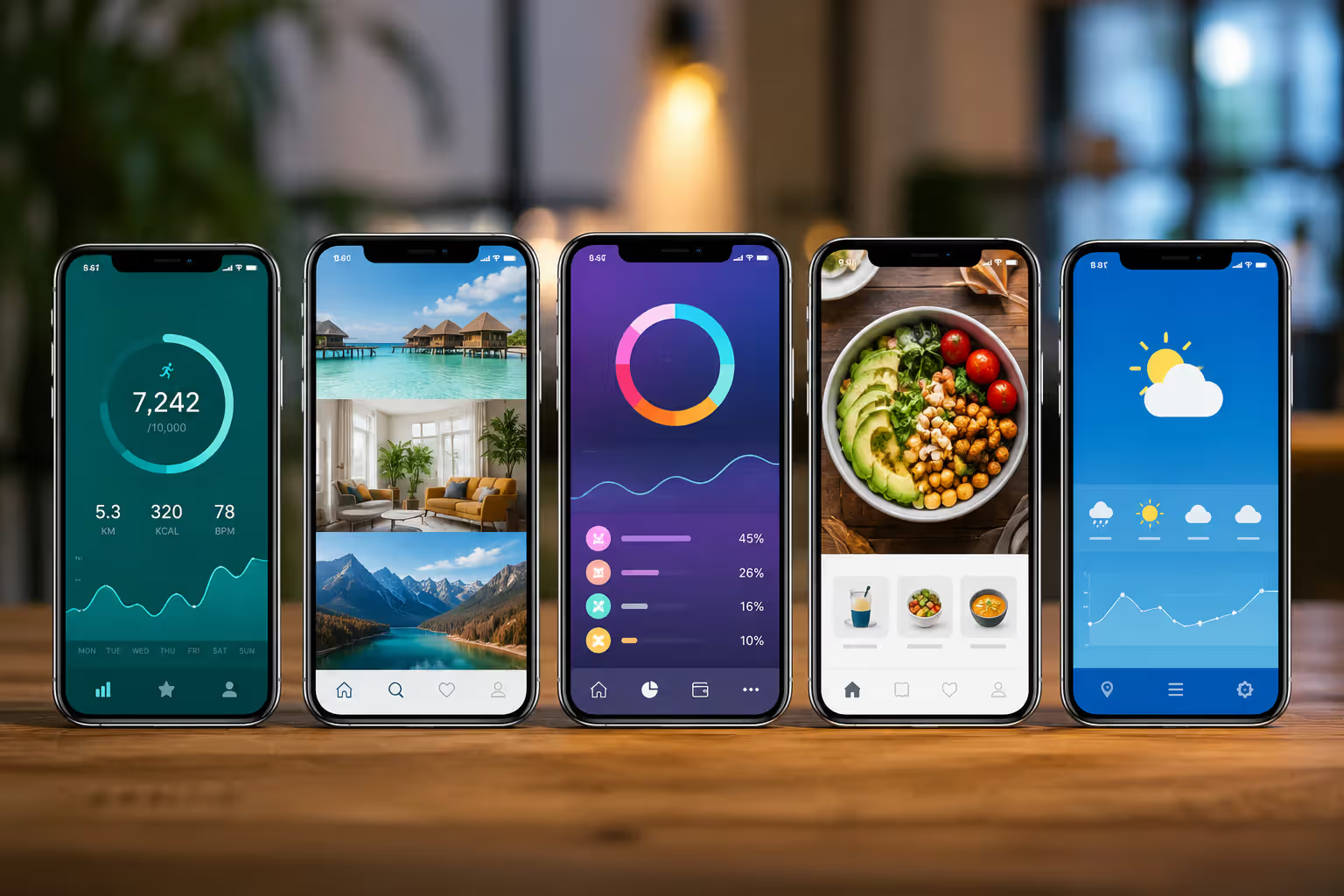
Artificial intelligence has changed how we build software. You don't need years of coding experience anymore to launch a functional mobile or web application. AI app builders let anyone—from small business owners to entrepreneurs with zero technical background—turn ideas into working apps. The technology handles the heavy lifting. You focus on what your app should do, not how to code it.
This shift matters because app development used to be expensive and slow. Now? You can prototype, test, and deploy in days instead of months.
What Is an AI App Builder
An AI app builder is a platform that uses machine learning and natural language processing to generate application code, design interfaces, and configure functionality based on your instructions. Instead of writing thousands of lines of code, you describe what you want—sometimes in plain English—and the AI translates that into a working app.
These tools differ from traditional app builders in one key way: intelligence. Older no-code platforms relied on pre-built templates and drag-and-drop components. You picked from existing options. AI-powered app builders go further. They interpret your requirements, suggest features, generate custom layouts, and even debug problems automatically.
The core technology combines several AI models. Natural language processing understands your text descriptions. Computer vision can analyze sketches or wireframes you upload. Code generation models produce the actual programming logic. Some platforms use GPT-style language models fine-tuned on millions of lines of application code.
Think of it this way: a traditional app builder is like assembling furniture from IKEA—you follow instructions and snap pieces together. An AI generated app explained simply is more like hiring a carpenter who listens to what you want and builds custom furniture to your specs.
The pattern I see most often is people underestimating how much an AI app builder can handle. These aren't toy tools anymore. Production-grade apps serving thousands of users have been built entirely through AI platforms.
How AI-Powered App Builders Work
The process follows a clear sequence, though each platform implements it differently.
Input requirements. You start by describing your app. Some platforms use chat interfaces—you type "I need an app for booking fitness classes with payment integration." Others provide structured forms where you select app type, core features, and target audience. Advanced tools let you upload wireframes, competitor app screenshots, or even voice recordings explaining your vision.
The AI analyzes this input. It identifies entities (users, classes, payments), relationships (a user books a class), and required functionality (calendar, notifications, payment processing).
AI generation. The platform generates multiple layers simultaneously. The backend logic—database structure, API endpoints, business rules—gets created first. Then the frontend: screens, navigation flows, UI components. The AI selects design patterns that match your app category. A fitness booking app gets different interface conventions than a food delivery app.
Most platforms generate code in standard languages: JavaScript, Python, Swift, Kotlin. You're not locked into proprietary systems. The smarter platforms also generate test cases and documentation automatically.
Customization. The initial AI output rarely nails everything perfectly. You'll refine it. Modern AI app development overview includes iterative improvement—you point out issues in natural language ("the booking button should be bigger") and the AI adjusts the code. Some platforms offer visual editors for fine-tuning layouts. Others let you directly edit generated code if you have technical skills.
This is where AI shines over templates. A template forces you into its structure. AI adapts to your feedback.
Deployment. Once you're satisfied, the platform handles deployment. Web apps get pushed to cloud hosting. Mobile apps get compiled for iOS and Android. Many AI app builders manage app store submission requirements—generating required screenshots, descriptions, and privacy policies.
The entire cycle can take hours instead of weeks. A straightforward app with standard features might go from concept to live in a single afternoon.
Author: Adrian Westmere;
Source: aleanetwork.net
Types of AI Application Creator Platforms
AI application creator platforms fall into several categories. Understanding these helps you pick the right tool.
No-code versus low-code. No-code platforms require zero programming knowledge. Everything happens through visual interfaces and natural language. You'll never see a line of code unless you choose to. These work well for straightforward business apps, internal tools, and MVPs.
Low-code platforms assume some technical familiarity. They generate most code automatically but let developers customize complex logic manually. These suit teams with at least one technical person who can handle edge cases.
The line between them blurs with AI. A no-code platform with strong AI can handle complexity that previously required coding.
Mobile-focused versus web-focused. Some AI builders specialize in native mobile apps—they output Swift for iOS and Kotlin for Android, optimized for phone screens and mobile-specific features like GPS and camera access.
Web-focused platforms generate progressive web apps or responsive websites that work across devices. They prioritize browser compatibility and SEO.
Hybrid platforms do both but often excel at one more than the other. Check what the platform optimizes for.
Industry-specific tools. Vertical AI app builders target specific sectors. Healthcare app builders understand HIPAA compliance and patient data requirements. E-commerce builders integrate with payment gateways and inventory systems out of the box. Restaurant app builders know about menu management and order workflows.
Generic platforms offer more flexibility. Specialized ones offer faster setup for their niche.
A common mistake: choosing a specialized tool too early. If you're not certain about your exact feature set, start with a general platform. You can always migrate later.
Popular AI Mobile App Builder Tools
The market has exploded since 2024. Here are the platforms leading in 2026:
Builder.ai uses a "studio" model where AI handles initial generation, then human experts review and refine. It's pricier than pure self-service platforms but delivers polish. Best for businesses willing to invest $10,000+ for a professional-grade app. Their AI excels at complex workflows—multi-user systems, marketplace apps, booking platforms.
Glide transforms spreadsheets into mobile apps. You organize data in Google Sheets or Airtable, and Glide's AI generates an interface. Perfect for internal tools, directories, and data-heavy apps. The AI suggests layouts based on your data structure. Pricing starts free for basic apps; pro features run $25–$100 monthly.
Draftbit targets the low-code crowd. It generates React Native code that you can export and modify. The AI assists with component selection and layout, but you retain full code control. Developers love this when they want AI acceleration without black-box limitations. Plans start around $40/month.
Nowa focuses on Flutter apps with AI-driven design. You describe screens, and it generates Flutter widgets. The visual editor lets you tweak everything. Strong for consumer apps with custom branding needs. Pricing is project-based, typically $500–$2,000 per app depending on complexity.
Sutherland Labs' AppBot (launched late 2025) uses conversational AI exclusively. You build entirely through chat—no visual editor at all. Surprisingly powerful for users who think better in words than pictures. Best for rapid prototyping. Free tier available; commercial use requires licensing.
Each platform has quirks. Builder.ai requires more upfront planning. Glide works best when your data model is clear. Draftbit assumes React knowledge. Test two or three before committing.
Platform Name
Best For
Pricing Model
AI Features
Deployment Options
Builder.ai
Complex business apps
Project-based ($10k+)
Full-stack generation, expert review
iOS, Android, Web
Glide
Data-driven internal tools
Freemium, $25–$100/mo
Spreadsheet-to-app, layout suggestions
Progressive Web App
Draftbit
Developers wanting code control
Subscription, $40+/mo
Component AI, React Native generation
iOS, Android (exportable code)
Nowa
Consumer apps with custom design
Per-project, $500–$2k
Flutter widget generation, design AI
iOS, Android, Web
AppBot
Rapid prototyping via chat
Free + commercial license
Conversational interface builder
Web, mobile hybrid
Author: Adrian Westmere;
Source: aleanetwork.net
How to Create an App Using AI
Let's walk through the actual process. This applies to most platforms with minor variations.
Planning Your App Requirements
Start with the problem you're solving. Write one sentence: "This app helps [user] do [action] so they can [outcome]." For example: "This app helps yoga studio owners manage class bookmarks so they can reduce no-shows and increase revenue."
List your must-have features. Keep it under ten items for your first version. Common mistake: trying to build everything at once. You can't. Focus on the core loop—the main action users will repeat.
Identify your users. Who are they? What devices do they use? What's their technical comfort level? An app for teenagers needs different design than one for medical professionals.
Sketch rough wireframes. Pen and paper works fine. You don't need design skills—stick figures and boxes are enough. This clarifies your thinking before you touch any tool.
Decide on integrations. Do you need payment processing? Email notifications? Social media login? Calendar sync? List these now. AI builders handle common integrations easily, but you'll need API keys and accounts set up.
Budget 2–4 hours for planning. Rushing this step costs you later.
Choosing the Right Platform
Match platform strengths to your app type. Building an e-commerce app? Prioritize platforms with strong payment and inventory features. Internal company tool? Look for enterprise authentication and data security.
Test the AI quality. Most platforms offer free trials. Build a simple version of one feature. See how well the AI interprets your instructions. Does it ask clarifying questions? Does it generate sensible defaults?
Check export options. Can you get your code and data out if you switch platforms later? Vendor lock-in is real. Platforms that export standard code (React, Flutter, etc.) give you more freedom.
Read the pricing fine print. What happens at scale? Some platforms charge per user, per app, or per feature. A $20/month plan might jump to $200/month when you hit 1,000 users.
Review app store success rates. Have apps built on this platform been approved by Apple and Google? Some AI-generated code has quirks that trigger rejection. Established platforms have solved these issues.
The simpler option usually wins here. Pick the platform that handles your core features natively rather than the one with the longest feature list.
Building and Testing Your App
Author: Adrian Westmere;
Source: aleanetwork.net
Create your account and start a new project. Most platforms begin with a questionnaire or chat interface. Answer specifically. Instead of "a booking app," say "a yoga class booking app where students can see schedules, book spots, pay online, and receive reminders."
The AI will generate an initial version. This takes anywhere from 30 seconds to 10 minutes depending on complexity. Review what it created. Check that core screens exist: login, main dashboard, key action screens.
Refine iteratively. Work section by section. Fix the login flow first. Then the main list view. Then detail screens. Don't try to perfect everything simultaneously.
Use natural language for changes. "Make the book button green and larger." "Add a filter for class type." Good AI builders understand these instructions. If you're typing the same request three times, switch to a different platform—the AI isn't learning.
Test on real devices. The desktop preview never tells the whole story. Install test versions on your phone. Tap everything. Try to break it. Common issues: buttons too small, text cut off, slow loading.
Get feedback from target users. Not friends who'll be nice—actual potential users who'll be honest. Watch them use the app. Where do they hesitate? What confuses them?
Expect 3–7 iteration cycles before you're satisfied. Each cycle gets faster as you learn the platform's quirks.
AI app builders don't replace developers—they multiply what a small team can accomplish. We're seeing solo founders ship products that would have required a five-person team three years ago.
— Hoffman Reid
Limitations and Considerations
AI app builders aren't magic. They come with real constraints you should understand upfront.
Scalability concerns. Apps built on AI platforms typically run on the platform's infrastructure. You're fine serving hundreds or even thousands of users. But if you hit viral growth—tens of thousands of concurrent users—you might strain the platform's resources. Some platforms charge exponentially more at scale. Others have hard limits.
If you anticipate massive scale, build with an export strategy. Use a platform that lets you take the generated code and move it to custom infrastructure later.
Customization limits. AI builders excel at common patterns. Standard CRUD operations (create, read, update, delete), typical UI components, normal workflows—all handled beautifully. But if you need something unusual—complex algorithms, real-time multiplayer features, advanced animations—you'll hit walls.
The AI generates what it's been trained on. Truly novel functionality requires custom coding. Low-code platforms help here since you can add custom code modules.
Ownership issues. Read the terms carefully. On most platforms, you own your app and its data. But some retain licenses to the underlying generated code. A few restrict what you can do with exported code.
This matters if you plan to sell your app or company. Investors care about clean IP ownership.
Cost factors. The monthly subscription is just the start. You'll pay for:
Hosting and bandwidth as usage grows
Premium features (advanced AI, priority support, white-labeling)
App store developer accounts ($99/year for Apple, $25 one-time for Google)
A "free" app builder can easily become $100–$300 monthly once you add necessary features. Budget accordingly.
Quality variance. AI output quality depends on how well you communicate requirements. Vague inputs produce mediocre apps. The platform can only be as good as your specifications.
Also, AI makes mistakes. It might generate a button that doesn't actually save data. Or create a navigation flow that traps users. You must test thoroughly. Don't assume AI output works correctly.
One counterintuitive point: simpler apps sometimes take longer than you expect. You'd think a basic app would be quick, but getting every detail right—the right shade of blue, perfect button placement, smooth transitions—takes time regardless of how you build it.
Author: Adrian Westmere;
Source: aleanetwork.net
FAQ: AI App Development Questions Answered
Can I really build an app with AI without coding experience?
Yes, but set realistic expectations. You can build functional apps for straightforward use cases—booking systems, content apps, simple e-commerce, internal tools. These don't require coding knowledge. You'll use visual editors and natural language instructions. The AI handles all technical implementation.
However, you'll need to understand basic app concepts: what a database is, how user authentication works, what an API does. You don't need to code these, but you should grasp the concepts. Think of it like driving a car—you don't need to understand engine mechanics, but you should know what the gas pedal and brakes do.
Complex apps with unusual features still need developer involvement. The AI gets you 70–90% there. The final polish might require technical help.
How much does it cost to use an AI app builder?
Pricing varies widely. Free tiers exist on platforms like Glide and AppBot—enough for personal projects or testing ideas. You'll hit feature limits quickly though.
Professional use typically costs $25–$100 monthly for subscription platforms. This covers basic features and moderate usage. Project-based platforms like Builder.ai charge $5,000–$50,000+ per app depending on complexity—you're paying for the finished product, not monthly access.
Don't forget ongoing costs: hosting scales with users, third-party services charge separately, and app store fees apply. A realistic budget for a small business app is $50–$200 monthly once you factor everything in.
The cheapest option isn't always the best. A $50/month platform that saves you 20 hours of work is cheaper than a $20/month platform where you struggle for 40 hours.
What types of apps can AI app builders create?
AI builders handle most common app categories well: business productivity tools, booking and scheduling apps, content and media apps, simple e-commerce, social networking (basic features), educational and training apps, restaurant and food service apps, fitness and wellness trackers, event management apps, and internal company tools.
They struggle with: high-performance games, apps requiring complex real-time features (like video editing), apps with advanced AR/VR, specialized scientific or financial calculation tools, and apps that need deep hardware integration.
The rule of thumb: if similar apps already exist in app stores, an AI builder can probably create something comparable. If you're inventing an entirely new app category, you'll likely need custom development.
How long does it take to build an app using AI?
A simple app—think digital business card, basic content viewer, or simple form collector—can be built in 2–4 hours. You'll spend more time on planning and testing than actual building.
A moderate complexity app—booking system, e-commerce store with 20–50 products, content app with user accounts—typically takes 1–2 weeks. This includes planning, building, testing, and refinement.
Complex apps with many features, custom designs, and multiple integrations might take 4–8 weeks. You're still dramatically faster than traditional development, which would take 3–6 months for the same scope.
The biggest time variable isn't the AI—it's you. How quickly can you make decisions? How many revision rounds do you need? Do you have content and assets ready? Clear requirements and quick decision-making cut timeline in half.
Do I own the app I create with an AI app builder?
Usually yes, but verify in your specific platform's terms. Most reputable AI app builders grant you full ownership of the app, its design, and its data. You can publish it, sell it, or transfer it freely.
Some platforms retain rights to the underlying generated code or framework. You own the app, but you can't take the code and resell it as a template to others. This rarely matters for normal use.
A few platforms (mainly free ones) include clauses that let them showcase your app in their marketing. Read terms before building anything confidential.
If ownership is critical—you're building for a client or plan to sell the company—choose platforms that explicitly state clean IP transfer. Builder.ai and Draftbit are clear on this. Free platforms are sometimes murkier.
Can AI-generated apps be published on app stores?
Yes, thousands of AI-generated apps are live on Apple's App Store and Google Play right now. The stores don't care how an app was built—they care whether it works, provides value, and meets their guidelines.
That said, you must ensure your app meets store requirements: it must function properly without crashes, follow platform design guidelines, include required privacy policies and disclosures, not violate content policies, and provide genuine utility (not just a wrapped website).
Some AI builders have higher app store approval rates because they've refined their output to match store requirements. Check platform documentation for app store success rates and support.
The submission process itself isn't automated. You'll handle app store accounts, screenshots, descriptions, and submission. Some platforms offer guidance or services to help with this.
Building apps with AI isn't about replacing developers—it's about making app creation accessible to more people. If you've got a clear idea and you're willing to iterate, these tools can turn your concept into reality faster and cheaper than ever before. The technology isn't perfect, but it's remarkably capable. Start with a small project. Learn the platform. Then scale up to your bigger vision.
Regression testing prevents code changes from breaking existing functionality. This guide covers regression test types, manual vs. automated approaches, building effective test suites, and implementing regression testing in agile and CI/CD environments.
Discover how DevOps automation transforms software delivery through automated pipelines, CI/CD tools, and intelligent deployment strategies. Learn which tools to use, how to implement continuous deployment, and best practices that reduce errors while accelerating releases.
Discover how generative AI is changing software development in practice. This guide covers workflow integration, code quality concerns, tool comparisons, and real-world implementation strategies for development teams looking to adopt AI coding assistants effectively.
Low code platforms let teams build applications using visual interfaces and pre-built components instead of writing extensive code. This guide explains how low code development works, who uses it, key benefits and limitations, and how to choose the right platform for your needs.
The content on this website is provided for general informational and educational purposes only. It is intended to explain concepts related to AI tools, agents, developer infrastructure, coding assistants, APIs, and productivity workflows.
All information on this website, including articles, guides, and examples, is presented for general educational purposes. Outcomes and tool performance may vary depending on implementation, skill level, and use case.
This website does not provide professional AI consulting, development services, or guarantees of results, and the information presented should not be used as a substitute for consultation with qualified AI or software development professionals.
The website and its authors are not responsible for any errors or omissions, or for any outcomes resulting from decisions made based on the information provided on this website.